
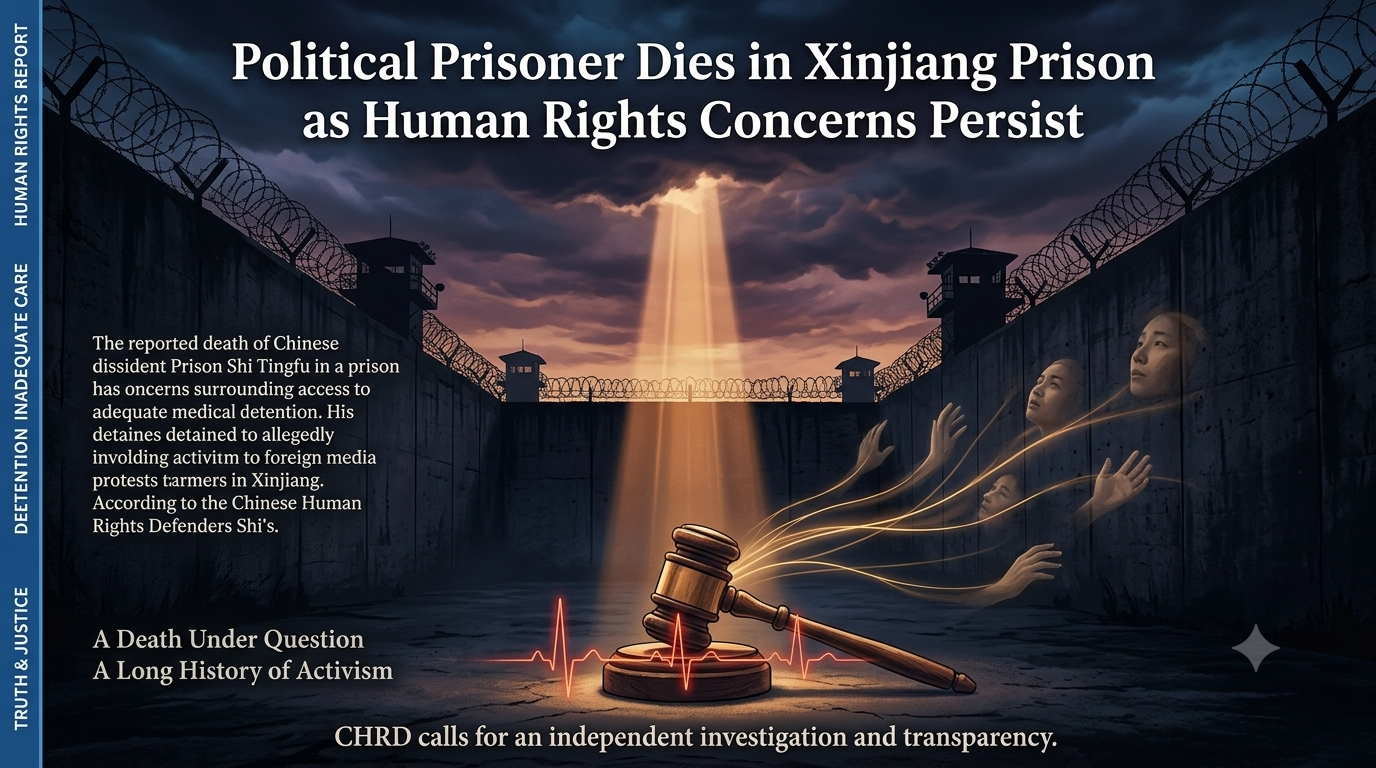
The reported death of Chinese dissident Shi Tingfu in a prison in Xinjiang has once again drawn attention to the treatment of political prisoners in China and the concerns surrounding access to adequate medical care in detention. Shi, a 67-year-old longtime activist, died while serving a three-year sentence after being detained for allegedly providing information to foreign media about protests by farmers in Xinjiang. According to the Chinese Human Rights Defenders (CHRD), prison authorities in Shahe prison informed Shi’s family of his death and attributed it to a heart attack. His death was reported as Chinese President Xi Jinping was visiting the United States for talks with President Donald Trump, during which trade, artificial intelligence, Taiwan and international conflicts were among the major issues under discussion. The timing has renewed attention to an issue that frequently receives limited space in high-level diplomatic engagements: human rights in China.
A Death Under Question
Shi was reportedly serving a sentence for “picking quarrels and provoking trouble,” a broadly used criminal charge that Chinese authorities have repeatedly applied in cases involving political and social dissent. His sentence was due to end in January 2027.CHRD has not claimed that it can conclusively establish that inadequate medical treatment caused Shi’s death. However, the organization has called on Chinese authorities to provide his family with detailed information about the circumstances of his death, including medical records, information about treatment he requested or received, and access to his body. It has also called for an independent investigation. The concerns are particularly significant because Shi reportedly suffered from several health problems, including hypertension, pneumonia and asthma. When his lawyer met him at the Aral City Detention Centre in April 2024, the lawyer reportedly observed that his health had deteriorated. At the same time, Shi’s family said that during a more recent visit he appeared to be in good health and did not complain of physical problems. This apparent contrast has contributed to questions surrounding the circumstances of his sudden death.
A Long History of Activism
Shi Tingfu’s history of activism stretched back decades. A former electronics factory worker in Nanjing, he supported the pro-democracy movement associated with the 1989 Tiananmen Square protests. After losing his job in the 1990s, Shi became increasingly active online, advocating freedom and democracy and drawing attention to alleged official corruption. He reportedly organized or participated in street demonstrations marking anniversaries of the 1989 crackdown and expressed support for democratic developments in Taiwan.
His activism also extended to campaigns supporting detained human-rights lawyers and the families of political prisoners. These activities resulted in repeated arrests and brought him into sustained conflict with Chinese authorities. His final detention began in January 2024 in Xinjiang. Authorities accused him of providing foreign media with information concerning fruit farmers in Aral who were protesting against the Xinjiang Production and Construction Corps, a state-controlled organization with extensive agricultural and administrative responsibilities in the region. Authorities initially accused Shi of “spreading and promoting terrorism and extremism.” Reports also indicated that he was denied timely access to legal counsel.
Concerns Over Medical Care in Detention
CHRD reports widespread inadequate medical care among prisoners of conscience in China, including cases linked to deaths in custody. While the organization considers denial of necessary treatment potentially torture, Chinese authorities dispute its characterization. Shi’s death raises questions about the medical care he received and whether his family will obtain sufficient information.
A Wider Human Rights Question
The case also illustrates the difficulties faced by political activists in China, particularly those who communicate with foreign media or challenge official narratives. Broad criminal provisions such as “picking quarrels and provoking trouble” have been criticized by international human-rights organizations for their use against activists, journalists and other dissenting voices. For Shi’s family, however, the immediate issue is more personal: understanding how a 67-year-old prisoner with known health problems died behind bars. The circumstances surrounding his death may remain disputed unless authorities release comprehensive medical documentation and permit an independent investigation. Transparency would be essential not only for Shi’s family but also for determining whether his medical needs were properly addressed.
Conclusion
The reported death of Shi Tingfu is more than the story of one imprisoned dissident. It highlights continuing concerns about political detention, freedom of expression and access to medical care in Chinese prisons. His decades-long activism, repeated arrests and final imprisonment in Xinjiang reflect the risks faced by individuals who challenge official policies or communicate information beyond China’s borders. At the same time, the precise cause of Shi’s death remains a matter requiring evidence rather than assumption. Chinese authorities have attributed it to a heart attack, while CHRD (Chinese Humen Rights Defenders), a prominent human-rights groups have called for greater transparency and an independent investigation.
Ultimately, the central question is straightforward: what happened to Shi Tingfu in the final days and hours of his life, and did he receive the medical care to which he was entitled? A transparent investigation and full disclosure of the relevant medical records would provide the most credible way to answer those questions.