

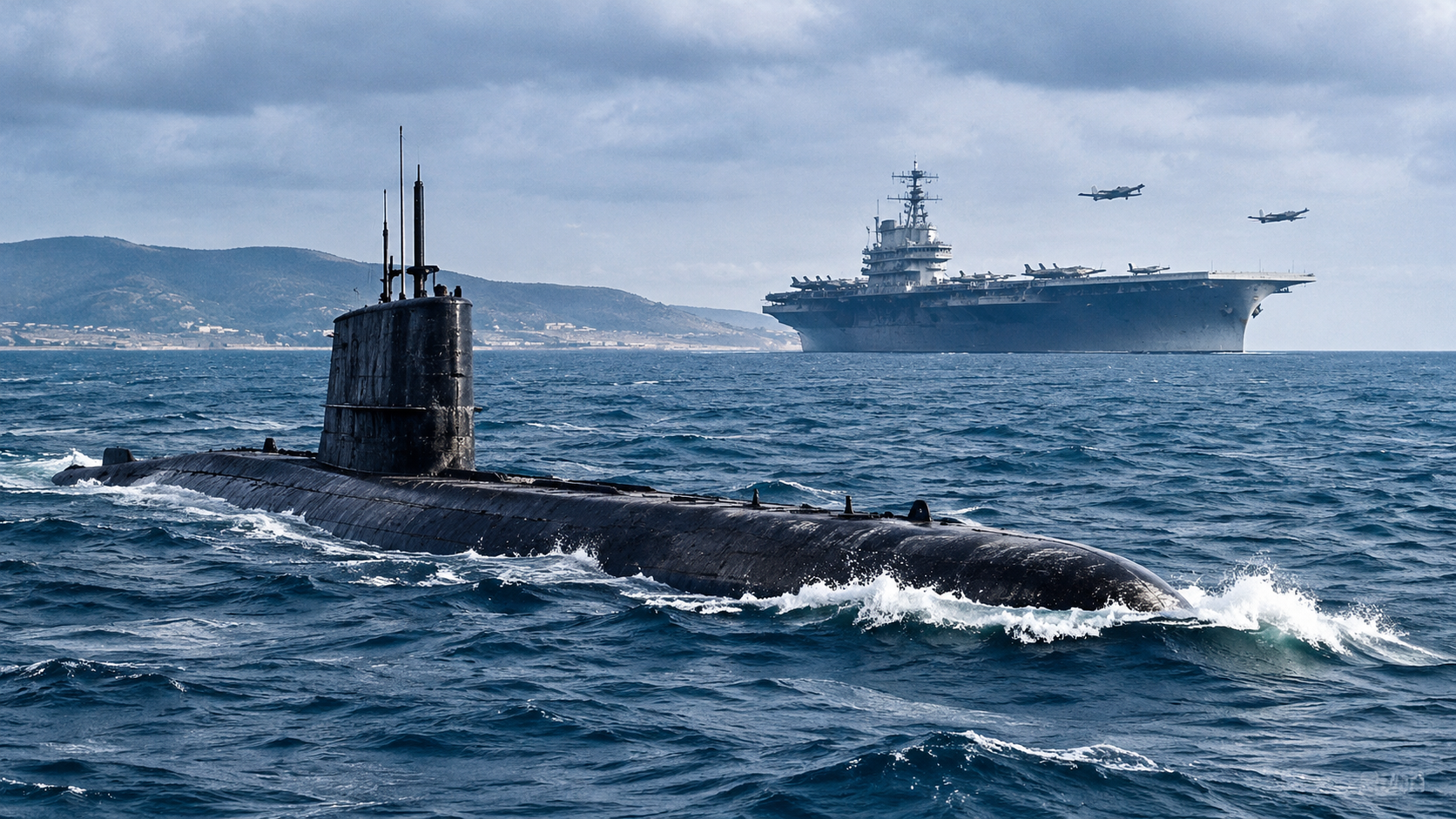
The 1971 war exposed a gap in Pakistan’s naval strategy: the distance between what its planners wished to achieve and what their forces were prepared to do. Nothing illustrates that gap better than PNS Ghazi, one of the Pakistan Navy’s most important long-range submarines. Sent into the Bay of Bengal to find and sink India’s aircraft carrier, INS Vikrant, Ghazi was lost during the mission. How exactly it sank is still debated. The more telling question is why such a precious asset was committed to an operation built on intelligence that turned out to be badly wrong.
From Karachi to the seabed
On 14 November 1971, Ghazi sailed from Karachi under Commander Zafar Muhammad Khan. Its main task was to locate and destroy Vikrant, with mine-laying as a secondary objective. The submarine would be operating thousands of miles from home, with almost no prospect of logistical support. It stopped at Trincomalee in Ceylon, now Sri Lanka, on 18 November to refuel, and then went on eastward. The voyage was a heavy demand on an ageing boat that had only recently returned from an extensive refit in Turkey.
The trouble lay in the picture of the enemy that Naval Headquarters carried. On 20 November, Karachi told Commander Khan that Vikrant was no longer at Chennai and that its whereabouts were unknown. Three days later, Pakistani naval intelligence, reading intercepted Indian messages requesting fuel and supplies, concluded that the carrier was at Visakhapatnam. In reality, Vikrant had been moved quietly to the Andaman Islands.
That picture had been shaped on purpose. The Indian Navy ran deception measures, using INS Rajput to create a false impression of where the carrier was. Pakistan’s planners did not independently check what they were being shown. They continued to rely on information that was outdated and, by several accounts, deliberately misleading.
Indian accounts say that on 25 and 26 November Ghazi received a signal from Karachi: “Occupy Zone Victor with all dispatch. Intelligence indicates carrier in port.” Zone Victor was Visakhapatnam. One must ask how thoroughly that intelligence was tested before the Navy committed its longest-range submarine to a mission of such risk.
Ghazi reached the waters off Visakhapatnam expecting to find Vikrant. The carrier was somewhere else. Then, in the night of 3 and 4 December, hours after hostilities formally began, a massive underwater explosion shook the waters off the port. Ghazi went down with all 93 personnel aboard.
The cause remains disputed. India has attributed the destruction to its naval countermeasures. Later analysis of the wreck has pointed to a possible internal explosion involving the submarine’s own ordnance. Whatever the mechanism, the outcome is beyond argument. Pakistan lost its longest-range submarine, the only one capable of such a deployment into the Bay of Bengal.
The consequences came quickly. With Ghazi gone, Vikrant could operate against East Pakistan with minimal underwater opposition. From 4 December, its Sea Hawk aircraft struck Chittagong and Cox’s Bazar, sinking or damaging most of the ships in harbour, while the Eastern Fleet tightened its hold on maritime communications. On 16 December 1971, Pakistani forces in East Pakistan surrendered.
Three questions the Pakistan Navy must answer
The first is about intelligence. The central aim was to destroy Vikrant, yet the submarine was directed to an area where the carrier was not. A submarine is only as effective as the information that guides it: accurate intelligence, reliable target identification, and a clear sense of the situation. No vessel, however advanced, can make up for flawed intelligence. Was the information independently verified? Were other locations considered? What was the plan if the target could not be found? These questions point beyond the ordinary uncertainties of naval warfare, towards the quality of Pakistan’s intelligence assessments, operational planning and command decisions.
The second is about risk. Ghazi was an ageing submarine given an exceptionally demanding mission at extreme range. Its endurance, maintenance condition, weapons safety and supply needs called for the closest scrutiny. Why was a strategically vital asset committed to an operation with so many open uncertainties? Owning an advanced platform does not guarantee that it will be used well.
The third is about leadership. Vice Admiral Muzaffar Hassan, Pakistan’s Chief of Naval Staff during the war, belongs in any serious examination of the Navy’s performance. The issue is not whether he directed Ghazi’s every move. It is whether the naval leadership had built a sound intelligence framework, set realistic objectives and weighed the risks adequately. Did Naval Headquarters reckon with the consequences of losing its only submarine able to operate in the Bay of Bengal? Was coordination between Karachi and the eastern command sufficient? Such questions deserve a closer look at decisions taken at the highest levels of naval command, and at the accountability of senior leadership as an institution.
A wider maritime defeat
Ghazi’s loss was one part of a larger failure in Pakistan’s maritime strategy. The Indian Navy kept up pressure on East Pakistan’s sea communications, and Vikrant carried out sustained air operations against key coastal installations. Pakistan’s naval forces in the east grew steadily more isolated from their headquarters in the west. The distance between the two wings complicated reinforcement, coordination and supply. These problems did not arise in December. They were built into how Pakistan had chosen to fight a war across two distant theatres.
A lesson in command
PNS Ghazi should remain one of the most instructive case studies in Pakistan’s naval history. It shows what follows when intelligence fails, operational judgement is poor, and planning is thin. The mission began with the aim of removing India’s most valuable maritime asset. It ended with the destruction of the submarine, the loss of its entire crew and a lasting weakening of Pakistan’s ability to challenge Indian naval operations in the Bay of Bengal.
While Ghazi lay on the seabed, the Indian carrier carried on with its campaign and Pakistan’s position in the east collapsed. That contrast is the real strategic story of PNS Ghazi.
The greatest humiliation for a professional navy lies not in losing a battle. It lies in failing to acknowledge the strategic and institutional failures that helped bring about the defeat. History does not judge a navy by the ambition of its orders. It judges it by the quality of its decisions, the care of its execution and its readiness to learn from failure.