
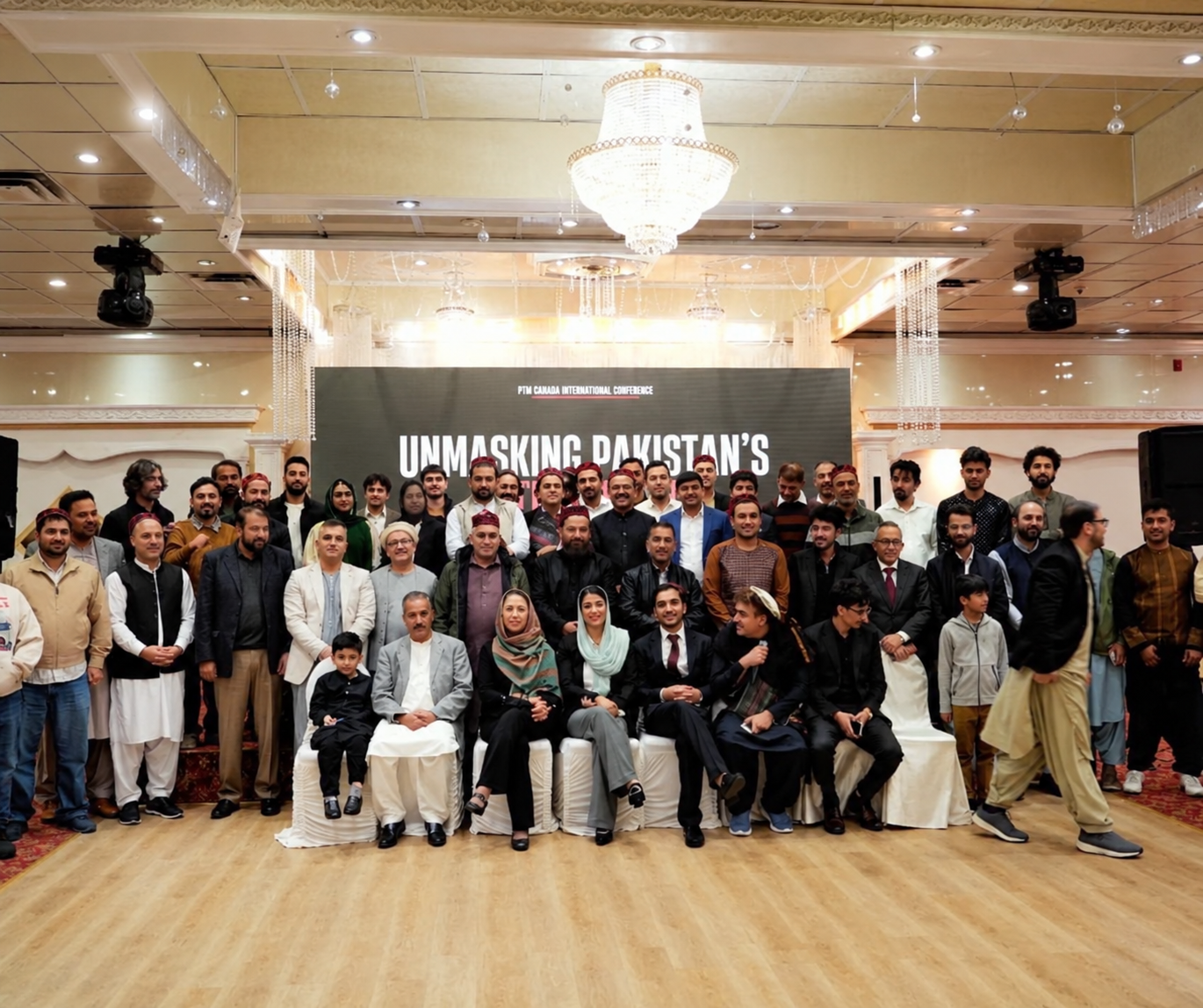
On October 11, several hundred people gathered in Toronto for an international conference organised by the Canadian chapter of the Pashtun Tahafuz Movement (PTM). The event was titled “Unmasking Pakistan’s Atrocities”, and it did what its name promised. Speaker after speaker accused Pakistan’s military of running a system of killings, disappearances and plunder in the country’s Pashtun belt. They urged the diaspora to carry that charge to the world’s capitals.
The movement’s leader, Manzoor Pashteen, joined online. His speech was blunt even by his own standards.
“The state is shedding Pashtun and Afghan blood like water,” he said. “It has plundered our resources and destroyed our homeland.”
A charge sheet against the state
Pashteen’s address read like a list of accusations. He alleged that Pashtuns are being held in “the military’s private prisons”, and he named the jailed PTM leader Ali Wazir and Haji Samad.
He also accused the army of the following:
• occupying land in Quetta and the mountains of Swat;
• extracting minerals while denying locals access to them;
• building housing for its own personnel on Pashtun land;
• designing an education system meant to keep Pashtuns subordinate.
“We are deprived of justice, media, security, and resources,” he said.
His sharpest words were for those who still believe Pakistan’s institutions can be reformed from within. “Look at its parliament: the military brings in whoever it wants and removes whoever it does not want,” he said. “No member of parliament can say a single word without the military’s permission.” Keeping hopes alive in such a system, he argued, “gives the military an opportunity to commit even more oppression”.
He also attacked Rawalpindi’s long-standing argument that its operations in Khyber Pakhtunkhwa are a war on terror. “What kind of strange terrorism is this that does not exist in Punjab, while projects of terrorism are implemented only in Pashtunkhwa?” he asked. He went further and called the military itself a terrorist organisation, alleging that other militant groups operate within its network.
Across the Durand Line
The conference took place against the background of repeated Pakistani strikes on Afghan territory, and that conflict ran through the speeches.
Pashteen warned that the pattern would spread. “If it bombed Tirah today, why would it not bomb Swat tomorrow? Why would it not bomb Paktia?” he asked. He also alleged that Kabul’s current rulers had aligned their policy with Islamabad.
Shinkai Karokhail, a former member of the Afghan parliament, went further. She argued that Pakistan had installed a government of its choosing in Afghanistan and now attacks it at will while presenting itself as the victim. On the Pakistani Taliban (TTP), she pointed to the 2008 agreements between the military and militant groups. In her view, the real aim was to suppress Pashtuns through the Taliban. “Pakistan both nurtures terrorism and presents itself as a victim of terrorism,” she said.
Karokhail drew a line that PTM leaders often draw. “Our problem is not with the people of Pakistan; the Pakistani people themselves are victims,” she said. She predicted that Pakistani military officers would one day face trial. She also pledged that Afghans would take documented evidence to “every door”.
A Canadian voice
The most notable outside speaker was Chris Alexander. He served as Canada’s ambassador to Afghanistan from 2003 to 2005 and later as the country’s immigration minister. He accused Pakistan’s military leadership of a decades-long effort to dominate Afghanistan through proxies and terrorism. He also linked the Taliban’s return to Kabul to a broader collapse of global deterrence. “End the violence. That is the key to everything,” he told the gathering.
Alexander also remembered Karima Baloch, the Baloch activist who had been granted asylum in Canada. She was found dead in Toronto in December 2020. Toronto police did not treat her death as suspicious, but many Baloch activists have never accepted that finding. Her name, invoked in the city where she died, gave the conference an emotional weight.
What the conference demanded
• The gathering adopted a declaration with a long list of demands:
• an independent truth and reconciliation commission under UN auspices;
• investigations into enforced disappearances, extrajudicial killings and civilian casualties;
• disclosure of the whereabouts of missing persons, and release of those unlawfully detained;
• lifting of the ban on PTM, and freedom for journalists and rights groups to work;
• safe, voluntary return of displaced families;
• local control over oil, gas, minerals and water;
• investigation of reported drone strikes;
• protection of girls’ education, and an end to internet shutdowns.
The declaration also cited figures from the Pashtun Qaumi Jirga held in Khyber district in October 2024: 76,584 deaths, 5.7 million internally displaced people, 170,000 homes destroyed, and more than 6,700 people missing. These numbers have not been independently verified. Islamabad’s refusal to allow independent access to the region is itself one of PTM’s central complaints.
A movement Pakistan banned
PTM began in 2014 as a protest movement against military operations, checkpoints and disappearances in the former tribal areas. Under Pashteen it became the most significant non-violent Pashtun rights movement in Pakistan’s history.
Its rallies drew huge crowds, and its slogans named the army directly, which was rare in Pakistani politics. In October 2024 the government banned PTM under the Anti-Terrorism Act, calling it a threat to national security. Activists have continued to disappear since then. In April this year, Amnesty International demanded that Pakistan disclose the whereabouts of PTM activists Hanif Pashteen and Noor Ullah Tareen, who went missing in 2025.
The Toronto conference shows where the movement’s energy is now going. With the movement banned at home, it is increasingly relying on its diaspora. Pashteen was explicit about this. “Make it so widely known that the Pakistani state is left isolated,” he told the audience, calling for intellectual work and lobbying alongside activism.
Pashteen also deliberately reached beyond his own community. He named Sindhis, Baloch and Kashmiris as fellow victims and called on them to stand together against what he called a common enemy. Mahrang Baloch, the Baloch rights campaigner, remains in prison. Speakers in Toronto invoked her as proof that peaceful advocacy in Pakistan’s periphery is treated as a crime.
Pashteen did not promise quick results. “Our conferences may not produce results quickly,” he admitted, “but this work will continue, and eventually we will reach a result.” Whether that is wishful thinking or a warning depends largely on decisions in Rawalpindi. On the evidence from Toronto, the generals are not winning the argument abroad.