
For decades, the standard story of American immigration followed a familiar script. In the 19th and early 20th centuries, European immigrants such as Germans, Irish, and Italians arrived poor and culturally distinct. Over a few generations, public schools, intermarriage, and workplace interaction blended them into a shared national identity. They “assimilated,” meaning they completely merged into the dominant majority.
Today, critics often demand that modern Indian immigrants follow the exact same path. They question why successful Indian Americans still build Hindu temples, celebrate traditional festivals, live in close-knit communities, and maintain ties to their home country. However, expecting Indian immigrants to follow this old European pattern ignores key historical and economic facts. The traditional “melting pot” concept is outdated and fails to capture the modern immigrant experience.
Lessons of Cultural Survival
To understand why cultural erasure is an unreasonable expectation, it helps to examine how Indian identity survived under far harsher conditions in the past. Between 1838 and 1917, more than 1.3 million Indian workers, known as Girmitiyas, were brought as indentured laborers to sugar plantations in British and Dutch colonies such as Fiji, Trinidad, Guyana, and Suriname. Like early European immigrants in America, these workers faced poverty, exploitation, and hardship. However, their experiences developed along very different paths:
- The European Path in America: Working-class European immigrants joined a growing industrial economy. While they encountered prejudice, they shared a broadly familiar Christian heritage (such as Catholicism or Lutheranism). Over generations, they moved up the economic ladder by adopting English and blending into the white majority.
- The Girmitiya Path in the Colonies: Indian workers were locked into rigid labor contracts, kept in isolated plantation camps, and denied basic rights. Colonial authorities frequently opposed their non-Christian traditions.
Unlike European immigrants who traded their ethnic identities for social mobility, the Girmitiyas preserved their faith to survive. Because colonial Christian institutions offered no connection to their roots, adapting to the surrounding religious environment would have meant spiritual erasure. Instead, their Hindu-based practices served as a key survival mechanism:
- Adaptable Practice: Lacking formal church hierarchies or ordained leaders, Hindu traditions were flexible and community-driven. On isolated plantations, workers kept their faith alive through home prayers, storytelling, and group songs.
- Unifying Framework: The inclusive nature of Hindu philosophy allowed workers from different regions, languages, and social classes to unite around shared spiritual themes.
- Faith as Resistance: Practicing ancestral rituals maintained personal dignity under colonial control. Holding onto these customs was not a refusal to participate in society, but a necessary defense against spiritual erasure.
Education and Hyper-Selection
When Indian immigration to the United States expanded after federal immigration law reforms in 1965, it looked nothing like earlier waves of factory workers or colonial laborers. Modern Indian American immigration is characterized by “hyper-selection,” meaning newcomers are disproportionately highly educated professionals.
Arriving largely through skilled work visas, corporate transfers, and graduate university programs, Indian immigrants enter the country with strong professional qualifications and high English proficiency. This starting point fundamentally alters how they integrate into American society:
- Bypassing the Bottom Rung: Unlike 19th-century European immigrants who spent generations rising from low-wage industrial jobs, skilled Indian immigrants often move straight into upper-middle-class suburban neighborhoods, high-performing school districts, and technology hubs.
- Direct Entry into Leadership: Indian Americans frequently enter competitive fields like medicine, engineering, technology, and corporate management right away. Because they integrate directly into high-status professional environments, their rapid economic success attracts distinct social and political attention.
A Proven Alternative: The Pluralist Model
The German-Irish-Italian “melting pot” is not the only successful model of integration in American history. The Jewish American experience offers a proven blueprint for how an immigrant group can participate fully in economic and civic life while maintaining a distinct religious identity and strong cultural ties to a spiritual homeland.
Rather than abandoning their heritage, Jewish Americans built synagogues and cultural institutions while simultaneously rising to prominent roles in education, law, business, and public service. They also maintained deep cultural and historical ties to Israel without undermining their commitment as American citizens.
For Hindu Americans, this pluralist framework is far more relevant than forced assimilation. It demonstrates that a community can build places of worship, honor traditional holidays, and still contribute directly to the strength of the nation.
Unreasonable Demands for Uniformity
Demanding that modern Indian Americans completely erase their distinct identity ignores two major realities:
- Non-Abrahamic Heritage: For European immigrants, a shared Judeo-Christian framework served as a cultural bridge. Shared basic narratives and moral concepts made blending easier over time. Traditions like Hinduism, Sikhism, and Jainism do not fit this pre-existing mold. Suburban temples, holidays like Diwali, distinct dietary practices, and unique arts are visually and culturally distinct. Demanding the removal of these traditions asks newcomers to abandon the core of their spiritual lives.
- Physical Visibility: European assimilation relied heavily on physical blending. By the third generation, descendants of European immigrants could walk into any room and visually match the majority population. In contrast, Indian Americans remain a visually distinct minority regardless of generation, native English fluency, or cultural familiarity. Expecting them to physically “fade into the background” is impossible.
The Responsibility of the Community
A successful model of integration requires active effort from both the host country and the immigrant group. To build trust and integrate smoothly, Hindu Americans must take proactive responsibility for their role in civic life:
- Confident Pluralism: As author Rajiv Malhotra notes in Being Different, true integration does not require copying the dominant culture out of an inferiority complex. Hindu Americans can engage with mainstream society confidently while offering unique ethical and philosophical contributions.
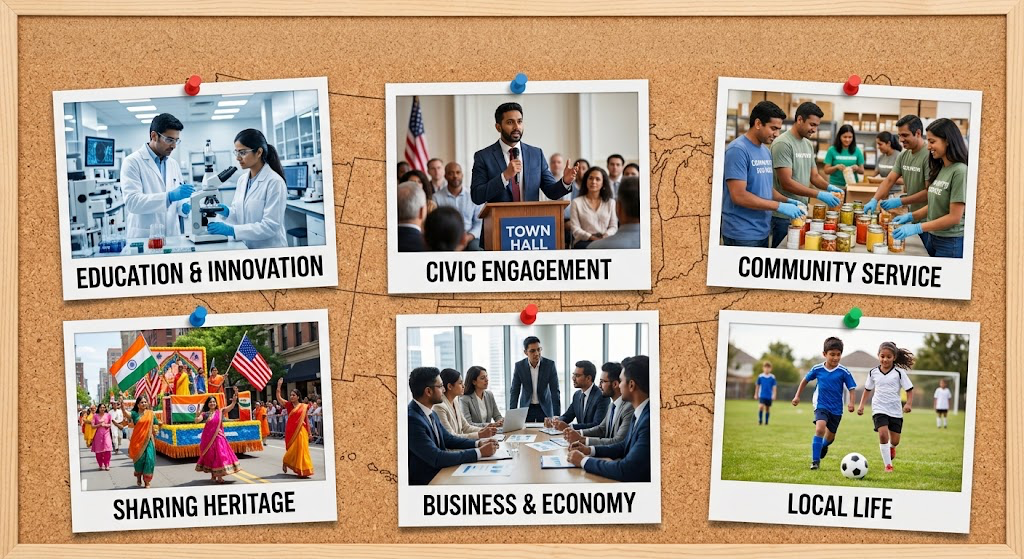
- Civic Engagement: Integration extends beyond economic success and paying taxes. Members of the community should participate in local governance by serving on school boards, joining civic committees, running for public office, and participating in neighborhood associations.
- Visible Public Service: Community outreach should extend beyond temple activities into the broader public through the spirit of Seva (selfless service). Initiatives such as local park cleanups, food drives, and disaster relief demonstrate a genuine commitment to the broader community.
- Respect for Local Norms: Practicing one’s faith freely requires respecting local community standards, such as noise ordinances and zoning regulations, ensuring that groups live as considerate neighbors.
- Building Cultural Bridges: Proactive engagement involves sharing traditions with the wider public. Events like Hindu Heritage Month in October provide opportunities to host open houses, educational programs, and cultural exchanges, showing that keeping a distinct heritage enriches American diversity.
Updating the American Integration Model
The 19th-century expectation of total assimilation is outdated. Demanding that newcomers erase their heritage in exchange for civic acceptance belongs to a bygone era.
America’s true strength has never been forcing absolute uniformity. Instead, its strength lies in its ability to unite people of varied backgrounds under equal laws, shared democratic principles, and economic opportunity. Hindu Americans already contribute at the highest levels of business, medicine, education, and public service while maintaining their rich heritage.
The United States needs an updated integration mode, one that measures success by national loyalty, civic participation, and shared values rather than cultural erasure.
(The writer is based in USA)