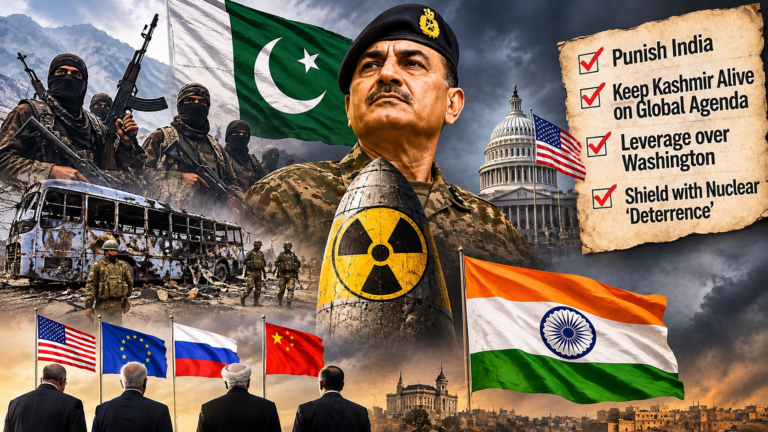

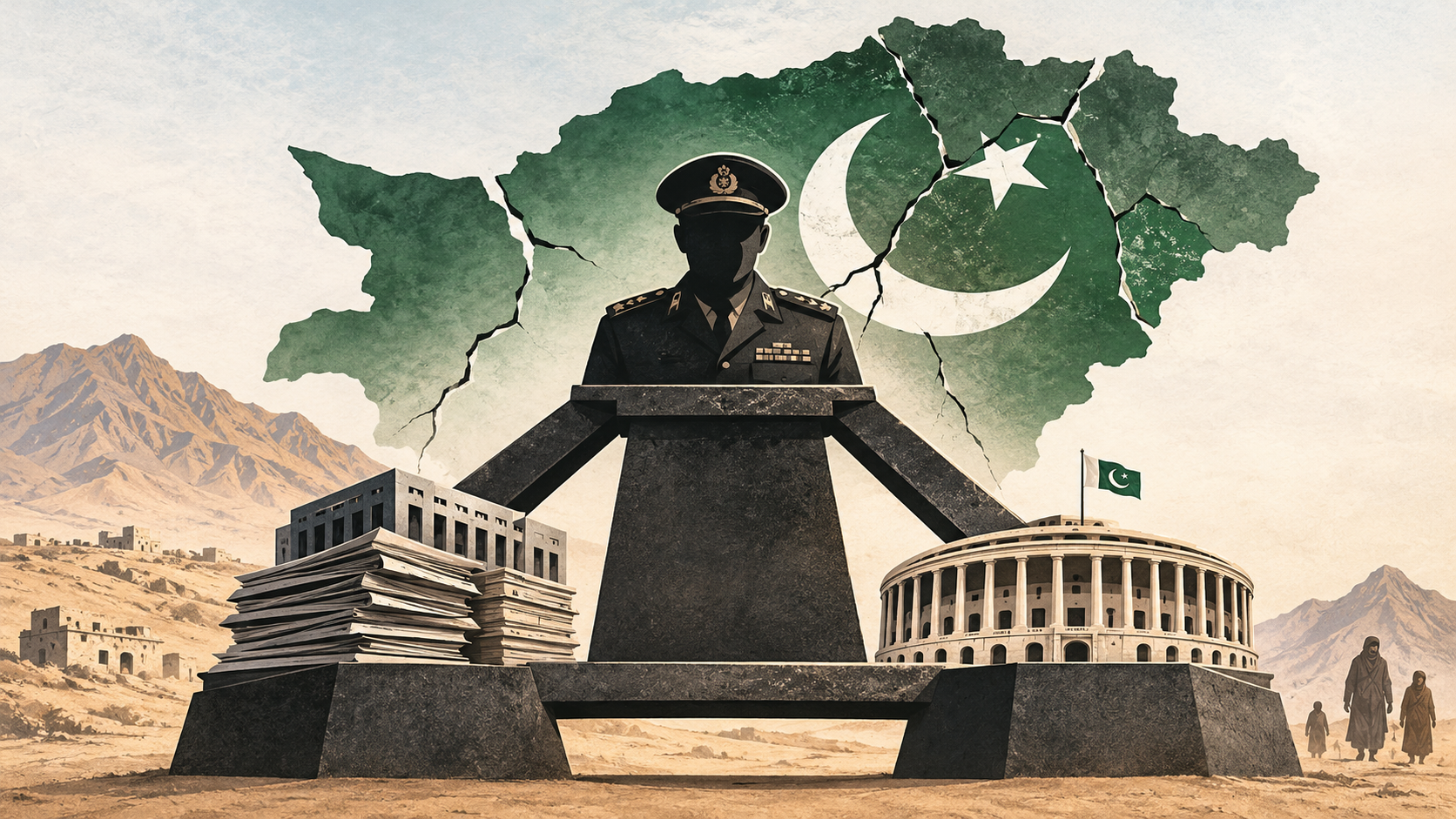
Pakistan’s crisis is commonly explained through political instability, economic mismanagement, militancy or weak institutions. Each explanation captures something real, but together they can miss the structure that links them. A Punjabi-dominated arrangement has concentrated authority, controlled public resources and treated the smaller nationalities as subordinate partners rather than equals in a federation. That arrangement comprises the military establishment, the senior bureaucracy, and a political class that depends on both. It may be called the Punjabi Power Triangle.
The three components reinforce one another. The military supplies coercive force. The bureaucracy supplies administrative continuity and control over public finance. Political elites supply the appearance of civilian legitimacy. This is not a single government or a temporary alliance of convenience. It is a durable system of power, and its methods have already broken Pakistan once.
The lesson of 1971
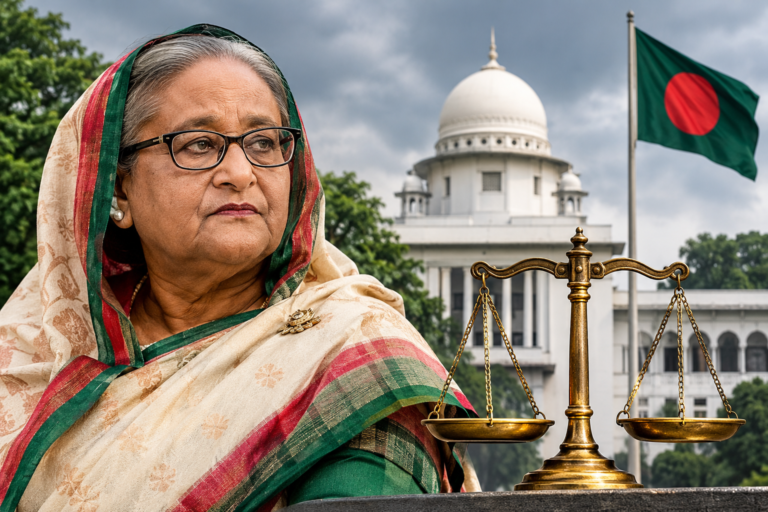
The break-up of Pakistan in 1971 was not an accident, and Indian intervention alone does not explain it. It followed from a political order that would not accept East Pakistan’s democratic mandate. The Awami League won a clear majority of the directly elected seats in the 1970 National Assembly election and, under any democratic arrangement, was entitled to form the government. Instead, power was withheld, negotiations became a means of delay, and force replaced political settlement. The result was mass violence, a humanitarian catastrophe, war and the birth of Bangladesh.
The lesson was plain. A state cannot hold together when its rulers place institutional dominance above the consent of the majority. Pakistan was not broken by the demand for democracy. It was broken by the refusal to accept it. That same mentality still shapes the state’s habits, and the ruling triangle has repeatedly shown it will risk national cohesion rather than give up control.
The military as a state within the state
The military is the most powerful pillar of the triangle. Since Pakistan’s early years, its role has extended well beyond defence into politics, foreign policy, economic management, and internal administration. The coups of 1958, 1977 and 1999 were not isolated interruptions in an otherwise stable democracy. They institutionalised the military’s claim to be the final arbiter of national affairs. Even under elected governments, it has kept decisive influence over security policy, political engineering and the limits of civilian authority.
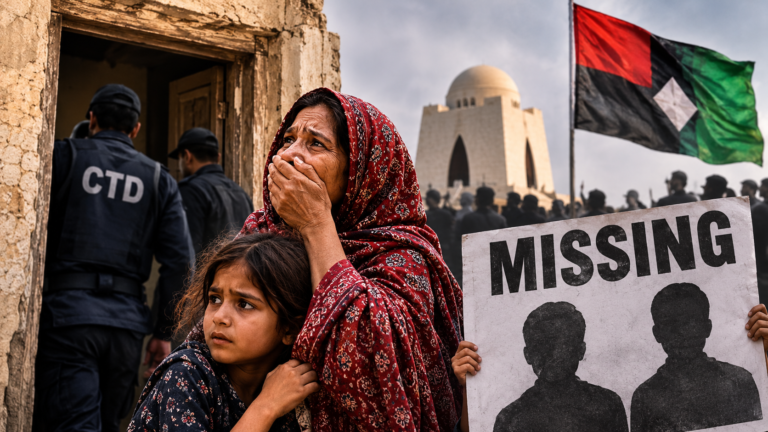
Nowhere is this clearer than in Balochistan. Political grievances, demands for autonomy and disputes over natural resources have too often been handled as security questions rather than constitutional ones. Instead of addressing the historical and constitutional roots of the conflict through negotiation, the state has leaned on military operations, intimidation and coercion.
Enforced disappearances, allegations of extrajudicial killings, curbs on peaceful political activity and pressure on journalists and rights defenders have deepened alienation. In August 2025, the Human Rights Commission of Pakistan reported continuing enforced disappearances, shrinking civic space, erosion of provincial autonomy and impunity in Balochistan. In April 2025, UN human rights experts had raised serious concern about enforced disappearances and the excessive impact of counter-terrorism measures in the province.
These are not only human rights concerns. They are a political failure. When a state answers political demands with force, it may suppress visible opposition for a time, but it also erodes the voluntary allegiance a federation depends on.
The bureaucracy and the question of resources
The second pillar is the senior bureaucracy. Much of the federal administrative machinery, which should act as an impartial instrument of public service, has in practice guarded centralised authority and unequal distribution of resources.
The bureaucracy shapes how budgets are framed, how development funds are allocated, how natural resources are regulated and how provincial demands are processed. In a genuine federation, these functions would protect constitutional balance. In Pakistan, centralised administrative practice has repeatedly weakened provincial autonomy and strengthened the ruling establishment.
Balochistan illustrates the point again. The province holds substantial mineral, energy and strategic resources, yet much of its population remains poor and under-employed, with inadequate infrastructure and limited access to public services. That contradiction raises unavoidable questions about ownership, accountability and who benefits. The same pattern appears in disputes over land, ports, minerals and large projects. Decisions affecting local people are often taken without meaningful consultation or consent, so development becomes a rationale for central control rather than a route to local prosperity.
The International Monetary Fund’s November 2025 Governance and Corruption Diagnostic Report identified persistent corruption risks, weak institutional capacity, fragmented oversight, ineffective accountability and constrained rule of law in Pakistan. It also pointed to opaque public financial management, weak procurement controls and regulatory advantages enjoyed by politically connected businesses. The IMF does not use the term “Punjabi Power Triangle”, which is a political interpretation of the structure described here. Its findings, however, document the governance weaknesses on which this system rests.
The political class and the limits of elections
The third pillar is the political establishment. Political parties and elected governments have often come to office through arrangements shaped by unelected institutions. Their survival has depended less on public confidence than on their relationship with the centres of coercive and administrative power.
The result is a political culture of patronage, corruption, manipulation and selective accountability. Accountability mechanisms are often used as instruments of political pressure rather than impartial justice. Governments change, alliances shift and individuals fall, but the underlying system remains largely intact.
The political class has also failed to defend the federal principle consistently. Many politicians have sought accommodation within the concentration of authority rather than challenging it. Provincial governments protest when their interests are threatened, then often join the same patronage networks once they gain access to power. The outcome is a system that holds elections without securing genuine popular sovereignty, in which parliament is weakened, provincial autonomy is compromised and public faith in constitutional politics erodes.
Economic power and fiscal distribution
The triangle is sustained by economic interests as well as political authority. Privileged access to state resources, public contracts, land, regulation and finance reinforces its hold.
The military’s commercial presence through foundations, trusts and companies raises serious questions about transparency, competition and accountability. The Fauji Foundation, Army Welfare Trust, National Logistics Corporation and Frontier Works Organisation operate in sectors well beyond conventional military responsibilities. The issue is not whether every activity of these bodies is unlawful. It is whether public accountability, competitive neutrality and transparent oversight can be assured when powerful state institutions take part directly in markets. Where political influence, administrative authority and commercial interest overlap, the line between public service and private benefit blurs.
Fiscal distribution belongs to the same problem. Under the seventh National Finance Commission Award, Punjab receives 51.74 per cent of the provincial divisible pool, Sindh 24.55 per cent, Khyber Pakhtunkhwa 14.62 per cent and Balochistan 9.09 per cent. These shares rest largely on population and do not by themselves prove deliberate ethnic discrimination. They do raise a wider question: can a federation achieve genuine equality when the distribution of resources, control over natural wealth and political decision-making remain deeply contested?
For Balochistan, the issue goes beyond fiscal transfers. It concerns who owns the land, who controls the minerals, who decides the future of ports and infrastructure, and who receives the benefits of the province’s resources.
Nationalities and the language of security
The most consequential effect of the triangle is its treatment of Pakistan’s constituent nationalities. Baloch, Sindhi, Pashtun and other communities have repeatedly sought political autonomy, resource rights, cultural recognition and constitutional equality.
Rather than answering these claims through a genuine federal compact, the establishment has often framed them in the language of national security. That approach turns political disagreement into security confrontation and constitutional grievances into prolonged conflicts.
Balochistan is the clearest case of this internal-colonial pattern. Its coastline, minerals, energy resources and location are treated as assets of the central state, while the political rights and economic priorities of its people are treated as secondary. They are expected to accept decisions taken elsewhere, even when those decisions determine the future of their homeland. Unity cannot be manufactured through deployments, administrative orders or coercion. It requires consent, equality and mutual respect.
The machinery is still operating
The tragedy of 1971 should have prompted Pakistan to rethink the foundations of its state. Instead, the centralising habits that contributed to that first break-up have persisted.
The warning signs are visible again: political polarisation, institutional confrontation, economic fragility, declining public trust, provincial alienation and deepening conflict in Balochistan and elsewhere. These are not separate accidents. They are symptoms of a system that has consistently placed the survival of its ruling machinery above the welfare and political rights of citizens.
A state can keep its army, bureaucracy, parliament, courts and international recognition and still lack a functioning federation. A country can preserve its formal boundaries while losing the political consent that gives those boundaries meaning. The ruling triangle appears to mistake control for stability. It assumes that a stronger security apparatus, greater centralisation and tighter supervision will hold the state together. In reality, these measures may accelerate fragmentation by eroding the trust a federation needs.
Reform or disintegration
Pakistan’s collapse is not inevitable, and no one can date it with confidence. But the continuation of the present power structure makes a deep constitutional and territorial crisis increasingly hard to avoid.
Another change of government, another military-backed settlement or another temporary economic package will not suffice. What is needed is a fundamental change in the structure of the state. The military must withdraw from political engineering and from commercial privileges that undercut civilian authority. The bureaucracy must become answerable to constitutional institutions and provincial governments. Political parties must end their dependence on unelected power centres and restore the authority of parliament. The provinces must exercise real control over their resources and political affairs. Enforced disappearances and extrajudicial practices must end, and genuine political dialogue must replace the security-led management of national grievances.
Above all, Pakistan must face the question it has avoided since 1947: can its constituent nationalities remain together through coercion, or must their union rest on voluntary consent and equal political rights?
In 1971, refusing to accept democratic reality cost Pakistan its eastern wing. Today, the triangle’s continued monopoly over political, military and economic power is placing what remains of the country under mounting strain. The danger is not simply another political crisis. It is that the machinery claiming to defend the state is steadily dismantling the conditions it needs to survive. The first Pakistan was broken by the arrogance of its ruling establishment. Unless that system gives way to a genuinely democratic and federal order, the same old machinery may break it again.
(The author is a political essayist, researcher, and literary activist whose writing addresses human rights, national identity, and state violence in South and West Asia. His work examines enforced disappearances, minority rights, and the failure of international institutions to prevent crimes against humanity. The views expressed are personal.)