
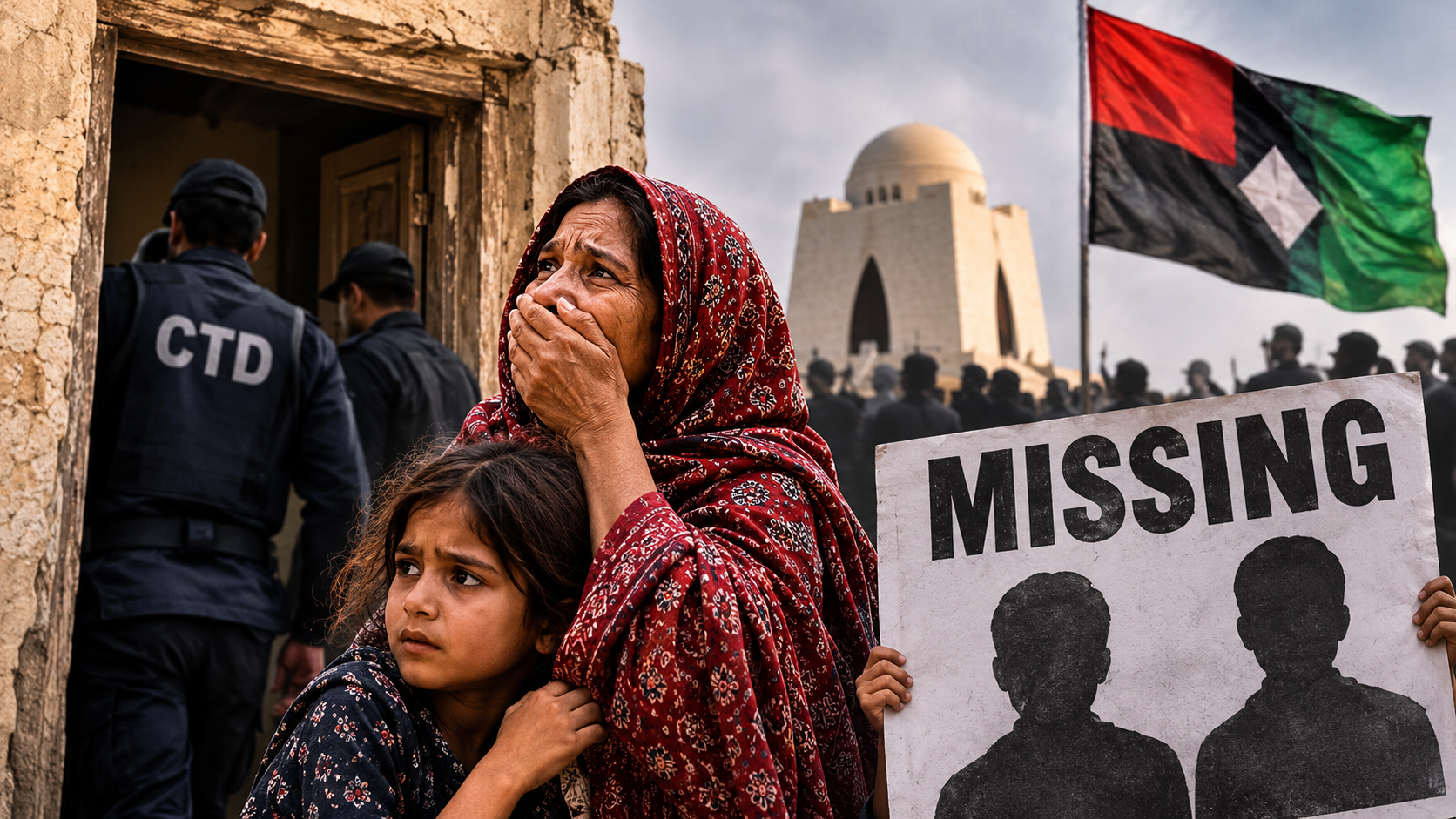
Anyone who has followed Sindh over the past two decades knows how these stories go. Armed men come to a house, some in uniform and some not. Someone is taken away. The family goes to the police station and gets no answer. Then the weeks turn into years.
The newest names on that list are two brothers from Jamshoro. The Jeay Sindh Freedom Movement (JSFM) says personnel of Pakistan’s Counter-Terrorism Department (CTD) and the police tried to abduct Saeed Tweeno, its Jamshoro District President. Local residents, along with Saeed and his brothers, resisted, and Saeed managed to escape. His brothers, Saleem Tweeno and Naeem Tweeno, were taken away. Their whereabouts are unknown, and the party fears they have been subjected to enforced disappearance.
JSFM Chairman Sohail Abro’s commented: “Saeed Tweeno’s only so-called crime is his love for his homeland, Sindh, and his peaceful political activism against the exploitation of Sindh’s natural resources, enforced disappearances, extrajudicial killings and forced religious conversions.”
The same door, again
This is not the first time the state has come for this family. In September 2025, JSFM reported a raid on the Tweeno residence at around 3 am, in which Saeed and his younger brother Dilbar were allegedly picked up by state intelligence agencies. Saeed was reported missing at the time, along with his brother. By January 2026 he was back in public life, leading the JSFM rally at Sann on the 122nd birth anniversary of G.M. Syed. That rally went ahead despite raids on activists’ homes and roadblocks set up to stop party convoys.
So within about fourteen months, one political worker has been picked up once and targeted a second time, and three of his brothers have been drawn into it. When an activist gets away, and the state takes his siblings instead, the family can hardly miss the message.
Why now
The timing deserves attention. JSFM has announced the First Oppressed Nations Parade for 10 December 2026, from Trafalgar Square to 10 Downing Street. The date is Human Rights Day, which marks the adoption of the Universal Declaration of Human Rights. The movement has done this before. In December 2024 it led a protest outside the Prime Minister’s residence alongside Baloch, Pashtun and Kashmiri groups, which ended with a memorandum handed in for Keir Starmer.
The party has also called a protest rally in Jamshoro against the proposed creation of a new province in Sindh. That question has been heating up in Pakistan’s politics all year. The MQM-P renewed its demand for new provinces and promised street protests. On 3 September the Sindh Assembly unanimously passed a resolution rejecting any plan to divide the province or change its borders, while the opposition walked out. Sindh’s nationalist parties announced a protest movement and compared the proposal to the One Unit scheme. Carving up Sindh is about as raw a nerve as Sindhi politics has.
So a district leader organising a rally on this very issue, in the weeks before an international march in London, became the target of a CTD operation. Readers can judge for themselves whether that is a coincidence.
A year of raids
The Tweeno case is one of many. In March 2026, JSFM alleged an intensified crackdown, including a raid on the home of Mohammad Osama Sumro, organiser of its UK chapter. The party also gave a list of long-running cases. Talib Laghari has been missing since January 2025. Sohail Raza Bhatti has been missing for eleven years. Allah Wadha Amhar was allegedly abducted at the age of 14, more than a decade ago.
In May, JSFM activist Zahid Laghari was killed in Moro, and the party demanded an FIR against the officers it held responsible. In the same month it blocked the Jamshoro–Kotri highway in a sit-in against enforced disappearances. In August it named activists of several Sindhi nationalist groups who had gone missing, among them Akash Mallah of the JSQM.
What the record shows
Pakistan’s own figures are bad enough. Its Commission of Inquiry on Enforced Disappearances had investigated 10,718 cases nationwide by November 2025, according to an Amnesty International Urgent Action. The same document points out that Pakistan is not a party to the International Convention for the Protection of All Persons from Enforced Disappearance and has no law that makes enforced disappearance a crime. Pakistani human rights groups told a joint press conference that the practice has gone on with near-total impunity for more than twenty years. Sindh’s own cases, rights defenders say, go back to 1999.
Families have taken their grief abroad, with protests outside the International Court of Justice in The Hague and outside the United Nations in Geneva. Sindh’s missing still get far less attention than Balochistan’s, and Balochistan’s get far less than they deserve.
The grievances behind the struggle
Saeed Tweeno’s causes, as his party describes them, are concrete. Take water. In February 2025, Army Chief Asim Munir and Punjab Chief Minister Maryam Nawaz inaugurated the Cholistan project, one of six new canals planned on the Indus. Sindh rose against it. Lawyers, farmers and nationalists blocked highways for weeks until the Council of Common Interests rejected the canals plan. Sindh learned that it gets heard only when it shuts down the country’s arteries.
Then there are forced conversions. In April 2026, UN experts reported that about 75 per cent of the women and girls subjected to forced conversion through marriage in Pakistan in 2025 were Hindu and 25 per cent Christian. Nearly 80 per cent of the cases were in Sindh, and girls aged 14 to 18 were the most frequent targets. The Hindus of Sindh are the remnant of one of the subcontinent’s oldest civilisational communities. They are losing their daughters at a rate the UN now calls systemic.
A young man who raises these issues in Jamshoro is doing what political workers do in any democracy. In Pakistan, that work brings counter-terrorism officers to his door.
What the world owes Sindh
JSFM has asked the United Nations, Amnesty International, the European Parliament, the British Parliament and international human rights organisations to take immediate notice of the incident. It wants them to demand the immediate recovery and safe release of Saleem Tweeno and Naeem Tweeno, to press Pakistani authorities to disclose where they are, and to investigate enforced disappearances in Sindh with accountability under international law.
None of this is too much to ask. The UN Working Group on Enforced or Involuntary Disappearances exists for cases like these. Britain is home to a large Sindhi diaspora and is about to see a march end at Downing Street, so it has more reason than most to ask Islamabad questions. India has watched the fate of Sindh’s Hindus since 1947, and it has every right to say what it sees.
The Tweeno brothers have names, a home and a family waiting for news. JSFM says that “intimidation, pressure and state violence cannot silence our political and national struggle.” Pakistan now has to answer a simple question: where are Saleem and Naeem Tweeno?