
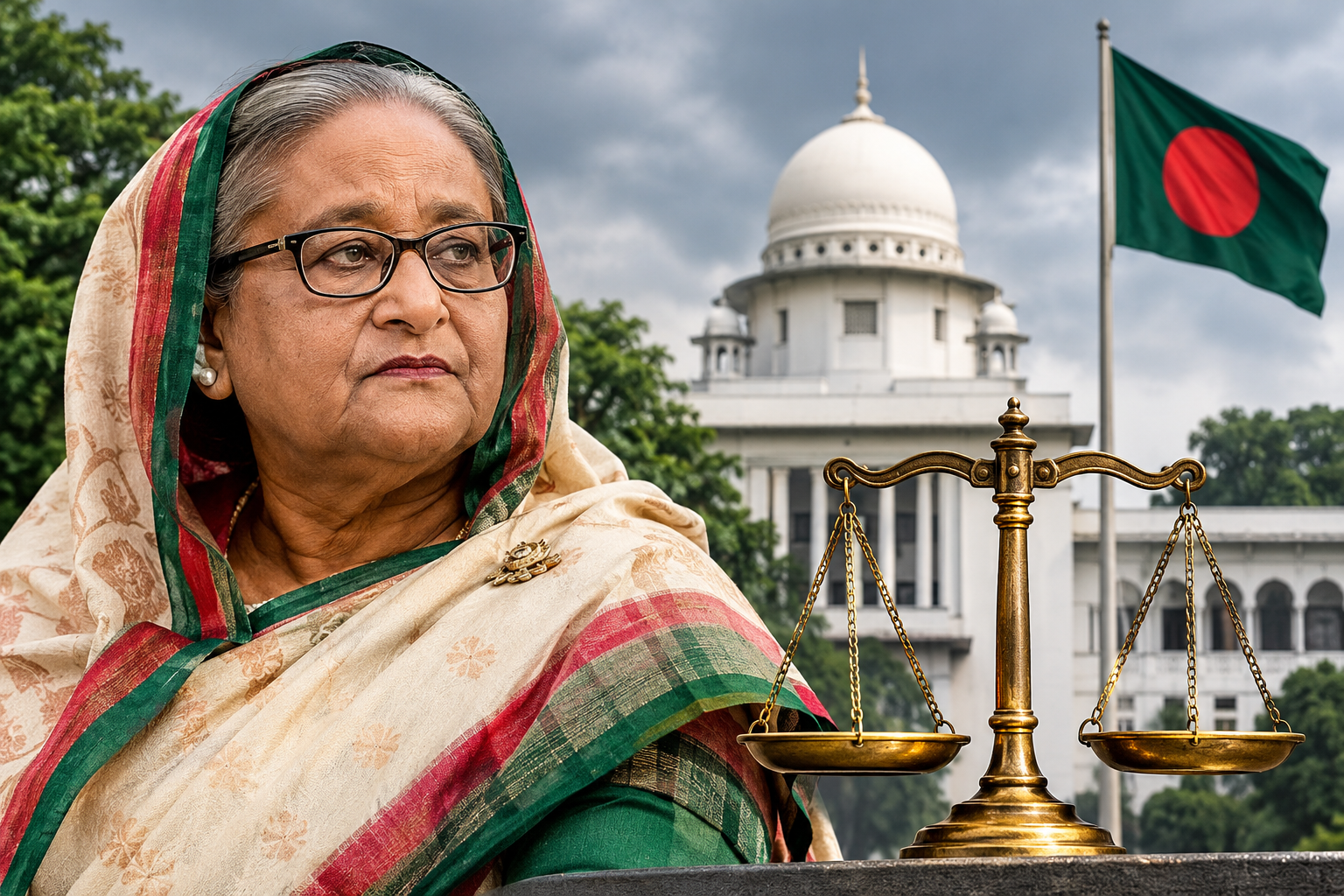
Bangladesh is approaching a potentially explosive political confrontation, and its centre is a question that the government of Prime Minister Tarique Rahman appears increasingly uncomfortable answering: What would happen if former prime minister Sheikh Hasina voluntarily returned to her homeland and demanded a genuinely fair trial? For a government that insists she must face the consequences of the judicial proceedings conducted against her in absentia, such a development should logically represent an opportunity to demonstrate the credibility of its justice system. Instead, the political debate surrounding her possible return is increasingly dominated by arguments over how she should enter Bangladesh, who should facilitate her return, and whether she should be permitted to determine the circumstances under which she faces the courts. This raises an uncomfortable question: Is the objective genuinely to bring Hasina before the law, or to ensure that the existing proceedings culminate in the punishment already pronounced against her?
Sheikh Hasina has publicly indicated her determination to return to Bangladesh by December 2026 and confront the legal proceedings against her. According to a Reuters report published on July 10, 2026, she has discussed returning alongside party colleagues and surrendering to the authorities. Her stated position presents an opportunity for Bangladesh to demonstrate that justice is not synonymous with political vengeance. Yet the response from sections of the country’s political establishment suggests that the manner of her return has become almost as important as the question of whether she should return at all.
The BNP government, headed by Tarique Rahman, inherited a deeply polarised political and judicial environment from the Muhammad Yunus-led interim administration. That administration came to power following the dramatic political upheaval of August 2024, when Hasina left the country. Its subsequent handling of the judicial proceedings against the former prime minister and several Awami League leaders has generated serious questions about due process, judicial independence and the political circumstances surrounding the trials.
Rather than distancing itself from the controversial legacy of the interim administration, the BNP government now faces criticism for continuing key elements of the same political and judicial agenda.
The extradition argument and its contradictions
A recent article published by Asia Times, titled “Hasina must return via extradition, not on her own terms”, provides an illustration of the increasingly contentious debate. Its author, Faisal Mahmud, argues that Bangladesh has requested India’s assistance in returning the convicted former prime minister and that the government should maintain extradition as the basis of its policy.
The article essentially suggests that Hasina should not be allowed to determine the circumstances of her return and that the state, rather than the individual facing prosecution, must establish the terms.
However, this argument raises a fundamental question: If the ultimate objective is to bring Hasina back to Bangladesh and place her before the authorities, why should her voluntary return be considered unacceptable?
British journalist David Bergman challenged precisely this contradiction in a Facebook commentary after sharing the Asia Times article. Bergman observed that those demanding Hasina’s return should logically welcome a voluntary return that results in her immediate detention. He also questioned the practical wisdom of insisting on formal extradition when such a process would be difficult and could involve conditions that the Bangladeshi government might find politically inconvenient.
His argument deserves serious consideration.
If Bangladesh government genuinely believes that the judicial proceedings against Sheikh Hasina are legitimate, her voluntary appearance should strengthen rather than undermine its position. The authorities could take her into lawful custody, provide her with appropriate legal representation and allow the judicial process to proceed under internationally recognised standards.
Instead, placing excessive emphasis on extradition risks creating the impression that the government is more interested in controlling the political circumstances of her return than ensuring that justice is served.
There is another important dimension. Bangladesh and India have an extradition treaty, but the existence of such an agreement does not mean that every extradition request must automatically be granted. Treaty provisions, applicable exceptions and the circumstances surrounding a particular prosecution all matter. Consequently, presenting extradition as an uncomplicated mechanism for securing Hasina’s return is an oversimplification.
The International Crimes Tribunal under scrutiny
The most troubling aspect of the controversy concerns the proceedings conducted by Bangladesh’s International Crimes Tribunal.
The tribunal was originally established under the International Crimes (Tribunals) Act of 1973. Its historical purpose was to prosecute individuals accused of committing serious international crimes. However, the credibility of any such institution depends not simply on its legal mandate but also on its adherence to fundamental principles of justice.
Those principles include the right of an accused person to know the charges, obtain effective legal representation, challenge evidence, examine witnesses and receive an impartial hearing.
In Hasina’s case, the proceedings conducted in her absence have become the subject of substantial criticism. Questions have been raised about the effectiveness of her legal representation, the opportunity to challenge evidence and the availability of meaningful appellate remedies.
Bergman has argued that Hasina’s return would not necessarily serve Bangladesh’s interests unless she were granted a full retrial following significant reforms to the International Crimes (Tribunals) Act and the tribunal’s procedural rules. He has particularly questioned the fairness of imposing the death penalty following an in absentia proceeding in which the accused could not personally instruct her lawyers.
This is not an argument that former political leaders should enjoy immunity from prosecution. Nor does it suggest that allegations of serious human rights violations should be ignored. Rather, it recognises a fundamental principle: the legitimacy of a judicial verdict depends on the fairness of the process through which it is reached.
On July 28, 2026, Human Rights Watch published a statement raising serious fair-trial concerns at Bangladesh’s International Crimes Tribunal. The organisation warned that failures to uphold international legal standards could deny justice to victims, undermine the rule of law, facilitate the imprisonment of political opponents and reproduce human rights violations associated with the country’s past.
Such criticism cannot simply be dismissed as political propaganda or foreign interference. Human Rights Watch has raised questions that the Bangladeshi authorities should address through transparency, institutional reforms and credible judicial safeguards.
Indeed, if the government is confident in the evidence against Hasina, why should it fear a process that gives her full legal representation and a genuine opportunity to contest the allegations?
From political transition to institutional credibility
The controversy surrounding Sheikh Hasina’s return also exposes a wider problem confronting Bangladesh: the persistent politicisation of institutions following the August 2024 upheaval.
The Yunus administration was expected to oversee a transition towards a more democratic political environment. However, its handling of political opposition, the exclusion and legal treatment of the Awami League, and the controversies surrounding the International Crimes Tribunal have left the country with serious questions about institutional neutrality.
The subsequent BNP administration now has an opportunity to correct these shortcomings. Yet critics argue that the continuation of controversial judicial and political arrangements risks perpetuating the same environment of exclusion and confrontation.
There are also wider concerns about law and order, mob violence, attacks on minorities, the activities of radical Islamist organisations and allegations of corruption and financial irregularities during the transition period. These issues require independent investigations and credible accountability rather than political rhetoric.
Bangladesh cannot claim to be moving towards democratic normalisation while allowing questions about judicial independence, political persecution and the protection of fundamental rights to remain unanswered.
The BNP leadership should understand that its credibility will ultimately be judged not by how effectively it prosecutes its political opponents, but by how consistently it protects those opponents’ rights.
A test for Tarique Rahman
For Prime Minister Tarique Rahman, Sheikh Hasina’s possible return represents a defining political and constitutional test.
If his government genuinely intends to establish the rule of law, it should welcome a transparent judicial process that can withstand scrutiny from domestic and international observers. That means ensuring that Hasina receives competent legal representation, that the evidence against her is independently examined, and that she has access to the full range of legal safeguards available under international standards.
If the existing proceedings cannot satisfy those requirements, the government should consider the necessary legal and procedural reforms, including a genuinely fair retrial where appropriate.
The death penalty makes these questions particularly consequential. An irreversible punishment imposed following proceedings that fall short of internationally recognised fair-trial standards would inflict enormous damage on Bangladesh’s international standing and undermine the credibility of its judicial institutions for years to come.
The government should also abandon any temptation to treat the extradition question as a political instrument. Whether Hasina returns voluntarily or through a legally negotiated extradition arrangement should not determine the quality of justice she receives.
Bangladesh needs accountability for past abuses. Victims and their families deserve justice. But justice cannot be selectively administered, nor can it be transformed into an instrument for eliminating political opponents.
The international community should therefore pay close attention to developments surrounding Hasina’s proposed return, particularly the government’s willingness to guarantee due process and permit independent scrutiny of the judicial proceedings.
Ultimately, Bangladesh faces a choice between demonstrating that it has emerged from its political upheaval with a stronger commitment to the rule of law or allowing the judicial system to become another battlefield in its seemingly endless struggle for political power.
If Sheikh Hasina is prepared to return and face the courts, the government should have no reason to fear that prospect. A genuinely fair trial would serve Bangladesh far better than an execution surrounded by allegations of political vengeance, procedural irregularities and international condemnation. The real test of Tarique Rahman’s government is not whether it can secure the return of a former prime minister, but whether it possesses the confidence and integrity to deliver justice even when the accused is its most formidable political adversary.
(The author is a security analyst and former member of the Australian Defence Force. Views expressed are personal)