
A new human rights report by Dr Amjad Ayub Mirza documents five months of proscription, gunfire, detentions and blackouts in Pakistan-occupied Jammu and Kashmir. Its quiet, careful method makes it harder to dismiss.
For five months, a part of Jammu and Kashmir that the world rarely looks at has lived under a terror ban on its own civil society. There have been internet shutdowns, mass arrests, missing activists and gunfire at protest sites. The place is Pakistan-occupied Jammu and Kashmir (PoJK), which Islamabad calls “Azad”, or free.
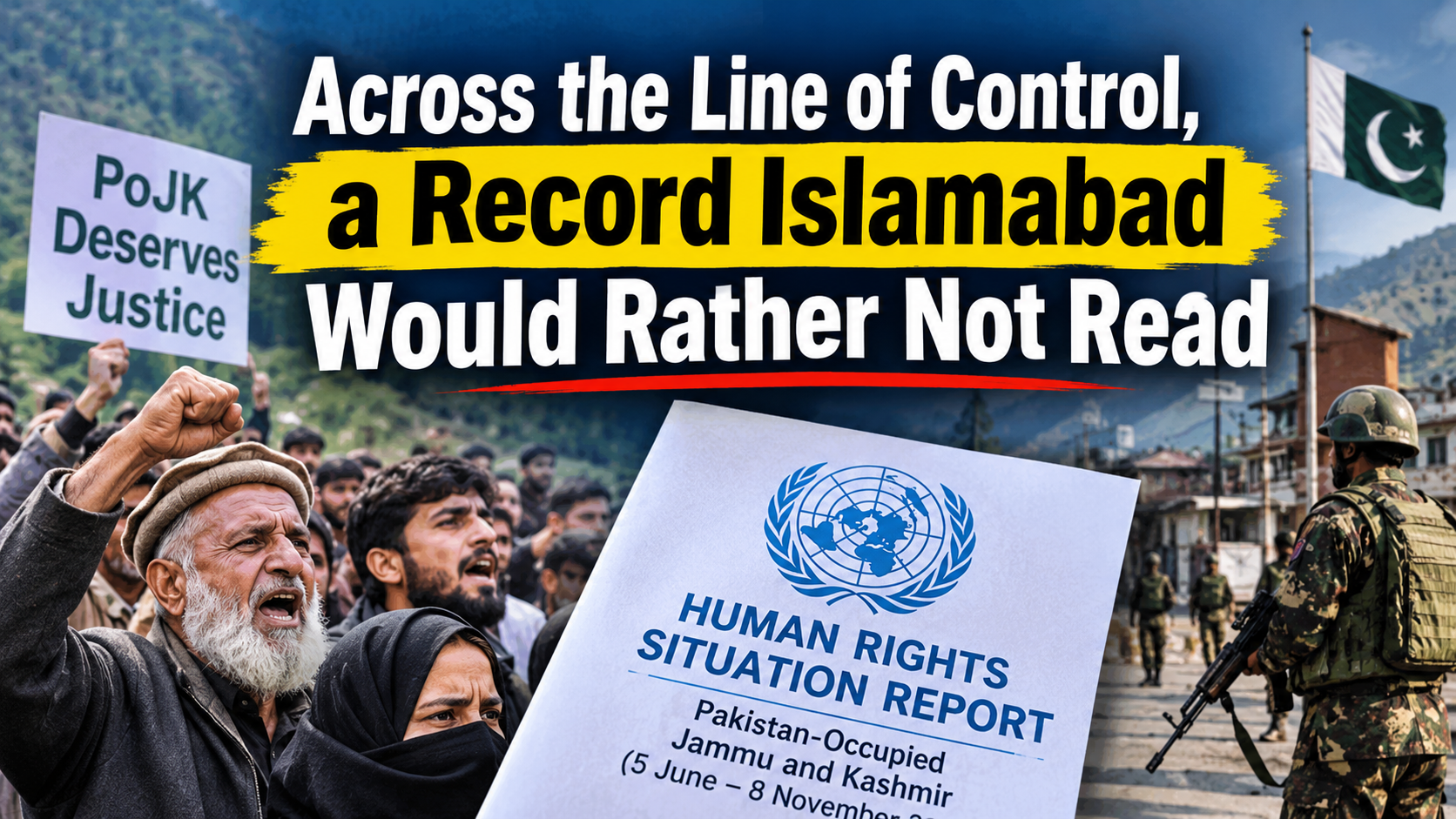
What happened there between 5 June and 8 November 2026 has now been set down in a Human Rights Situation Report prepared by Dr Amjad Ayub Mirza, the Glasgow-based human rights activist and journalist who has documented conditions in the region for years. The report is addressed to the Office of the UN High Commissioner for Human Rights, the UN Human Rights Council’s Special Procedures, Amnesty International, Human Rights Watch, the Human Rights Commission of Pakistan (HRCP) and the International Federation for Human Rights. It asks for one thing above all: an independent investigation.
The report’s strength lies in its restraint. It is a preliminary desk-based submission and says so. It separates what has been independently documented from what is credible but unproven, and from what remains an allegation. It warns readers not to add up casualty figures drawn from different sources and dates. That discipline is precisely what makes its conclusions so difficult for Islamabad to wave away.
A terror ban on a people’s movement
The Jammu Kashmir Joint Awami Action Committee (JKJAAC) is no militant outfit. It brings together traders, lawyers, transport workers, students and community representatives. Its demands are about daily life: affordable electricity and wheat, working public services, administrative accountability and fair political representation.
One demand goes to the heart of how Pakistan governs the territory. Twelve seats in the PoJK Legislative Assembly are reserved for “refugees” from Jammu and Kashmir who live elsewhere in Pakistan. These seats are elected by voters spread across Pakistani cities, far from the territory itself, and they give Islamabad a dependable lever over the Muzaffarabad assembly. The JKJAAC wants them abolished. The authorities point to their constitutional protection.
On 5 June the PoJK government placed the JKJAAC in the First Schedule of the Azad Jammu and Kashmir Anti-Terrorism Act, 2014, days before a planned protest call for 9 June and weeks before the 27 July assembly elections. Officials said the group was engaged in terrorism and creating anarchy; a government aide later spoke of external elements funding it.
Amnesty International called the designation a dangerous escalation. Its Deputy Regional Director for South Asia, Isabelle Lassee, said: “The proscription of JKJAAC under anti-terror laws is disproportionate, unlawful and a violation of the right to freedom of association.” A day after the ban, journalist Sohrab Barkat was arrested under the Prevention of Electronic Crimes Act, reportedly over published material concerning the JKJAAC.
Dr Mirza’s report frames the central question plainly: was an anti-terror law aimed at specific unlawful conduct, or at peaceful civic participation that happened to challenge the government? Criminal acts by individuals, it notes, should be investigated individually. They cannot strip peaceful demonstrators of their rights.
The dead, and the problem of counting them
The killing began almost at once. Amnesty reported that JKJAAC activist Shahzeb Habib was shot during a police encounter on 5 June. In the days that followed, Rawalakot became the centre of the violence, with deaths among protesters and police alike.
The figures climbed through the summer, each from a different source and cut-off date. At least 24 people were reported dead by 19 June, with hundreds detained. Media figures cited by Amnesty put the toll at 40 or more before the late-July violence. The Jammu Kashmir Human Rights Organisation (JKHRO) put its own verified count at 89 by 5 August.
The report refuses to merge these into a single grand total. Claims of more than 100 dead, it says, must be checked against one reconciled, person-by-person register. That caution is a challenge to the authorities: if the state disputes the numbers, it holds the hospital records, the custody logs and the operational files that would settle them.
The official version has been consistent. After the early June clashes, PoJK police said three people linked to the committee died from their own “indiscriminate firing”. The report does not take either side’s word. It holds both narratives up against the UN Basic Principles on the Use of Force and Firearms, which permit intentional lethal force only when strictly unavoidable to protect life, and asks that every potentially unlawful death be examined under the Minnesota Protocol.
Late July brought renewed lethal confrontations during the election period, again centred on Rawalakot. Amnesty demanded an end to the communications blackout that accompanied them. An election held while phone lines are cut and a leading civic movement is banned under terror law is a strange advertisement for “Azad” Kashmir.
Rawalakot, 5 November
The crisis flared again before dawn on 5 November. Security forces moved on the long-standing protest sites at Farooq-e-Azam Chowk and the Matiyalmera bus terminal in Rawalakot to clear barricades and end the sit-ins.
The JKJAAC and JKHRO have named three dead: Ehtisham Younis, 30; Atif Jirjees, aged around 33 to 35; and Adil Rashid, 32. The committee reports at least 18 injured. It alleges that security personnel fired on demonstrators; police sources say armed men among the protesters opened fire.
Claims of drones, explosive munitions and damage to homes have circulated widely. The report does not treat them as proven. It asks instead for the material that would prove or disprove them: original footage, drone and weapons logs, forensic evidence, casualty records, testimony from civilians and security personnel, and an answer to whether ambulances were obstructed. The HRCP, Pakistan’s own leading rights body, called for restraint, independent reporting and dialogue after the operation.
Detained, missing, silenced
Amnesty reported more than 100 arrests of JKJAAC-linked people in early June. Around 150 members were placed under anti-terror restrictions; the PoJK government put 147 activists and supporters on the Fourth Schedule of the Anti-Terrorism Act. The report records complaints of thin legal grounds, limited access to lawyers, alleged ill-treatment and a failure to tell families where detainees were held.
Two cases stand out. JKJAAC figure Shaukat Nawaz Mir, against whom the PoJK government had initiated sedition proceedings, was, according to his family, apprehended in Dhirkot on 30 June and has remained unaccounted for. In October a court summoned the local station house officer over his alleged arrest. The report stops short of calling this an enforced disappearance, since custody records have not been independently confirmed. It insists the state must say where he is.
The second is Ahmad Farhad, the journalist and poet, held under administrative measures in Bagh from 20 June. Amnesty’s August urgent action described alleged pressure on him to denounce the protests and concern over a hunger strike. Farhad is no stranger to this treatment. In May 2024 he was picked up from his home in Islamabad, in a case that became a national scandal in Pakistan.
Alongside the arrests came the blackouts. Mobile and internet services were cut in June, and interruptions continued after. A shutdown does more than silence reporters. It cuts families off from detained relatives, delays ambulances, shuts classrooms and starves small businesses. The report asks who authorised each shutdown, on what legal basis, and whether anything less drastic was considered.
The cost to ordinary life
Shops, banks, fuel stations and transport were shut for long stretches. Daily-wage workers were hit hardest. Local monitors reported trouble getting medicine, food and transport during the worst periods. Children, the elderly, pregnant women and people with disabilities bore a heavier share. The report is careful here too: it does not claim a deliberate policy to deprive the population of essentials, and it records late-October allegations of civilian deaths at a residence as claims awaiting site investigation.
The irony is hard to miss. This is a region whose rivers turn the turbines of Pakistan’s power grid. Its people took to the streets over the price of electricity and wheat, and were answered with a terror law.
The world has taken note
This is no longer a matter that Islamabad can file away as Indian propaganda. Amnesty has spoken repeatedly. In July the UN Human Rights Office called for prompt and impartial investigations into the deaths of protesters and security personnel, restoration of connectivity and protection of civic freedoms. In September six UN Special Procedures mandates issued allegation letter AL PAK 4/2026, asking Pakistan to explain the JKJAAC designation and the allegations of force, deaths, detention and restrictions. In August the HRCP’s own fact-finding mission found serious restrictions on rights, deep institutional distrust and an urgent need for inclusive dialogue.
When Pakistan’s own human rights commission and six UN mandate holders raise the same concerns, the usual charge of a foreign hand does not hold.
What the record says about Islamabad’s Kashmir narrative
For decades Pakistan has presented itself at the United Nations as the guardian of Kashmiri rights. Dr Mirza’s report shows how that guardian behaves when Kashmiris under its own control ask for cheaper flour, honest administration and an end to assembly seats that answer to Islamabad. It bans their movement under a terror law, cuts their phones, detains their organisers and journalists, and sends security forces to clear their sit-ins at dawn.
The contrast with the Union Territory of Jammu and Kashmir is instructive. In 2024 its people voted for a new assembly in large numbers, in elections that passed off peacefully and drew turnout close to 64 per cent. Nobody needed a blackout to hold them.
India’s position on PoJK has been settled since Parliament’s unanimous resolution of 22 February 1994, which declared the whole of Jammu and Kashmir an integral part of India and called on Pakistan to vacate the areas it occupies. The people living in those areas are therefore not a distant concern for India. Their rights, their safety and their voice are a legitimate subject for Indian public debate and for Indian diplomacy.
The appeal that deserves an answer
The report ends with a set of measured requests and a 30-day timetable. Protect witnesses and preserve weapons, drone, medical, video and custody records at once. Within seven days, publish auditable lists of the dead, the injured, the detained and the missing. Within 14 days, announce an independent investigation and judicial review of contested detentions. Within 30 days, allow independent monitoring and publish a timetable for real political dialogue.
None of this is radical. It is what any state that claims to respect the people it governs should be willing to do. The OHCHR, the Special Procedures and the major rights organisations now have a careful, sourced document in hand. The test is whether they apply to Pakistan in PoJK the same scrutiny they have so readily applied elsewhere in Jammu and Kashmir.
Dr Amjad Ayub Mirza has done the patient work of putting the record in order. The question now is whether the world will read it, and whether Islamabad will be made to answer.
This article draws on the Human Rights Situation Report: POJK, 5 June – 8 November 2026*, prepared by Dr Amjad Ayub Mirza, human rights activist and journalist, Glasgow, United Kingdom.*