

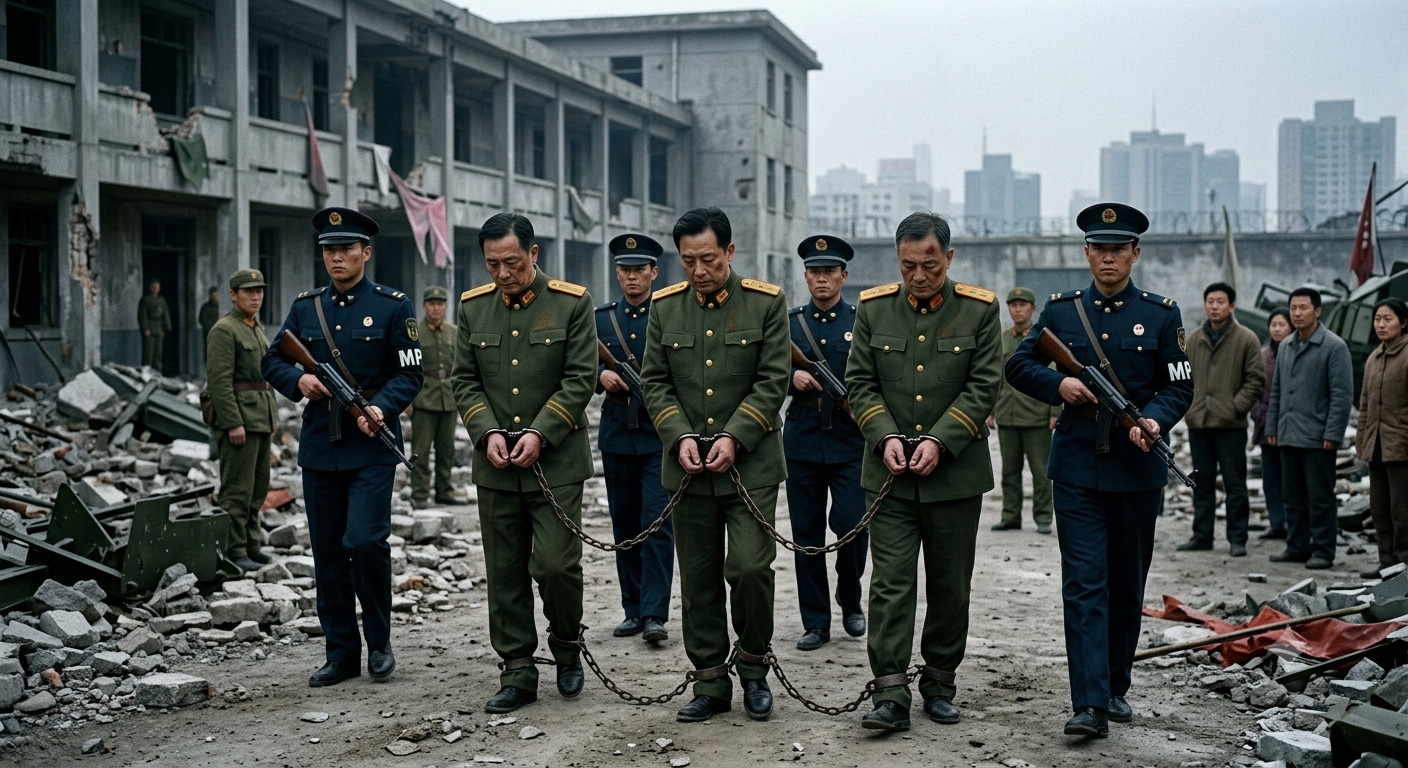
The sudden downfall of former Shenzhen Mayor Qin Weizhong is not an isolated incident but part of a broader pattern that exposes the deep rot within China’s political system. His abrupt resignation in August followed by a disciplinary probe in September underscores the opaque and arbitrary nature of governance under the Chinese Communist Party (CCP). While Beijing frames such investigations as part of its anticorruption campaign, the reality is that these purges reveal a system built on fear, factionalism, and political manipulation rather than genuine accountability.
A Career Cut Short
Qin’s trajectory was typical of China’s technocratic elite. Educated at Tsinghua University, he rose through the petrochemical industry before entering government service. His appointment as vice governor of Guangdong in 2019 and later as mayor of Shenzhen in 2021 placed him at the helm of one of China’s most dynamic cities.
By 2022, he had secured a position as an alternate member of the CCP’s Central Committee, signalling his ascent into the Party’s upper ranks. Yet his career collapsed almost overnight. Officially, Qin’s resignation was explained as a “change in work assignment,” a euphemism often used to mask political disgrace.
Within weeks, the Central Commission for Discipline Inspection announced he was under investigation for “serious violations of discipline and law.” This vague phrase, deployed countless times in CCP purges, can mean anything from corruption to political disloyalty. The lack of transparency is deliberate: it allows the Party to remove officials without explanation, leaving citizens and observers to speculate about the true motives.
Patronage and Political Networks
Qin’s fall cannot be understood without examining the patronage networks that dominate Chinese politics. His career overlapped with Ma Xingrui, the former Guangdong governor who was himself expelled from the Party in July 2026 for corruption.
Qin’s ties to Tsinghua University also linked him to Chen Xi, the former CCP Organization Department chief who oversaw personnel appointments nationwide. These connections illustrate how advancement in China depends less on merit than on factional alliances.
When a patron falls, protégés are often dragged down as collateral damage. As one commentator put it, “When one prospers, all prosper; when one falls, all fall”. This system breeds instability. Officials rise not because of competence but because of loyalty to powerful figures. When those figures are purged, entire networks collapse, disrupting governance and eroding public trust. Qin’s case is emblematic of this vicious cycle.
The Broader Purge
Qin’s investigation is part of a sweeping campaign that has already toppled senior generals and Politburo members. In recent months, figures such as Zhang Youxia and Liu Zhenli were removed from the military’s top command, while Ma Xingrui was expelled from the Party.
These purges hollow out institutions, leaving them weakened and leaderless. The military in particular has suffered repeated blows, undermining its modernization and morale.
Xi Jinping presents these actions as proof of his determination to root out corruption. In reality, they serve to consolidate his personal power. By eliminating rivals and reshuffling leadership, Xi ensures that no alternative centers of authority can emerge. The result is a climate of fear where officials are more concerned with survival than with effective governance.
The Illusion of Discipline
China’s propaganda machine insists that these investigations strengthen discipline and integrity. Yet the opposite is true. The lack of transparency means citizens cannot distinguish between genuine corruption cases and politically motivated purges.
The Party’s monopoly on information ensures that the public receives only the official narrative, while independent voices are silenced. This erodes confidence in institutions and fosters cynicism about the rule of law.
Moreover, the purge culture discourages initiative. Officials who fear sudden disgrace are unlikely to take risks or pursue bold reforms. Instead, they cling to conformity, stifling innovation and responsiveness.
Qin’s removal from Shenzhen, a city known for its dynamism, illustrates how political instability can derail local governance and economic progress.
A System Built on Fear
The CCP’s disciplinary apparatus is less about justice than about control. By keeping charges vague and procedures opaque, the Party maintains the ability to strike at anyone, anytime.
This unpredictability is intentional: it keeps officials obedient and prevents dissent. Yet it also reveals the fragility of the system. A government that relies on fear rather than legitimacy cannot sustain long-term stability.
Qin’s downfall highlights the dangers of this model. His career was built on education, industry experience, and political connections, yet none of these could shield him from the Party’s arbitrary wrath.
His case demonstrates that in China, no official is safe, no matter how loyal or accomplished.
Conclusion: A Warning to the World
The investigation into Qin Weizhong is more than a local scandal. It is a window into the dysfunction of China’s political system.
Behind the façade of discipline lies a regime plagued by corruption, factionalism, and paranoia. Xi Jinping’s purges may eliminate rivals, but they also weaken institutions, disrupt governance, and erode trust.
The fall of Qin is not a triumph of justice but a symptom of systemic decay.
For the world, the lesson is clear. China’s rise is undermined by the very system that sustains its leadership. A government that devours its own officials cannot project stability abroad.
Qin’s case should remind observers that beneath China’s economic power lies a brittle political structure, vulnerable to the very corruption and fear it claims to fight.
Until transparency, accountability, and genuine rule of law replace arbitrary purges, China will remain trapped in a cycle of instability that threatens both its people and the international community.