
In Pakistan’s fraught political landscape, where military dominance has often operated behind a veil of civilian rule if not outrightly seizing power, a new chapter is being written. Analysts and experts describe the country’s current governance framework as a ‘hybrid system’ wherein military exerts control over the civilian executive. But, instead of resisting such entrenchment in the executive affairs of Pakistan, the country’s political class is openly celebrating the system and its own active complicitly. Its latest manifestation was witnessed in the aftermath of Pakistan Army Chief General Asim Munir’s June 2025 Washington luncheon with the US President Donald Trump where he was accorded an honour typically reserved for heads of state. Defence Minister Khawaja Asif in a recent social media post on X (formerly Twitter) hailed the so-called “hybrid model” of governance as the secret to Pakistan’s recent successes.
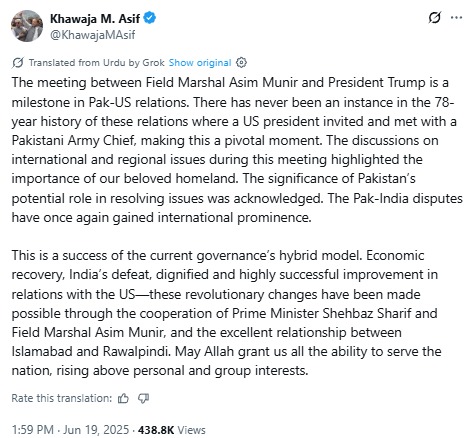
Asif’s post was unambiguous, stating, “The revival of the economy, the defeat of India, the glorious and highly successful improvement in relations with the US” were all, according to him, made possible not by democratic governance or parliamentary mandate, but by “excellent relations between Islamabad and Rawalpindi.” This was the highest form of from the current political elite referring to not only the civilian government’s alignment with the military high command but its subservience to it.
Far from being a gaffe or one-off comment, Asif’s post was emblematic of a broader trend, which is the normalization, and even celebration, of military dominance in Pakistan’s political system under the tenure of current Chief of Army Staff.
Field Marshal Asim Munir, who assumed command of Pakistan’s powerful military in November 2022, has swiftly moved to expand the influence of military establishment far beyond traditional defence and security matters. During these years, Pakistani Army has reasserted itself as the ultimate arbiter of political legitimacy, economic policy, foreign affairs, and even media narratives, something that is not lost in the currently in Pakistani information space.
Munir’s model of control is less about martial law and more about managed democracy, which is a façade of civilian rule where real power resides in the barracks of Rawalpindi. In contrast to some of his predecessors like General Qamar Javed Bajwa and Raheel Sharif who preferred to operate in the shadows, Munir’s approach is increasingly overt. Whether through the military’s economic arm, the ever-growing surveillance state, or the selective engineering of elections and political alliances, his footprint has growingly become unmistakable.
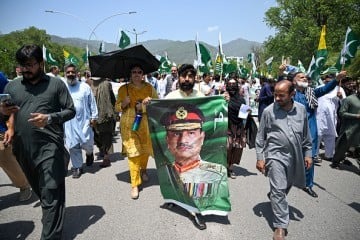
This has been demonstrated by the much controversial 2024 general elections through brazen manipulation of the system to ensure the current government under Shehbaz Sharif takes shape. It included the use of all arms of the state, be it the election commission or judiciary, the military establishment ensured that the Pakistan Tehreek-e-Insaaf (PTI) party was restrained from partaking in elections and denying its nominees a unified platform to contest besides scores others imprisoned, disqualified on technicalities, or marginalized through media blackouts.
Nevertheless, what makes this moment particularly alarming is not just the military’s overreach and dominance over civilian executive, but the political class’s enthusiastic submission to it. Instead of resisting authoritarian drift, Pakistan’s major political parties, led by ruling Pakistan Muslim League-Nawaz (PML-N), along with Pakistan People’s Party (PPP), have largely embraced it for seeking favour with the military brass in the hopes of electoral blessings or protection from legal troubles.
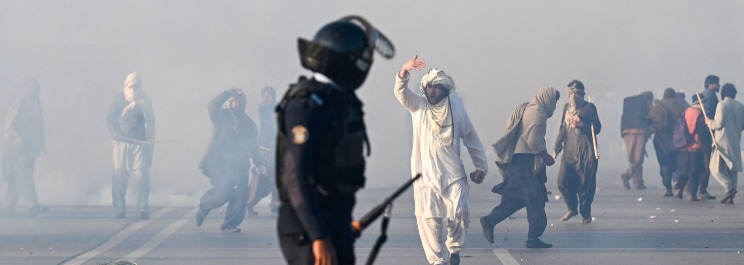
As such, once symbols of democratic resistance, the silence of these political parties on issues of censorship, enforced disappearances, political victimization, and military trials of civilians speaks volumes. They are increasingly toeing the establishment’s line and facilitating its power grab by enabling legislative amendments. Under this arrangement, Pakistan Military (Army, Air Force and Navy) Acts have been amended to increase powers of the armed forces along with increasing the tenures of service chiefs, besides 26th constitutional amendment to undermine the country’s judiciary by tweaking the judicial appointments procedure and weaking the powers of Chief Justice of Pakistan.
The most revealing indicator of this alliance is the mainstreaming of “hybrid regime”, once a derided term used by analysts and civil society to describe the country’s militarized democracy. It is now worn as a badge of honour by ruling politicians, as Khwaja Asif’s adoration highlights. That a sitting defence minister could proudly glorify military dominance over civilian executive, without fear of political backlash, signals how far democratic norms have eroded. It also glosses over the fact that Pakistan all kinds of ills, ranging from economic woes, security unravelling, and political instability, are all because of the very military establishment’s Machiavellian overreach beyond their constitutional mandate.
Under Asim Munir’s command, the military has expanded its grip on key civilian institutions, including the judiciary, the Election Commission, the media, and even elements of the economic policy machinery. It can be safely argued that this so-called “hybrid model” is little more than a euphemism for authoritarianism in civilian clothes as Pakistani judiciary is being either co-opted or cowed into silence, while journalists face harassment, detention, or worse for merely questioning the prevailing order. In such a system, the military does not need to seize power as it already exercises it, via the institutions it controls.
For decades, Pakistan has oscillated between overt military dictatorships and fragile democratic transitions. Each time democracy has been restored, there was hope, however faint, that the balance of power might tilt in favour of civilian supremacy. Under Field Marshal Munir, that hope appears to be vanishing fast. What distinguishes the present era is not just the military’s ambition, but the political elite’s abdication of responsibility.
By cheerleading military dominance, political leaders are not just compromising democratic norms, they are legitimizing authoritarianism. And in doing so, they are narrowing the space for dissent, weakening civilian institutions, and undermining public trust in electoral processes, which are all basic indicators of a democracy.
The consequences are profound. Pakistan’s economy, already struggling under the weight of inflation, debt, and a collapsing rupee, cannot recover without institutional accountability. Foreign policy, especially relations with neighbours like India and Afghanistan, requires democratic consensus, not militarized doctrine. And internal security, increasingly threatened by extremism and separatism, as evidenced by raging Baloch insurgency and Islamist extremism, cannot be addressed through brute force alone.
For Pakistan to reclaim its democratic identity, it must begin with a clear-eyed recognition of where it stands today. The so-called hybrid system is not a strength, but a symptom of institutional decay. Political leaders must stop outsourcing legitimacy to the military and instead invest in rebuilding the public’s faith in democratic governance.
Asim Munir’s consolidation of power may serve the short-term interests of a few, but it comes at the cost of Pakistan’s democratic soul. If left unchallenged, the current trajectory will lead not to national revival, but to a more entrenched and unaccountable authoritarianism. And history has shown, time and again, that such regimes do not end in glory, but in collapse.