The Taliban direction of Bangladesh’s Islamists

Amidst the developments in Bangladesh’s political trajectory, the resurgence of Islamists has been the one catching everyone’s attention. A country with about 90 per cent Muslim population, this surely is not supposed to be alarming. But Bangladesh is no Middle East or Central Asia — wherein religion profoundly shaped their political systems. Religion, albeit a strong influence, has more cultural and symbolic presence than a political one — whereby Bangladesh’s political establishment is influenced by principles of nationalism, socialism, secularism and democracy. Here, cultural and ethnolinguistic identity have historically taken precedence over religious one.

Islamist revival in Bangladesh as law and order spirals downward

Islamists in Bangladesh seek a complete overhaul of the socio-political-legal system rooted in Islamic values and principles, contrary to the present establishment in Bangladesh. However, Islamists do not comprise a homogenous group, as they take their ideological orientation from different Islamic schools of thought, namely, Hanafi, Deobandi, Barelvi, Salafi and Sufi. Among these, Hanafi and Deobandi exert the most socio-political influence. The Islamists, initially marginalised post Bangladesh’s independence, were rehabilitated under military rule. After restoration of democracy and civilian government in 1990, some created formal political alliances while maintaining grassroot mobilisation in religious institutions and madrasas and entered the electoral field. Others took the path of militancy, launched a series of terror attacks in Bangladesh and re-configured into newer factions after facing state crackdowns and bans, especially under the Awami League government.

The recent unofficial visit of seven Islamic scholars to Afghanistan on Taliban’s invitation needs a careful assessment. The meeting was framed as seven Bangladeshi Islamic scholars observing human rights and women’s rights situation in Afghanistan in face of backlash from the West. However, one cannot overlook the heavy political intent as the meeting also prioritised strengthening ties between Islamic scholars of the two countries, to enhance diplomatic relations in future, beside cooperating on areas like trade, education and healthcare.

Following the Taliban takeover of Afghanistan in 2021, Bangladesh government (now dismantled), maintained its distance and refused to give Taliban any diplomatic recognition. Rather, it exercised caution — monitoring and countering the celebratory reactions of Islamists on social media who hailed it as a ‘triumph of Islam’. Even before the takeover, many Bangladeshi Islamist radicals were arrested by security authorities who were caught attempting to join the Taliban in Afghanistan by crossing India.

Why were Bangladesh’s Islamist influenced youth attracted to the Taliban? Because of Bangladesh’s own home-grown extremist groups that emerged in the 1980s-90s, notable being Harkat-ul Jihad Al Islami Bangladesh (HuJIB), and Jamaat-ul-Mujahedeen Bangladesh (JMB), established by fighters who joined the Taliban during Afghan jihad’s fight against Soviet invasion of Afghanistan. After these fighters returned to Bangladesh, they sought to bring the Taliban’s envision into reality—to establish an Islamic rule in Bangladesh, based on Shaira jurisprudence. These groups are also reported to have links with transnational terrorist organisations like al-Qaeda, al-Mujahideen and even Lashkar-e-Taiba (LeT). The early to mid 2000s was a period of rampant Islamic terror attacks by these groups, primary targets being NGOs and secular and cultural events that they deemed to be ‘un-Islamic’. However, most extremist organisations were checked via strict counterterrorism measures by 2007, although another wave of terrorist attacks surfaced between the period of 2013-2016.

The seven Islamic scholars who attended the meeting with Taliban included Khelafat Majlis chief Mamunul Haque, Nayeb-e-Amir (Pir of Madhupur) of Hefazat-e-Islam Bangladesh Abdul Hamid, Abdul Awal, Abdul Haque, Habibullah Mahmud Qasemi, Monir Hossain Qasemi and Mahbubur Rahman. Both Hefazat and Khelafat belong to the same Deobandi tradition and predominantly trained in Qawmi madrasas, that emphasises in Islamic scholarship independent of state regulated Alia system. In terms of core ideological beliefs, both lay strict emphasis on scriptural orthodoxy, rejection of Barelvi tradition, Sufi practices and Ahmadiya’s inclusion as Muslims and opposition to Western influences, especially on culture and education. In effect, both champions complete Islamisation of socio-cultural life.

Khelafat Majlis, founded in late 1989, emerged during the Bangladesh anti-Ershad movement. An Islamist political party, Khelafat, stated its goal of creating a national governance framework that is based on Qura, Sunnah and early Islamic Caliphates. Therefore, the party’s main target of mobilisation were Islamic scholars and aimed at creating a larger unity between these scholars and general Muslims against the secular system of governance who would push for Khelafat’s Political Islam. Its activities largely confined to anti-secular and blasphemy protests—be it organising a large mass demonstration from Dhaka to Ayodhya demanding for Babri Masjid restoration that was demolished in 1993, protest against installation of “Eternal Flame” at Suhrawardy Udyan, the anti-Taslima movement that led to her exile, the 2017 anti-Statue protest against the installation of the statue of Lady Justice from the Supreme Court premises in Dhaka.

In electoral politics, it had a minimal presence, entering into coalition with both BNP (that it opted out in 2021). Although not involved in overt terror activities, Khelafat’s hardline stance coupled with ideological leniency towards the Taliban were deemed threatening to Bangladesh’s secular principles. Its leaders, including chief Mamunul Haque, were arrested under Digital Security Act and Anti-Terrorism Act under the Awami League government for their participation in protests in anti-secular, anti-blasphemy protests, in alliance with Hefazat-e-Islam.

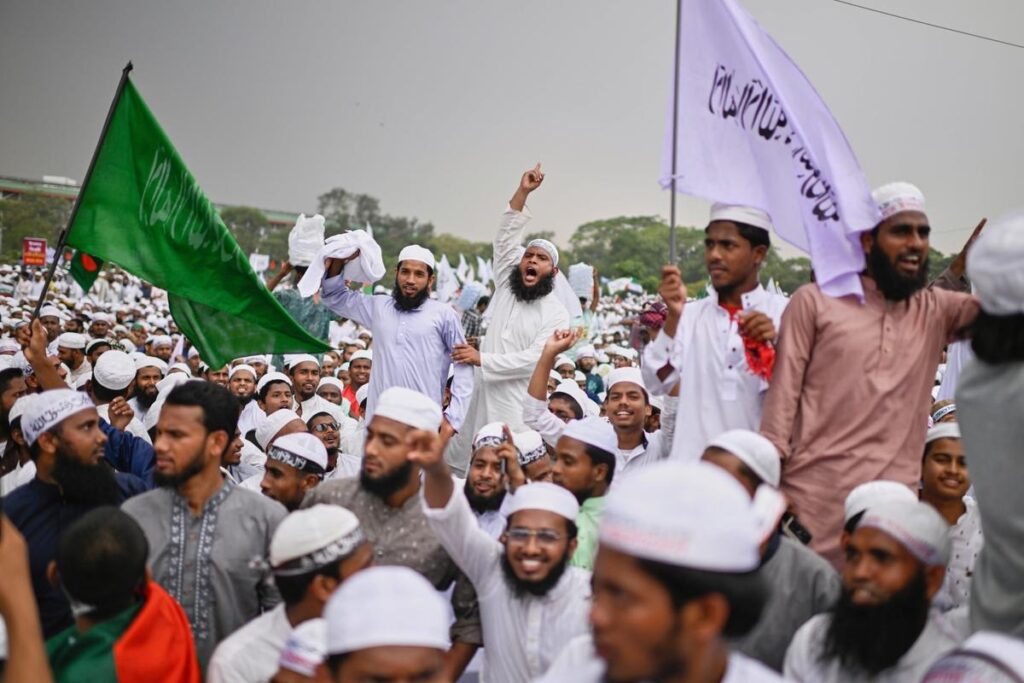
Unlike Khelafat Majlis, Hefazat-e-Islam is not a political party but an Islamist organisation, drawing on the same ideology and traditions like Khelafat. A coalition of more than 25,000 Qawmi madrasas across Bangladesh, Hefazat emerged in 2010 as a reaction to Awami League government’s Women Development Policy (2009) draft giving women equal inheritance rights. In 2013, Hefazat held a massive rally by blocking roads, commerce and regular activities. Known as the Shapla Chattar siege in Dhaka, Hefazat presented its 13-point demands that included introduction of blasphemy laws, gender segregation in public, declaring Ahmadiyyas as non-Muslims, and curbing every un-Islamic activity, to state a few.

Following Jamaat’s decline in Bangladesh under Awami League’s government, Hefazat’s emergence was seen as the rise of a new radical Islam in Bangladesh and this 2013 siege, a pivotal moment of radical Islamists urban mobilizational efforts directly challenging the secular state authority. Other notable protests are the anti-statue protest of 2017, anti-Modi protest in 2021, the latter turning violent and the death of 17 people. The leaders of Hefazat-e-Islam were meted the same treatment as its ally Khelafat, who provided logistical and ideological support to Hefazat’s programmes.

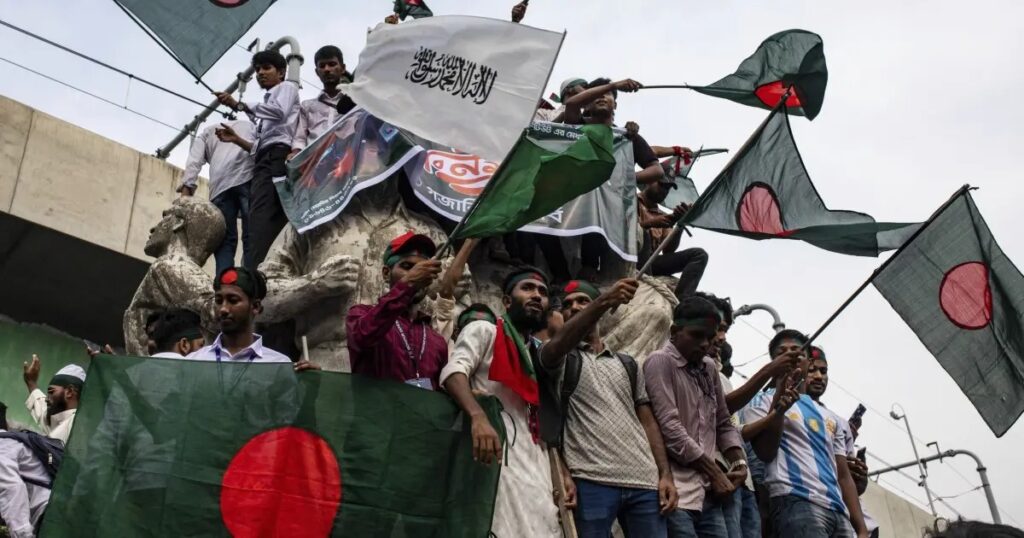
Following the July Uprising and the establishment of an interim government, both Hefazat-e-Islam and Khelafat Majlis regained their position and marked its active presence in the country. Detained leaders, including Hefazat chief were released, seen as part of the interim government’s reconciliation. However, thanks to both, and its allied Islamic parties, Bangladesh has also been witnessing a series of attacks, especially on the freedom of cultural expression.

Towhidi Janata, a loosely organised group of ‘agitated Muslims’ has been notorious to wreak havoc on events like Book Fair, Lalon Fakir Mela, Basant Utsav and women’s football match. Needless to say, Hefazat and Khelafat provide backing to Towhidi that has also been making headlines recently for increasing attacks on shrines, including the exhumation and burning of body of Nurul Pagla. While these Islamic scholars were in Kabul to meet the Taliban, its leaders and activities back home organised street rallies demanding for implementation of the July Charter and declaring Ahmadiyas to be non-Muslims and a Constitutional reform that is based on Sharia.

Khelafat and Hefazat, although not a terrorist organisation, are ideologically extremist whose beliefs go against Bangladesh’s core national principles. The Taliban meeting surely is their symbolic assertion — of Bangladesh’s Islamists envision of Talibanising the country. This meeting with the Taliban also points to a future normalisation of diplomatic relations between Bangladesh and Taliban’s Afghanistan, as the interim government seems to not object to such an informal meeting. A radicalised Bangladesh under the garb of Islamists pose a serious problem for South Asian neighbours, given these factions’ ideological links not just with Taliban, but also with Pakistan. The Global South, therefore, needs to keep an open eye to such ‘harmless’ meetings.

–IANS

Bangladesh set to become launchpad for jihadist expansion across South Asia: Report

World’s most densely populated nation at risk of slide into jihadist chaos

Bangladesh’s ultimate goal of forming an Islamic Revolutionary Army goes beyond internal consolidation and aims to position the country as a strategic outpost for transnational jihadist operations – serving Pakistan’s geopolitical interests and silencing secular voices, a report cited on Wednesday. It mentioned that by forging alliances with Islamist elements and portraying them as “grassroots defenders”, the regime led by Muhammad Yunus seeks to weaken the Bangladesh Army – the last standing national institution capable of resisting radical influence.

“A grave and coordinated conspiracy is unfolding within Bangladesh. Behind the façade of political rhetoric and ‘anti-discrimination’ activism, the regime of Muhammad Yunus has embarked on a project that could ignite the most serious security crisis in South Asia since the rise of the Taliban,” a report in leading Bangladeshi outlet ‘Blitz’ has detailed. Citing multiple sources – including regime insiders, social media disclosures, and intelligence leaks- the report indicated that an Islamic Revolutionary Army (IRA) is being formed to supplant the Bangladesh Army with an ideologically driven militia loyal to Yunus and his Islamist allies.

“This so-called ‘Islamic Revolutionary Army’ is not a mere political stunt or student enthusiasm. It represents a dangerous convergence of radical Islamism, foreign intelligence collusion, and calculated efforts to militarise civilian networks. The consequences, if unchecked, could transform Bangladesh from a moderate Muslim democracy into a launchpad for jihadist expansion across South Asia,” it stressed. According to the report, in a stunning revelation on his social media platform earlier this week, Asif Mahmud Shojib Bhuyain – “an influential as well as controversial” advisor to the Yunus regime – publicly announced the recruitment and training of 8,850 individuals across seven training centres in Bangladesh.

He outlined the programme, stating that trainees would undergo martial arts, judo, taekwondo, and firearms instruction. Hours after the post, the screenshots went viral before disappearing. Citing sources within Dhaka, the report confirmed that this marked only the first phase of a larger plan with five successive batches of 8,850 recruits each set to complete training by January 2026. “The recruitment process reportedly includes written, viva, and physical tests — all overseen by retired Bangladeshi officers with strong pro-Pakistan leanings, alongside covert representatives of Pakistan’s Inter-Services Intelligence (ISI) and Turkey’s Milli İstihbarat Teskilati (MIT),” it highlighted.

“Bangladesh’s civil society, its remaining independent journalists, and the patriotic factions within the military must act before it is too late. Once a revolutionary army rooted in ideology replaces a professional army bound by the constitution, Bangladesh will no longer be a sovereign republic – it will be a caliphate in disguise,” the report noted.

–IANS