
-Arun Anand
The idea of reconnecting world’s largest democracy with Central Asia carries deep civilizational resonance. For centuries, merchants, monks, and monarchs traversed the mountain passes of the Hindu Kush and the plains of Bactria, linking the subcontinent to the great cities of Samarkand and Bukhara. Today, that geography survives only in memory. The modern state system — shaped by partition and rivalry — has severed those routes. Despite its significant economic size and cultural reach, India remains effectively walled off from a region with which it shares both history and strategic interests. Persistent hostility with Pakistan, compounded by instability in Afghanistan, has transformed what should be a natural corridor into a geopolitical cul-de-sac.
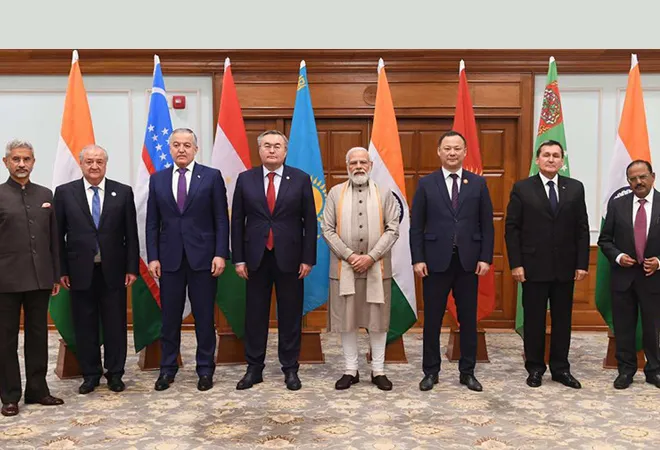
At first glance, the logic of the partnership between India and the five Central Asian republics — Kazakhstan, Kyrgyzstan, Tajikistan, Turkmenistan, and Uzbekistan — appears natural. Central Asia is rich in hydrocarbons, uranium, and fertilisers; India needs all three. India, in turn, produces pharmaceuticals, machinery, textiles, and IT services that the Central Asian economies cannot supply in sufficient quantity. On paper, the relationship should be mutually reinforcing: resources for technology, raw materials for finished goods. In reality, the commercial relationship remains stubbornly modest. India’s total trade with the region barely exceeds $2 billion, representing less than half a per cent of New Delhi’s global trade. The promise exists, but geography and politics have denied it substance.
A Geography of Constraint
The principle obstacle is physical access. India shares no direct border with Central Asia, and its only practical land route passes through China or Pakistan and Afghanistan. Although India’s Himalayan frontier intersects the wider region leading toward Central Asia on the Chinese side, there is currently no usable or politically open land corridor that would allow India direct access through China. Beijing has developed Xinjiang as its own controlled gateway to Central Asia under the Belt and Road Initiative, and granting India transit would undermine China’s strategic advantage in the region.
The Aksai Chin area, where old trade routes once connected Ladakh with Xinjiang, is not feasible today because India still claims the territory while China exercises firm control over it. This ongoing dispute, combined with tense political relations, effectively eliminates any prospect of a functional route through that region.
Meanwhile, Pakistan does not permit Indian cargo to transit through its territory, effectively cutting India off from its northern neighbourhood. Shipments that could travel just over a thousand kilometres instead traverse over five thousand kilometres via Iran and the Caspian Sea. Freight costs through these alternative corridors are estimated to be thirty to forty per cent higher, and delivery times often double. Initiatives such as the development of Iran’s Chabahar Port, the International North–South Transport Corridor (INSTC), and India’s accession to the Ashgabat Agreement in 2018 are important diplomatic signals, but they cannot erase the structural disadvantage of distance.
The economic consequences are measurable. Research by the Institute of Economic Growth suggests that if India had unimpeded access through Pakistan and Afghanistan, trade volumes with Central Asia could be five to ten times higher. The trade potential index — a model that estimates potential trade based on distance and GDP — ranks trade through a direct route from 10 to 15, but with detours through Iran or China, it collapses to just two or three. In concrete terms, the difference between potential and actual trade represents billions of dollars lost annually. India’s exports to Uzbekistan, for instance, are dominated by pharmaceuticals, worth approximately $167 million, as well as machinery and medical equipment. With a viable corridor, those numbers could multiply several times over. Similarly, trade with Turkmenistanstands at a mere $41 million, and with Tajikistan at around $42 million, figures that remain absurdly low for economies of this size and proximity.
The unrealised potential is most visible in the energy sector. The Turkmenistan–Afghanistan–Pakistan–India (TAPI) gas pipeline, once hailed as a flagship of regional integration, was expected to transport 33 billion cubic metres of gas annually to India’s northern markets. Three decades since its conception, it remains unfinished — a monument to regional distrust. A volatile security situation in Afghanistan and the lack of political trust between India and Pakistan has frozen the route, causing Turkmenistan to turn east instead, supplying gas to China through operational and conflict-free pipelines.
China’s ability to move swiftly within the same geography has reshaped regional alignments. Between 2018 and 2023, Chineses trade with Central Asia increased from $40 billion to almost $70 billion, while India’s trade remained stagnant at around $2 billion. The gap is not only one of resources or ambition, but of connectivity. Beijing built the infrastructure — via the Belt and Road Initiative and Central Asia–China gas pipelines —to become the region’s immediate investor and transporter. India remains a distant but friendly partner with limited physical reach.
Diplomatic Pressure Without Strategic Depth
This asymmetry also constrains India’s diplomatic posture. Within multilateral platforms like the Shanghai Cooperation Organisation, where both India and Pakistan sit alongside the five republics, New Delhi’s political bandwidth is often consumed by managing its rivalry with Islamabad rather than cultivating deeper partnerships. Central Asian states — cautious by necessity — avoid choosing sides. For countries like Kazakhstan or Uzbekistan, alienating China or Pakistan is riskier than neglecting India. The result is polite stagnation: strong communiqués but limited implementation.
The gap between potential and reality is evident across sectors. India is among the world’s leading suppliers of affordable medicines; its generics already dominate parts of the Uzbek and Tajik markets. Demand for Indian pharmaceuticals, engineering goods, and educational services could expand tenfold with better logistics. Thousands of Central Asian students study in Indian universities, mostly in medicine and technology but the number could be much higher with cheaper travel. Meanwhile, Central Asia could supply India with oil, gas, uranium, and potash at competitive rates. Since 2015, Kazakhstan has supplied over 5,000 metric tons of uranium to India under a long-term contract, demonstrating that where connectivity exists, cooperation flourishes.
Defense partnerships demonstrate a similar paradox. India has established defense agreements with Kazakhstan and Uzbekistan, and maintains working groups on security cooperation. Yet exercises and exchanges require circuitous routing through Iran or Russia, making sustained engagement slow and costly.
For Central Asian republics, strategic balancing remains paramount. India’s trade potential, educational capacity, and restrained diplomacy are appreciated. But economic and infrastructural dependence lean toward China, Russia, and — via the China-Pakistan Economic Corridor — increasingly Pakistan. Access to the Arabian Sea through Gwadar offers what India cannot: a functional maritime outlet. While New Delhi’s initiatives on digital technology, renewables, and training are well-received, they occupy a secondary layer in the regional hierarchy of partnerships. The Delhi Declaration of 2022, issued at the first India–Central Asia Summit, captured this reality diplomatically, calling for “peaceful resolution of regional conflicts” as a prerequisite for deeper connectivity — a clear reference to South Asia’s unresolved instability.
Time magnifies the challenge. Every additional border and detour not only raises costs but slows delivery. Studies on the INSTC and trans-Iran routes suggest that while these alternatives can reduce transit time by roughly 30–40 per centcompared to traditional Suez-based sea routes, shipments to Central Asia still take several weeks. For example, multimodal services from western India to hubs like Tashkent typically take between two to three weeks, depending on the route and the reliability due to political, security, and infrastructural uncertainties of links via Iran and the Caspian. By the time Indian goods arrive, Chinese or Turkish goods often already stock regional markets. Counter-terrorism and narcotics control cooperation are similarly constrained. While drug trafficking and cross-border extremist movements originating in Afghanistan are a shared concern, yet India’s participation in joint monitoring or training is limited to symbolic exchanges.
Can New Delhi Pursue a Continental Vision While Secluded?
India has responded to a lack of connectivity with creative alternatives. While New Delhi invests in Chabahar and deepens the INSTC through building links through Iran and Azerbaijan, it has also sought to create “digital corridors.” Through tele-education, tele-medicine, and e-governance initiatives, India has found a way to bypass connectivity issues. These initiatives matter, however they cannot substitute for the movement of goods, energy, or large-scale infrastructure. Without even minimal technical dialogue with Pakistan on transit, India’s northern horizon remains closed. Periodic crises — whether the 2019 Pulwama attack, the 2025 Pahalgam incident, or renewed ceasefire violations — only reinforce the perception that South Asia is too volatile to serve as a transit route. For investors and logistics firms, that perception translates into risk premiums and missed contracts.
The strategic price is as much in influence as it is in dollars. Central Asia could have served as India’s strategic depth in the continental balance with China; instead, it is increasingly becoming Beijing’s economic backyard. Each year of inaction entrenches new dependencies that India will struggle to unwind. The contest is not simply about pipelines and trade routes but about whose narrative of connectivity will define Eurasia in the twenty-first century. Ultimately, the struggle is about which great power will set the rules, select the partners, and shape the strategic direction of Eurasian connectivity in the twenty-first century. Connectivity is therefore not merely about infrastructure or trade; it is a vehicle for influence, trust, shared norms, and the broader balance of power across Eurasia. The contest, in essence, is about who will shape the region’s future order as much as about how goods move across it.
A Frontier of Lost Opportunity
India’s exclusion is not dictated by nature but constructed by politics. The Himalayas are real barriers; the Indian-Pakistan border is a chosen one. If even partial normalization were achieved, the geometry of Eurasian trade could shift dramatically. Containers that now take a month to travel from Kandla to Tashkent could arrive in under two weeks. Energy pipelines could flow south. Educational and digital exchanges could scale. Central Asia would gain further diversification beyond China and Russia; India would gain continental reach.
Until that possibility emerges, India’s engagement with Central Asia will remain an exercise in compensating for geography. Trade volumes will remain small, corridors incomplete, and partnerships largely declaratory. Central Asia will continue to view India as a friendly presence in diplomatic forums but an absent partner in markets and infrastructure. The cost of that absence is borne not only by India but by Central Asia itself, deprived of balance and competition.
History offers a quiet irony: lands once united by commerce, culture, and movement are now divided by modern borders. The enduring hostility between India and Pakistan has frozen not only their bilateral future but also the regional one. The numbers are unambiguous: trade that could be ten times larger, routes twice as fast, and energy networks capable of transforming economies all remain unrealized. Until the politics of hostility yield to the pragmatism of connectivity, Central Asia will remain a frontier of lost opportunity — a neighbor that India can see on every map, but cannot yet reach.