
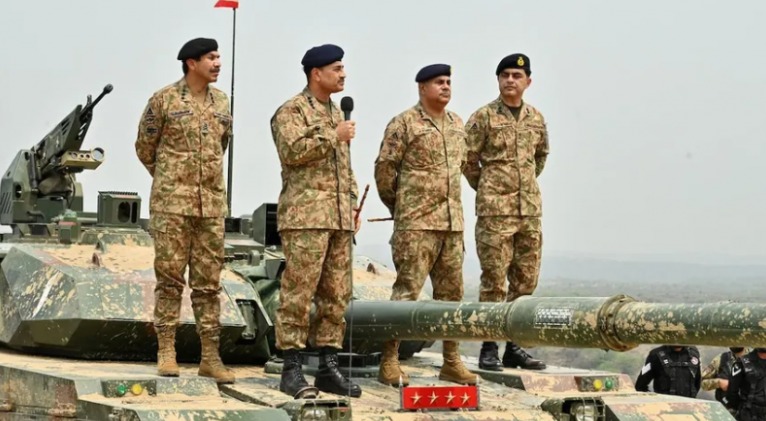
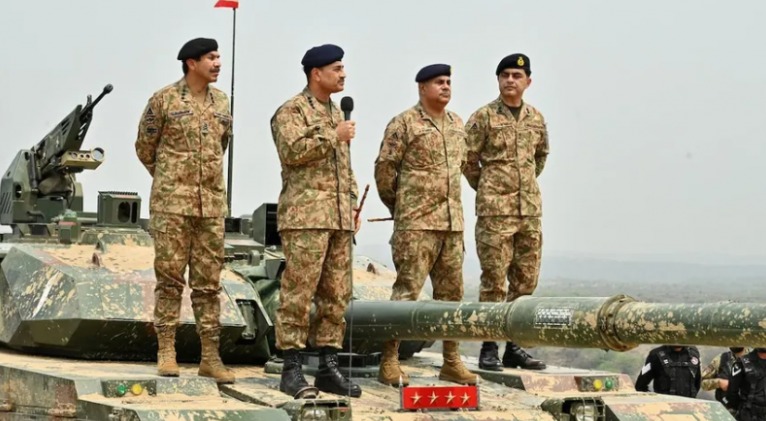
Strategic analysts say recent public statements by leaders linked to militant organisations in Pakistan point to a worrisome blurring of lines between the state and extremist groups, potentially reshaping the country’s security and foreign policy dynamics. Independent observers note that comments by well‑known militant clerics and figures suggest a shift in how Pakistan’s military establishment engages with both domestic proxies and foreign policy objectives—a development with implications for regional stability.
The debate was sparked after a senior cleric associated with a Pakistan‑linked militant ecosystem publicly praised the country’s military leadership and suggested alignment with national interests if regional demands were not met. Commentators say such public endorsements, historically rare, point to growing open synergy between certain militant factions and state actors, rather than covert cooperation that has defined past decades.
Analysts say Pakistan’s security establishment has long been accused of tolerating or even nurturing militant organisations for strategic purposes, including past conflicts in Afghanistan and Kashmir. Historically, groups like Lashkar‑e‑Toiba and Jaish‑e‑Mohammad have operated in ways aligned with Islamabad’s objectives, especially during times of regional tension. Critics argue that such relationships enabled irregular warfare strategies without clear accountability.
What is significant, experts point out, is not simply the existence of ties between militant networks and state elements, but the manner in which public rhetoric and symbolic endorsements are now entering mainstream discourse. By appearing to endorse top military leadership and make geopolitical demands through statements outside formal diplomatic channels, militant figures are perceived to be conveying a message that extremists enjoy tacit acceptance and may be deployed as instruments of influence.
Observers say these developments come at a time of heightened tension in South Asia, with Pakistan’s relationships with neighbouring countries — particularly Afghanistan and India — already strained by diplomatic and security disputes. Analysts warn that any apparent legitimisation of militant voices could complicate efforts at conflict resolution, cross‑border cooperation and counter‑terrorism initiatives, undermining official diplomatic engagement.
Concerns also extend to how such trends might affect Pakistan’s internal political environment. Critics argue that the increased visibility of extremist rhetoric could erode civilian authority and empower non‑state actors at a time when governance and democratic processes face significant challenges. Militant endorsement of state leaders could reinforce narratives that sideline institutional checks and balances, making it harder to pursue long‑term security reforms.
Pakistani military and government officials have not formally confirmed any change in policy regarding militant groups, often reiterating that security measures are focused on legitimate threats and national interests. However, analysts say the public prominence of militant voices cannot be separated from broader strategic calculations, noting that such dynamics reflect deeper issues in how Pakistan manages external threats, internal security and geopolitical relationships.
As regional powers watch these developments closely, diplomats and security experts emphasise the importance of transparent counter‑terrorism policies, strengthened institutional governance and renewed diplomatic engagement to prevent extremist actors from gaining undue influence over national policy.
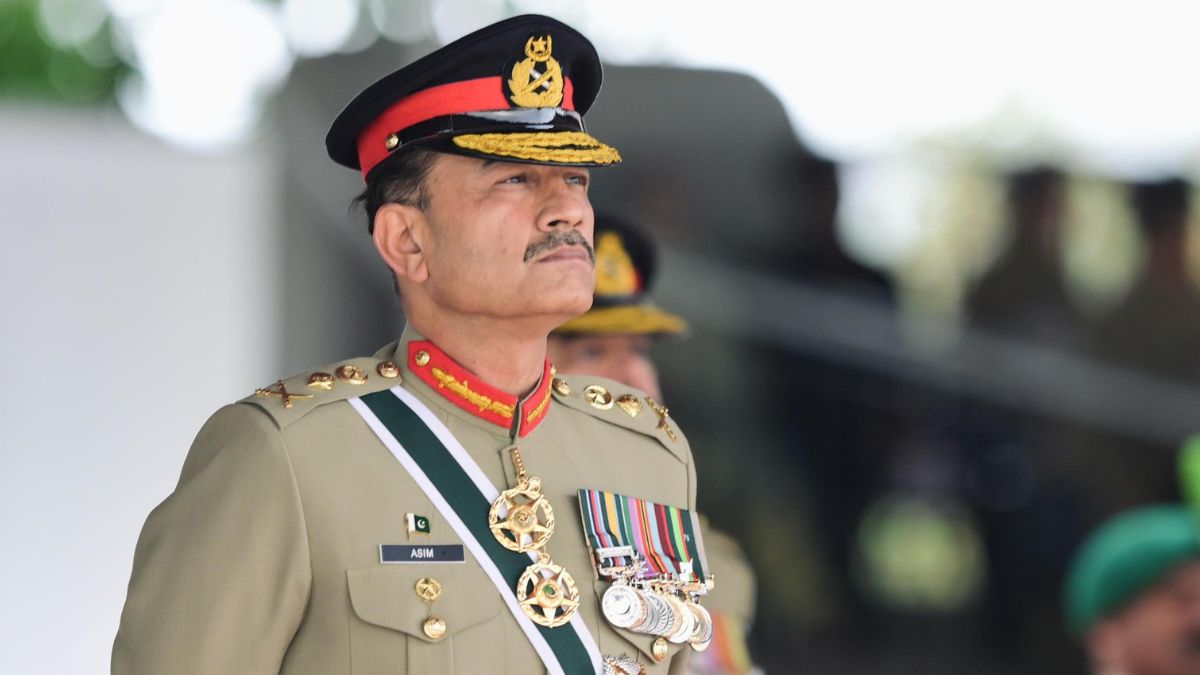
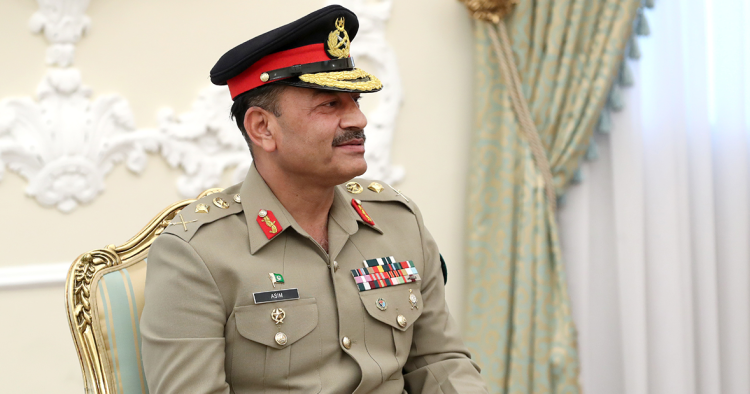
Pakistan’s military under Field Marshal Asim Munir has drawn widespread attention both domestically and internationally amid what analysts describe as an assertive doctrine of power consolidation that some commentators liken to the controversial “Thick Face, Black Heart” ethos — a philosophy emphasizing relentless ambition and emotional detachment in pursuit of strategic goals.
Asim Munir, elevated to the rare rank of Field Marshal and now serving as Pakistan’s top military leader with expanded authority across all branches of the armed forces, has increasingly been portrayed as the central figure in the country’s power matrix. This perception follows a series of constitutional, policy and institutional shifts that have strengthened the military’s role in governance and national decision‑making while civilian authority appears weakened in practice.
Analysts say the “Thick Face, Black Heart” description — originally a controversial management/philosophy concept suggesting ruthless focus on one’s own objectives — has been applied by observers to illustrate how Pakistan’s military leadership under Munir navigates political opposition, dissent and strategic competition with little regard for conventional political constraints or public criticism. Supporters of this view argue that it reflects a pragmatic effort to stabilise a deeply fractured nation; critics warn that it risks undermining democratic norms and civil liberties.
Under Munir’s command, Pakistan’s military has expanded its influence beyond core security functions into economic, legal and political domains. Constitutional changes adopted in recent months have formalised the military’s institutional reach and provided legal protections for its leadership, raising concerns among human rights advocates, religious scholars and political opponents about accountability and the balance of power. Critics argue that such measures create a near‑imperial position for the army chief, insulated from civilian oversight or judicial review.
The assertiveness of Munir’s leadership is reflected in the military’s public posture on key national issues, including counterterrorism operations, foreign relations, and domestic order. Statements from the armed forces emphasise national unity against external threats while framing internal dissent as destabilising “digital terrorism,” a term used by military officials to describe what they see as coordinated efforts to erode public confidence in the army.
Within Pakistan, reactions to Munir’s approach are sharply divided. Supporters within the establishment credit him with restoring stability after years of political volatility and with guiding the country through complex regional security challenges. They point to the army’s increased public approval and recent strategic achievements as evidence of effective leadership.
At the same time, political figures and civil society voices remain highly critical. Some legislators and religious leaders have publicly questioned the unaccountable powers granted to the military leadership, arguing they exceed constitutional norms and contradict the principles of democratic governance. A noticeable rift has also emerged with segments of the religious establishment that oppose lifetime legal immunity and other protections afforded to Munir under recent constitutional amendments — labeling such privileges as both legally and ethically indefensible.
Beyond internal politics, Pakistan’s strategic posture under Munir remains assertive. Military statements emphasise readiness to respond decisively to any perceived threats, reinforcing Islamabad’s hardline stance on longstanding tensions with neighbouring states and militant groups. This has coincided with broader defence cooperation agreements with regional partners, efforts to expand military exports, and high‑level engagements with international counterparts.
Observers say this blend of strategic assertiveness and political control suggests a doctrine in which military priorities — and the personalities driving them — play a defining role in setting Pakistan’s national agenda. Whether this model will produce long‑term stability or deepen democratic deficits in a nuclear‑armed nation facing significant economic, social and geopolitical challenges remains a key question for analysts watching developments in South Asia.