
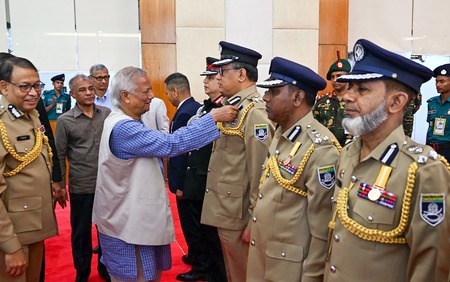
Bangladesh today stands on the brink of an unprecedented national catastrophe. Under the guise of reform and accountability, the pro-Islamist regime of Muhammad Yunus has begun dismantling the nation’s most vital institutions – the Armed Forces and the Directorate General of Forces Intelligence (DGFI). What appears to be a judicial process is, in reality, a political purge aimed at replacing the patriotic guardians of Bangladesh’s sovereignty with a militant, ideologically driven “Islamic Revolutionary Army”. In doing so, the Yunus regime risks transforming Bangladesh from a moderate Muslim democracy into a jihadist state – a South Asian version of Iran or Afghanistan.
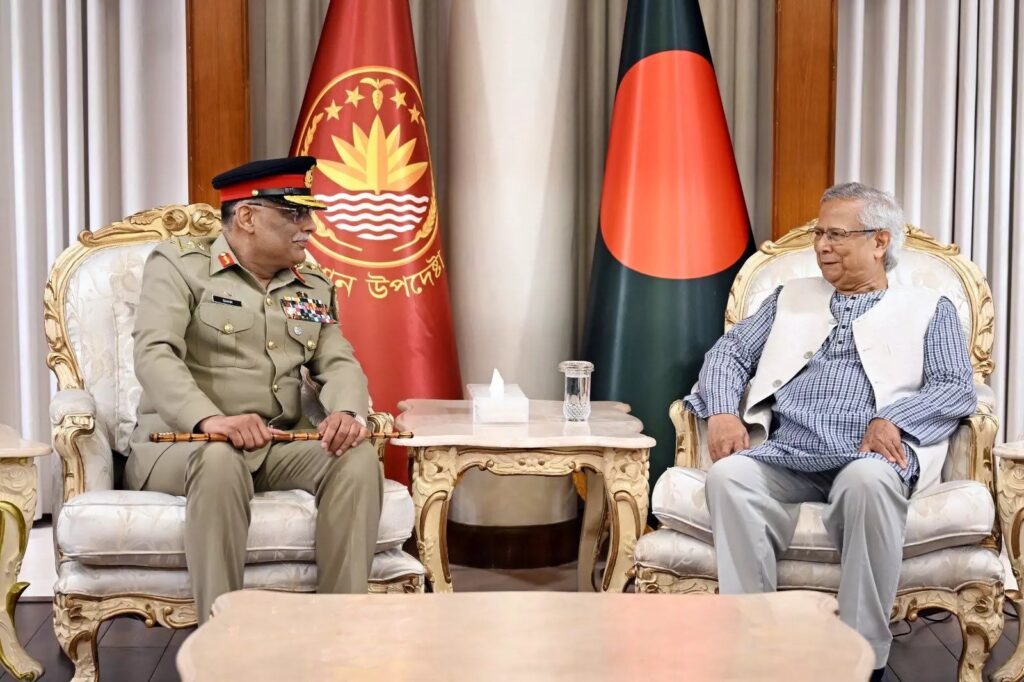
As anticipated, the regime in Dhaka, led by Muhammad Yunus has begun implementing its blueprint to create an Islamic Revolutionary Army (IRA) by disbanding the Bangladesh Armed Forces and the country’s primary intelligence agency, the Directorate General of Forces Intelligence (DGFI).
According to credible media reports, investigators have submitted a chargesheet against 11 army officers, including eight Generals, accusing them of committing “crimes against humanity” – offences carrying the death penalty. The charge sheet also names former Prime Minister Sheikh Hasina as the principal accused. Simultaneously, the regime has launched legal measures to permanently outlaw the Awami League, Bangladesh’s oldest and largest political party, in a move clearly engineered to eliminate any chance of an inclusive national election, which Yunus intends to stage in February 2026 under his absolute control.
The accused listed in the chargesheet include: former Prime Minister Sheikh Hasina, former National Security Advisor Tarique Ahmed Siddique, former DGFI Director General Lt. Gen. (retd) Mohammad Akbar Hossain, former DG Major General (retd) Saiful Abedin, Lt. Gen. (retd) Md Saiful Alam, former DG Lt. Gen. Tabrez Shams Chowdhury, former DG Major General (retd) Hamidul Haque, Major General Towhidul Islam, Major General Sarwar Hossain, Major General Kabir Ahmed, Brigadier General Mahbubur Rahman Siddique, Brigadier General Ahmed Tanvir Majhar Siddique, and Lt. Col. (retd) Makhsurul Haque.
Among them, four are currently in active service. However, under the amended International Crimes Tribunal Act, serving officers accused in such cases are suspended from holding official positions, according to Chief Prosecutor Tajul Islam.
The entire case behind this chargesheet accusing senior military officers originates from a dramatized “documentary film” funded by the National Endowment for Democracy (NED) – an organisation that has, for several years, played an active role in defaming the Bangladesh Army and DGFI.
Unfortunately, during this massive propaganda campaign, both institutions failed to mount an effective counter-narrative. Even after Sheikh Hasina’s ouster, when Yunus and his allies intensified their attacks on DGFI — particularly through claims of detentions inside “Aynaghar”, an imaginary facility invented by a NED-funded, overseas-based media outlet – the disinformation continued unchecked. The so-called “documentary” presented fabricated testimonies from alleged victims, serving as the foundation for the current legal onslaught.
Most importantly, the Bangladesh Armed Forces and DGFI had played a crucial role in the 2024 anti-Hasina protests, which ultimately enabled the US Deep State’s regime-change operation to succeed. More than 14 months after Sheikh Hasina’s removal and the installation of the Yunus regime – a transition initially supported by segments of the military – it has become evident that the ultimate goal of Yunus and his foreign backers is to completely dismantle Bangladesh’s Armed Forces and counterterrorism institutions to pave the way for transforming the country into an Islamist Caliphate.
It was earlier reported that Pakistan’s Army Chief General Asim Munir has been orchestrating this plot to dismantle the Bangladesh Army and DGFI, working in concert with key figures of Jamaat-e-Islami, Ansar Al-Islam (the local franchise of Al-Qaeda), and several high-ranking members of the Yunus regime. Although the current chargesheet targets former DGFI chiefs and counterterrorism officials, credible intelligence sources suggest Islamabad’s ultimate goal is to implicate Army Chief General Waker Uz Zaman, accusing him of “enforced disappearances and unlawful detentions”.
Muhammad Yunus and at least two of his close foreign-linked advisors are believed to be quietly assisting this effort, providing legal and diplomatic cover to neutralise Bangladesh’s last line of defence against Islamist expansionism.
Commenting on this alarming development, noted military analyst M A Hossain stated, “This is possibly the first-ever case in any country where top officials of a national intelligence agency have been prosecuted for defending their nation from terrorism. It defies logic. How can a judiciary target its own security defenders in a case clearly masterminded by Pakistan’s military establishment and its local proxies? The next step, inevitably, will be implicating Army Chief General Waker Uz Zaman – the ultimate command authority – to decapitate the Armed Forces entirely”.
Defence expert Damsana Ranadhiran, a special contributor to Bangladesh’s Blitz media outlet, warned: “This legal ambush targetting Bangladeshi Generals will have dire consequences. It will weaken the military’s command structure and open the door for Pakistan-backed officers to take charge. This is a textbook ISI strategy – a blend of legal warfare, psychological manipulation, and political subversion – identical to what Pakistan executed in Afghanistan and Kashmir”.
Ranadhiran further cautioned that Bangladesh’s sovereignty and regional stability are now at stake.
“Bangladesh did not endure the genocide of 1971 only to be subdued again by Pakistan’s puppeteers and Islamist collaborators. If Pakistan’s designs are not countered immediately through diplomatic, military, and legal means, South Asia may descend into chaos – a region overrun by proxy wars, terror networks, and narcotics-driven insurgencies”.
These fabricated charges against senior military officers are designed to discredit and paralyse the Armed Forces, paving the way for Yunus to replace them with a new paramilitary militia modelled after Iran’s Islamic Revolutionary Guard Corps (IRGC). The envisioned Islamic Revolutionary Army (IRA) will be ideologically loyal to the regime rather than to the nation – a hallmark of theocratic authoritarianism.
The motive behind Yunus’s hostility toward the military lies in its potential to resist his project of selling out Bangladesh’s sovereignty for personal and foreign gain. Much like his political idol Hamid Karzai, Yunus seeks to maintain power through foreign patronage rather than public legitimacy.
Analysts estimate his genuine domestic support at no more than five per cent. His crusade against the Awami League, with its 45 million supporters, is part of a larger design to eliminate all political opposition. After banning the Awami League, the regime now aims to suppress smaller parties such as the Jatiya Party and left-leaning groups to cement a one-man rule under the pretext of “national reform”.
Alongside institutional purges, Yunus has unleashed a campaign of terror against journalists, intellectuals, and dissenters. Hundreds have been imprisoned, and at least 266 journalists face fabricated murder charges – making Yunus arguably an even greater oppressor of the press than Turkey’s President Recep Tayyip Erdogan.
Meanwhile, the regime is rapidly replacing the national police with an “Auxiliary Police” modeled on Iran’s morality police. Recruited from Hizb ut-Tahrir, Hefazat-e-Islam, and Ansar Al-Islam, this force enforces Taliban-style dress codes and harasses women in traditional Bengali attire. Reports of hijab-clad patrols intimidating citizens are becoming alarmingly common.
For decades, DGFI played a pivotal role in fighting terrorism and militancy, dismantling insurgent networks, and shutting down foreign-backed terrorist training camps – including those of India’s United Liberation Front of Assam (ULFA). Its success in keeping Bangladesh free of transnational terrorism made it a target of Islamist extremists and the Pakistani ISI, who now see an opportunity for revenge under the Yunus administration.
Since last year’s Jihadist Coup, Bangladesh has been slipping rapidly toward Islamist rule. Top jihadists – including Ansar Al-Islam leader Jashimuddin Rahmani – were released from prison and now allowed to operate freely. Rahmani has publicly vowed to attack secular voices and bloggers, branding them as “enemies of Islam”. Shockingly, the regime has made no effort to re-arrest such fugitives or curb their militant propaganda.
If this trajectory continues unchecked, Bangladesh may soon cease to exist as the secular republic envisioned by the martyrs of 1971. The systematic destruction of the Armed Forces, intelligence services, and democratic institutions is not merely a domestic tragedy – it is a regional security crisis. South Asia cannot afford another failed state governed by zealots and manipulated by Pakistan’s ISI. The international community, especially India and democratic allies, must recognise that defending Bangladesh’s Armed Forces today is equivalent to defending the last line of resistance against the spread of militant Islamism in South Asia. Silence is complicity – and complicity, in this case, could be catastrophic.
–IANS
Pakistan’s geopolitics seem to have reached a full circle with the continuous terror of Tehrik-e-Taliban Pakistan (TTP).Founded in 2007, the TTP is a jihadist militant organisation whose prime target is the Pakistani military. The extremist group envisions creating an Islamic caliphate state based on the Deobandi tradition in Pakistan. Besides, the TTP supported the Taliban’s efforts in Afghanistan. Banned by Pakistan in 2008, TTP is believed to have strong ties with al-Qaeda and Taliban in Afghanistan, and its militant attacks are mostly concentrated in Pakistan’s Federally Administered Tribal Areas (FATA) and Khyber Pakhtunkhwa, bordering Afghanistan.
Following the Taliban’s takeover of Afghanistan in 2021, TTP’s activities resumed, and attacks intensified, adding to Pakistan’s own internal terror attacks. At the same time, Pakistan’s state-sponsored terror groups continue their cross-border terrorism, especially in India. The recent military operation by Pakistan in Khyber Pakhtunkhwa that killed 17 TTP militants disclosed a shocking report: one of the militants killed has been identified as a Bangladeshi national. Bangladesh media reported that the slain militant’s family had no idea of his militant background, who claimed to have moved to Dubai to earn a living. However, as per police intelligence, the Bangladeshi militant moved to Afghanistan.
Pakistani authorities reported to have hounded two or three Bangladeshi militants in their earlier operations, while these men allegedly went to Afghanistan on the pretext of religious work, where they later joined an extremist terrorist organisation. This is, however, not a lone case. In April, a 23-year-old Bangladeshi national, Ahmed Zubair, reported to be a member of Tehreek-e-Taliban, was among the 54 militants killed by Pakistan’s military forces. At least eight Bangladeshi nationals were also reported to have migrated to Afghanistan to join the TTP. The Bangladeshi digital platform also stated that Bangladesh’s own security intelligence remains oblivious to TTP’s outreach in Bangladesh, and if any camps are operating inside the country presently. Again, two individuals—33-year-old Ahmed Faisal and 49-year-old Shamin Mahfuz—were arrested in Bangladesh in July for their alleged TTP links.
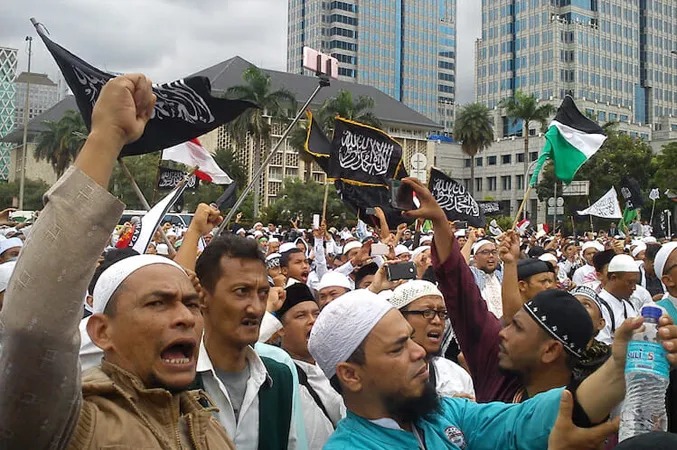
It should be noted that Mahfuz is a former leader of Jamaat-ul-Mujahedeen Bangladesh (JMB), and later founded Jama’atul Ansar Fil Hindal Sharqiya in 2019. Both individuals were also previously detained on multiple terrorism charges. From Faisal’s confession, it came to light that most of these Bangladeshi-national militants have moved to Afghanistan either via Saudi Arabia or via Pakistan to join the TTP. Mostly youth, these militants seek to establish an Islamic caliphate worldwide based on the Sharia. During this arrest, it was also learned that four Bangladeshi nationals who joined the TTP were killed on the Afghan-Pakistan border, while 25 more were preparing to leave Bangladesh to join jihad.
The confession also shed light on one Imran Haider, a senior TTP figure, as being the central figure behind the online indoctrination of Bangladeshi youth to recruit them to the TTP. Around the same time, 36 Bangladeshi nationals were reportedly detained in Malaysia for their alleged involvement in a “radical militant movement”. However, Bangladesh’s home advisor downplayed this and denied their extremist links. Since last year, South Asian geopolitics has gone through an unpredictable arc with the fall of Sheikh Hasina in Bangladesh following the July Uprising. On one hand, the interim government in Bangladesh pivoted to Pakistan, boosting bilateral ties—including trade, education, defence and intelligence sharing, while maintaining a deliberate distance with India, Bangladesh’s oldest and long-standing regional partner.
On the other hand, Bangladesh witnessed a rapid surge of Islamist groups, so long sidelined and suppressed via counterterrorism efforts of the Awami League government. Transnational extremist groups like Hizb-ut Tahrir (banned in 2009) made their presence felt in the country, notably for allegedly organising a procession by students in Dhaka under the banner of ‘Conscious Teachers and Students’, demanding the establishment of an Islamic Caliphate system in Bangladesh in October last year and the ‘March to Khilafat’ rally this March. Muhammad Yunus has also appointed individuals associated with Hizb-ut Tahrir in his interim government, sparking controversy in the political scenario.
Moreover, leaders and associates of groups like Hefazat-e-Islam, Ansarulla Bangla Team and Khelafat Majlis—arrested for their extremist links were also released under the interim government, who have now resumed their hate propaganda, to push for the creation of an Islamic state in Bangladesh based on Sharia law. These developments raise concerns about the resurrection of Islamist extremism in Bangladesh, given its history. Those from Bangladesh joined the Taliban to fight against the Soviet Union in Afghanistan, returned to their homeland in the 1980s and 90s and established extremist organisations, such as Harkat-ul Jihad Al Islami Bangladesh (HuJIB), and Jamaat-ul-Mujahedeen Bangladesh (JMB).
Needless to say, these groups not only had ideological links with the Taliban but also received logistical support and training from al-Qaeda and Pakistan-based Laskhar-e-Taiba (LeT), and their terror operations in Bangladesh were aimed at creating a Taliban-like establishment in the country. While their activities were crippled due to counterterrorism measures by 2007, Bangladesh remained under periodic terror attacks, witnessing a surge from 2013-2016. The political changes in Bangladesh following Hasina’s deposition further strengthen concerns of Islamist extremists’ comeback in the country, as evident from the above-stated reports.
The recent visit of seven Islamic clerics, including the Khelafat Majlis chief and Nayeb-e-Amir (Pir of Madhupur) of Hefazat-e-Islam, to Afghanistan on the invitation of the Taliban should be viewed with the same caution as the rising trend of militancy in Bangladesh. These groups share the same ideological orientation—Deobandi school of Islam—as that of the Taliban and hailed the Taliban takeover of Afghanistan as a “triumph of Islam”. While not extremist groups themselves, these parties’ ideological inclination to the Taliban and their own hardline stance on socio-cultural-political life signal a possible convergence of interests between these organisations and foreign-linked militant ones. Nevertheless, Bangladesh’s Anti-Terrorism Unit’s additional inspector general claims that there is no militant activity in Bangladesh while simultaneously stating that future militant activity cannot be ruled out either. With the election around the corner and Bangladesh’s fragile state of democracy, this rise of militancy in Bangladesh now poses the greatest security risk, not just for Dhaka but also for South Asia as a whole.One can only hope that Bangladesh’s law enforcement forces to deal with militant trends seriously without having to resort to denial. Otherwise, it would not be long before Bangladesh becomes the second Pakistan.
–IANS