
By: Dr. Sreoshi Sinha, Abu Obaidha Arin
The recent conviction of former Prime Minister Sheikh Hasina and UK Member of Parliament Tulip Siddiq in connection with alleged irregularities in RAJUK’s Purbachal New Town plot allocation has raised serious legal and constitutional concerns. Beyond the merits of the allegations themselves, the forum, process, and jurisdiction under which these proceedings have been conducted call into question the very legitimacy of the case.
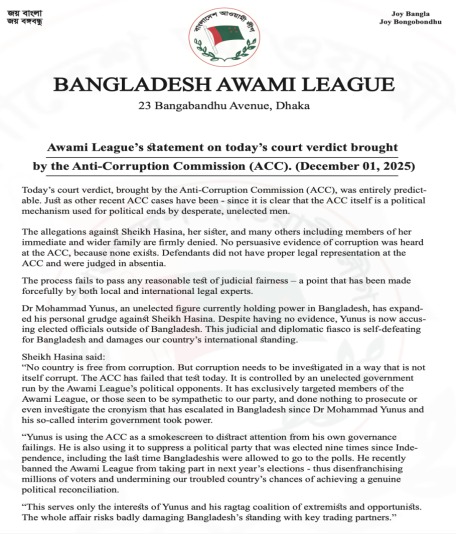
This concern has also been formally articulated in the Bangladesh Awami League’s official statement dated 1 December 2025, which describes the verdict as procedurally flawed, politically motivated, and inconsistent with basic standards of judicial fairness.
1. The foundational problem: the ICT Tribunal has no jurisdiction over land or corruption cases
The International Crimes Tribunal (ICT) of Bangladesh was established under the International Crimes (Tribunals) Act, 1973, with a single, narrowly defined mandate:
to prosecute genocide, crimes against humanity, war crimes, and related international crimes committed during the 1971 Liberation War. This mandate is explicit in both the title and substance of the law.
There is no provision, express or implied, that authorizes the ICT to hear:
Such offenses, even if proven, fall squarely under the jurisdiction of ordinary criminal courts, typically initiated by the Anti-Corruption Commission (ACC) and tried under the Penal Code or Criminal Law Amendment Acts.This question strikes at the core of the rule of law.
2. Forum shopping and the erosion of constitutional safeguards
Trying a domestic corruption or land case before a tribunal designed for war crimes effectively bypasses procedural protections available in regular courts, including:
The Constitution of Bangladesh, under Article 35, guarantees protection in respect of trial and punishment, including due process and lawful jurisdiction. When a specialized tribunal is used beyond its statutory purpose, the trial risks becoming ultra vires, meaning legally void due to lack of authority.
3. Trial in absentia and denial of effective defence
As noted in the Awami League’s statement, the accused were judged in absentia, without meaningful opportunity for defense representation. International legal standards, particularly Article 14 of the International Covenant on Civil and Political Rights (ICCPR), require that an accused be given a real and effective chance to participate in their trial. While trials in absentia are not entirely prohibited, they are permitted only under strict safeguards. In this case:
This is what significantly weakens the credibility of the verdict.
4. Absence of proven personal benefit
Criminal corruption requires proof of personal enrichment or material gain. Publicly available information does not demonstrate that:
At most, the allegations point to a possible administrative irregularity, which under established legal principles belongs in civil or departmental proceedings, not criminal punishment.
5. Selective prosecution and equality before law
RAJUK’s Purbachal project involved thousands of allocations to officials across administrations. Yet prosecution has disproportionately targeted members of a single political family, raising concerns under Article 27 of the Constitution, which guarantees equality before the law. Selective enforcement undermines public confidence and reinforces perceptions of political motivation.
6. Political context and institutional credibility
The Awami League statement highlights that the case emerged after a change in political power, during a period of institutional realignment. Comparative legal studies on post-transition prosecutions show that such cases often risk being perceived as instruments of political consolidation rather than impartial justice.
This perception is amplified when:
The legitimacy of the Purbachal plot case is not undermined merely by political disagreement but by serious legal defects. The most fundamental of these is the misuse of the International Crimes Tribunal, an institution created exclusively to address the gravest crimes of 1971, not domestic land or corruption matters. When jurisdiction is stretched beyond law, when trials occur in absentia, when personal benefit is not demonstrated, and when prosecution appears selective, the issue transcends individual guilt or innocence. It becomes a question of whether the rule of law itself is being upheld.
Accountability is essential in any democracy. But accountability loses meaning when the legal process is perceived as procedurally flawed, jurisdictionally unsound, and politically instrumentalized. In such circumstances, justice is not strengthened; it is weakened.
(Dr Sreoshi Sinha is a Senior Fellow Centre for Joint Warfare Studies (CENJOWS), while Abu Obaidha Arin is a student at the University of Delhi.)