
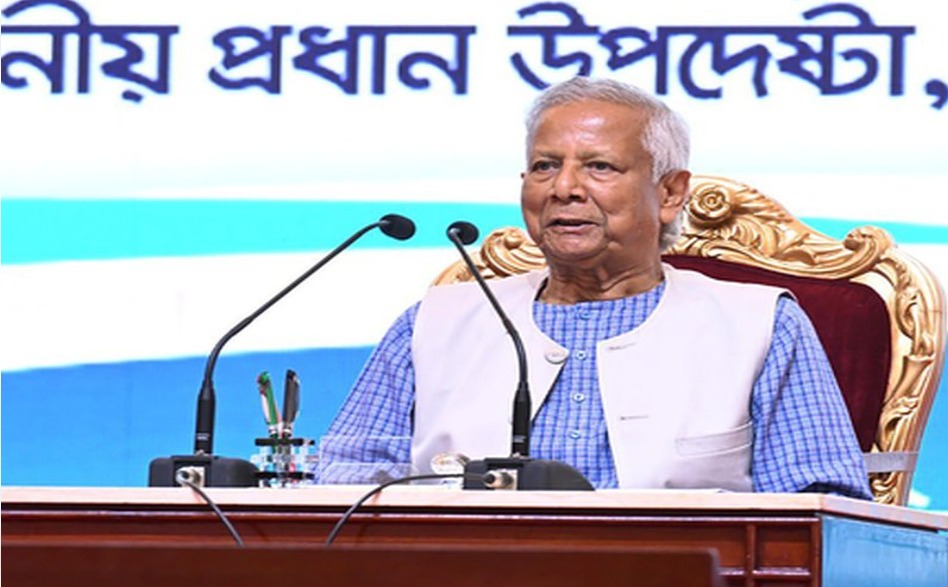
Questions over press freedom in Bangladesh have resurfaced amid allegations that the interim government led by Nobel laureate Muhammad Yunus has failed to ensure an independent and secure environment for journalists, despite pledges of democratic reform.
According to critics and media observers, journalists in Bangladesh continue to face intimidation, legal pressure and harassment, raising concerns that freedom of expression remains constrained under the current administration. The claims suggest that the media environment has not seen the expected improvement following the political transition of 2024.
Journalists and press freedom advocates allege that reporters critical of the government have been subjected to arrests, questioning and legal cases, creating a climate of fear within newsrooms. Several journalists have reported receiving threats, while others say they are increasingly resorting to self-censorship to avoid retaliation. Media organisations argue that the use of legal provisions against journalists has continued under the interim government, undermining assurances that press freedom would be protected during the transition period.
Local journalist bodies have expressed alarm over attacks on media offices and individuals, claiming that insufficient action has been taken against those responsible. They warn that the lack of accountability has emboldened hostile elements and weakened trust in the state’s commitment to protecting journalists. Editors and reporters say the environment for independent journalism has become increasingly hostile, with many fearing for their personal safety while carrying out their professional duties.
The debate over media freedom is unfolding against a backdrop of wider political tension in Bangladesh. Critics of the interim government accuse it of suppressing dissenting voices and narrowing democratic space, particularly as the country prepares for national elections expected in early 2026. Opposition figures and civil society groups argue that restricting media freedom risks undermining the credibility of the electoral process and weakening public confidence in democratic institutions.
The Yunus-led interim government has rejected allegations of press repression, maintaining that it respects freedom of speech and that any legal action against journalists is based on due process rather than political motives. Officials have stated that maintaining law and order and preventing misinformation are key priorities during the transition.
International press freedom and human rights groups have urged Bangladesh’s leadership to strengthen safeguards for journalists, review laws that may be misused to silence criticism, and ensure that media professionals can work without fear or interference. As Bangladesh moves closer to a crucial election year, the state of media freedom is likely to remain under close domestic and international scrutiny, serving as a key measure of the country’s democratic health.
By: Dr. Sreoshi Sinha, Abu Obaidha Arin
The recent conviction of former Prime Minister Sheikh Hasina and UK Member of Parliament Tulip Siddiq in connection with alleged irregularities in RAJUK’s Purbachal New Town plot allocation has raised serious legal and constitutional concerns. Beyond the merits of the allegations themselves, the forum, process, and jurisdiction under which these proceedings have been conducted call into question the very legitimacy of the case.
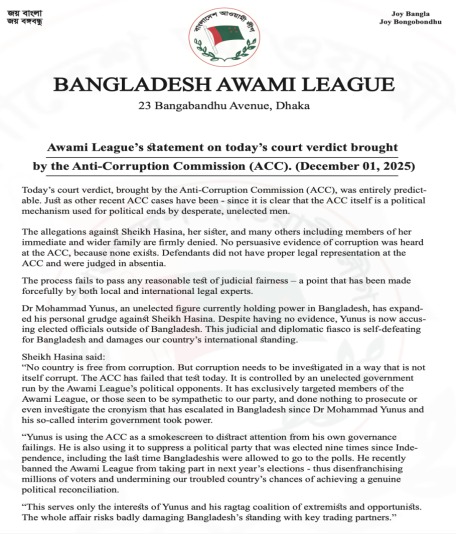
This concern has also been formally articulated in the Bangladesh Awami League’s official statement dated 1 December 2025, which describes the verdict as procedurally flawed, politically motivated, and inconsistent with basic standards of judicial fairness.
1. The foundational problem: the ICT Tribunal has no jurisdiction over land or corruption cases
The International Crimes Tribunal (ICT) of Bangladesh was established under the International Crimes (Tribunals) Act, 1973, with a single, narrowly defined mandate:
to prosecute genocide, crimes against humanity, war crimes, and related international crimes committed during the 1971 Liberation War. This mandate is explicit in both the title and substance of the law.
There is no provision, express or implied, that authorizes the ICT to hear:
Such offenses, even if proven, fall squarely under the jurisdiction of ordinary criminal courts, typically initiated by the Anti-Corruption Commission (ACC) and tried under the Penal Code or Criminal Law Amendment Acts.This question strikes at the core of the rule of law.
2. Forum shopping and the erosion of constitutional safeguards
Trying a domestic corruption or land case before a tribunal designed for war crimes effectively bypasses procedural protections available in regular courts, including:
The Constitution of Bangladesh, under Article 35, guarantees protection in respect of trial and punishment, including due process and lawful jurisdiction. When a specialized tribunal is used beyond its statutory purpose, the trial risks becoming ultra vires, meaning legally void due to lack of authority.
3. Trial in absentia and denial of effective defence
As noted in the Awami League’s statement, the accused were judged in absentia, without meaningful opportunity for defense representation. International legal standards, particularly Article 14 of the International Covenant on Civil and Political Rights (ICCPR), require that an accused be given a real and effective chance to participate in their trial. While trials in absentia are not entirely prohibited, they are permitted only under strict safeguards. In this case:
This is what significantly weakens the credibility of the verdict.
4. Absence of proven personal benefit
Criminal corruption requires proof of personal enrichment or material gain. Publicly available information does not demonstrate that:
At most, the allegations point to a possible administrative irregularity, which under established legal principles belongs in civil or departmental proceedings, not criminal punishment.
5. Selective prosecution and equality before law
RAJUK’s Purbachal project involved thousands of allocations to officials across administrations. Yet prosecution has disproportionately targeted members of a single political family, raising concerns under Article 27 of the Constitution, which guarantees equality before the law. Selective enforcement undermines public confidence and reinforces perceptions of political motivation.
6. Political context and institutional credibility
The Awami League statement highlights that the case emerged after a change in political power, during a period of institutional realignment. Comparative legal studies on post-transition prosecutions show that such cases often risk being perceived as instruments of political consolidation rather than impartial justice.
This perception is amplified when:
The legitimacy of the Purbachal plot case is not undermined merely by political disagreement but by serious legal defects. The most fundamental of these is the misuse of the International Crimes Tribunal, an institution created exclusively to address the gravest crimes of 1971, not domestic land or corruption matters. When jurisdiction is stretched beyond law, when trials occur in absentia, when personal benefit is not demonstrated, and when prosecution appears selective, the issue transcends individual guilt or innocence. It becomes a question of whether the rule of law itself is being upheld.
Accountability is essential in any democracy. But accountability loses meaning when the legal process is perceived as procedurally flawed, jurisdictionally unsound, and politically instrumentalized. In such circumstances, justice is not strengthened; it is weakened.
(Dr Sreoshi Sinha is a Senior Fellow Centre for Joint Warfare Studies (CENJOWS), while Abu Obaidha Arin is a student at the University of Delhi.)
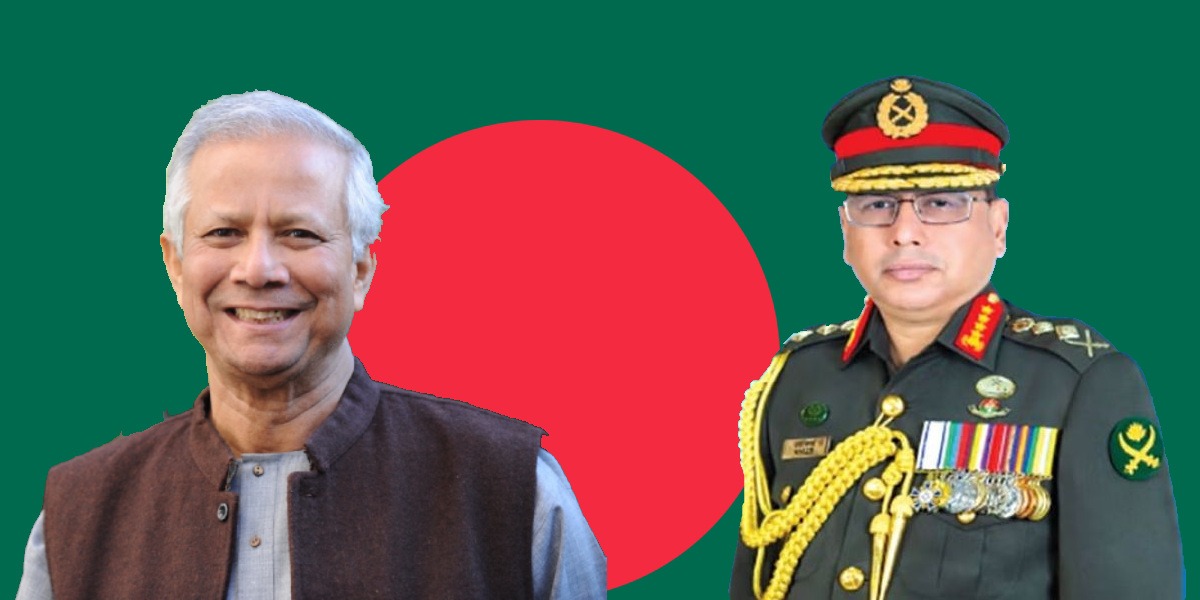
Bangladesh remains in a state of perpetual uncertainty, as reports surface of an escalating rift between the Muhammad Yunus-led Interim Government and the country’s military establishment. Amidst allegations of coup attempts aimed at dislodging Army Chief General Waker-Uz-Zaman from his leadership, the chasm between the two factions has become increasingly conspicuous. Contentious disputes have emerged over critical matters, including the nation’s deteriorating law and order situation and the timeline for forthcoming elections. The Yunus administration, however, exhibits a palpable reluctance to facilitate timely electoral proceedings, thereby fuelling concerns that it might be seeking to prolong its unconstitutional grip on power.
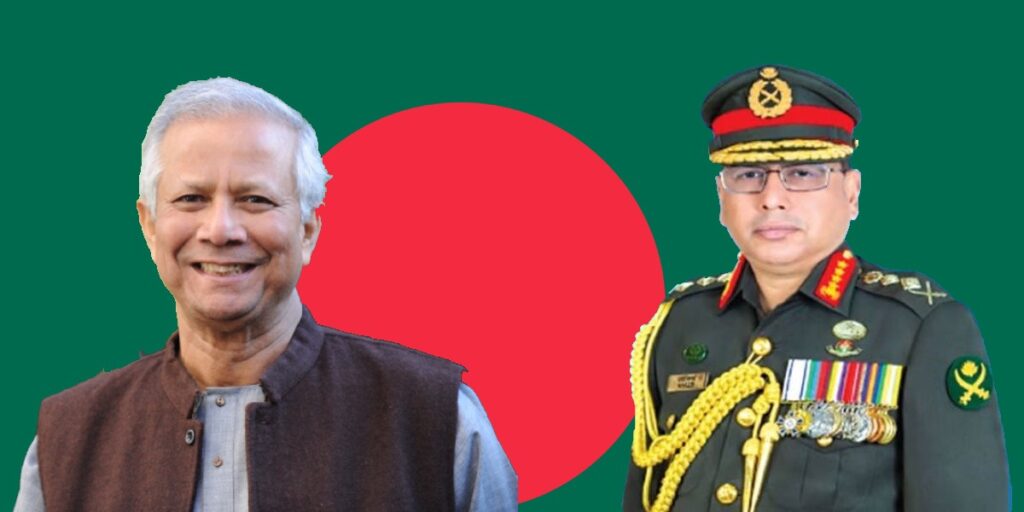
Deepening discord has emerged between the military establishment and the Interim Government, precipitated by the country’s deteriorating security environment and the pervasive political instability aggravated by internecine strife among rival factions. On the law-and-order front, the country has witnessed a sustained wave of arson attacks over the past several months, targeting Awami League leadership and cadre besides minority Hindus. The arsonist mobs, predominantly led by groups aligned with the Students Against Discrimination (SAD) movement and Islamists, have been brazenly targeting even sites of national significance. Among the most egregious incidents was the desecration of Dhanmondi 32, the family residence of the nation’s founding father, Sheikh Mujibur Rahman, which serves as Bangabandhu Memorial Museum. It may be recalled that SAD played a critical role in the anti-government agitation that culminated in the ousting of Sheikh Hasina from power in August 2024, and has ever since maintained strong influence over the governance affairs of the country through the interim administration of Muhammad Yunus, with a number of its members serving as the advisors, that is de facto ministers of the government.
Additionally, as the SAD movement transitioned into formal politics through the establishment of its own political entity, the Jatiya Nagorik Party (JNP), it has been at loggerheads with other political parties such as the Bangladesh Nationalist Party (BNP) over the timeline of the elections and implementation of constitutional reforms in the country. Given its considerable influence within the Interim Government, SAD has persistently advocated for the implementation of constitutional reforms as a precondition for any electoral process. However, the BNP and its allied factions demand the immediate conduct of elections, contending that any institutional reforms should rightfully be the prerogative of a legitimately elected government. In addition, SAD affiliates have violently tackled BNP’s student wing, Jatiotabadi Chatradal, injuring over 150 students in one of the incidents at a Khulna University last month.
Amidst these increasing uncertainties, on his part, the Army Chief has persistently criticized the Interim Government’s incompetence in maintaining law and order and also voiced grave concerns over the surge of Islamist radicalism, cautioning that such developments pose an existential threat to the nation’s stability and territorial integrity. General Zaman issued a grave reprimand to political factions on February 27, warning that their relentless hostilities and factional rivalries could imperil Bangladesh’s hard-won sovereignty. Expressing his frustration with the lingering turmoil of the preceding “seven to eight months,” Zaman cautioned, “If you cannot forget your differences and work together, if you engage in mudslinging and fighting, the independence and sovereignty of this country and nation will be at stake.”
Subsequently, the SAD leadership has increasingly targeted the Army Chief, accusing him of political interference, even threatening anti-military protests across the country. For instance, on March 22, Hasnat Abdullah, SAD convener, claimed that General Zaman was attempting to reintroduce and reinstate Awami League by pushing for the participation of what he called “Refined Awami League,” which would include mostly the second rung leadership of Sheikh Hasina’s party. Hasnat warned that the students’ groups were ready to launch a movement against the military establishment over this kind of “political interference”. Another student leader and an advisor in Yunus administration, Asif Mahmud Bhuiyan, in a video message on March 21, also accused General Zaman of harbouring resentment against Muhammad Yunus by claiming that the Army chief “had reluctantly agreed to appoint” him as the chief adviser of the interim government following the removal of Sheikh Hasina on August 5, 2024.
These provocations assume criticality in light of March 12 revelations that General Zaman thwarted a Pakistan-sponsored and Interim Administration-endorsed intra-Army coup against the military establishment. As per reports, Bangladesh Army’s Quartermaster General (QMG), Lt. Gen. Muhammad Faizur Rahman, a staunch Islamist who is known for his pro-Pakistan Army and Jamat-e-Islami (JeI) proclivities, led the failed coup attempt alongside Principal Staff Officer (PSO) of the Armed Forces Division (AFD), Lt. Gen. S M Kamrul Hassan. Interestingly, both officers have been instrumental in facilitating increased military engagements between the Pakistan Army and their Bangladeshi counterparts, with Lt. Gen. Rahman having recently hosted an Inter-Services Intelligence (ISI) delegation in Dhaka, while Lt. Gen. Hassan led a military delegation to Pakistan merely a month prior. Reports further alleged that Chief Advisor Muhammad Yunus and the SAD leadership acquiesced to the plot to remove General Waker, who has resisted overt Islamisation of the state institutions and has maintained pressure on the transitional government against delaying elections.
Following these provocations, General Zaman, as reports indicate, convened a series of high-level meetings with the Army leadership on March 22 to deliberate on the country’s precarious political and security landscape. Though Army dismissed such conjectures describing these meetings as routine for assessing country’s security situation, these developments raised speculations across Bangladesh’s social media sphere, with widespread conjecture that the military establishment might imminently resort to the imposition of emergency measures to quell the prevailing uncertainty. Some reports even claimed that concurrent to these deliberations, Bangladesh Army even mobilised its Savar-based 9th Division, ostensibly towards Dhaka. Such speculations of Army’s potential resort to extraordinary measures to prevent further destabilization underscores the pervasive fear that these developments could spiral into a broader conflict.
As such, these unfolding events serve as a starkly demonstrate the deepening chasm of mistrust between Gen. Waker-Uz-Zaman-led military establishment and the SAD-dominated Interim Government of Muhammad Yunus. General Zaman’s recent warnings regarding the nation’s deteriorating security environment and the risk of civil unrest suggest a growing sense of urgency within the military ranks. Therefore, as the trust deficit between military establishment and the Interim Government widens, the country faces an increasingly perilous trajectory, with the looming threat of political disarray and a descent into outright anarchy.