
The digital realm was initially envisaged as a great equalizer of knowledge, breaking down barriers of geography, class, and institutional gatekeeping to make huge repositories of information freely accessible to anyone with an internet connection, to empower individuals across the world, to learn, to innovate, and to challenge pre-established narratives on an unprecedented scale. However, what the digital realm has now been turned into is the paramount battlefield of the 21st century, wherein states vie for territory, not just through conventional arms, but dominance over perceptions, narratives, and decision-making. This marks the rise of cognitive warfare, or the strategy that weaponizes information to shape minds, erode trust, and achieve strategic objectives, without even firing a shot.
China has pioneered the approach, as part of its ‘unrestricted warfare’ doctrine, integrating propaganda, disinformation, cyber operations, and psychological manipulation to influence the cognitive environments of its adversaries. People’s Republic of China’s (PRC’s) People’s Liberation Army (PLA) explicitly sees the human brain as the new domain of conflict, aspiring for cognitive dominance, through coordinated campaigns that exploit social media, AI-generated content, and state-affiliated networks.
A stark example of this tactic was recently witnessed early this year, following the U.S. Department of Justice’s release of additional Jeffrey Epstein files. Chinese state-controlled media and affiliated outlets amplify claims that the Dalai Lama was deeply implicated, highlighting mentions of his name over 150 times, often citing emails where Epstein speculated about meetings or events. China Global Television Network, for example, published an article titled, “Dalai Lama’s name appeared at least 169 times in Epstein files. The Office of His Holiness, the Dalai Lama, unequivocally stated that no meeting ever occurred, and no interactions were authorized, and the references were aspirational at best, with no evidence of any connection or wrongdoing. The timing of PRC outlets and narratives on social media is worth noting and emerged immediately after the Dalai Lama’s Grammy Award win. The objective was to tarnish his global moral authority and to undermine Tibetan cultural identity.
The tactic is not new. In 2023, as well, China’s “Pedophile” Smear Campaign tried to tarnish the image of His Holiness. In 2023 again, Global Times tried portraying pre-1959 Tibet as a feudal, slave society under the Dalai Lama’s theocratic rule, accusing him of being a slave owner. In 2021 as well, the Global Times’ white paper reprint, titled “Tibet Since 1951: Liberation, Development and Prosperity, tried showcasing Tibet as ruled by a theocratic, feudal serfdom, that “crushed human dignity, ignored human rights, and impeded development”.
These oft-repeated episodes exemplify how Beijing exploits the digital realm to sow doubt, leveraging platforms, to spread narratives to attempt to portray the Dalai Lama as morally compromised, aligning with China’s long-standing efforts to delegitimize him as a “separatist”.
China’s cognitive warfare against the Dalai Lama is neither isolated nor new. For decades, as seen in the given examples, Beijing has targeted Tibetan exile networks, through cyber-attacks, such as the 2009 GhostNet operation that infiltrated the Dalai Lama’s offices, to ongoing smear campaigns to portray him as a threat to stability. The attempt is to erase Tibetan autonomy in global perceptions, and to manufacture consent for assimilationist policies in Tibet. The tactic now is to flood digital spaces with false scandals, and to diminish his influence among Tibetans and supporters in India and elsewhere.
India also has repeatedly found itself on the receiving end of similar cognitive warfare from China, which gets heightened during recurring border conflicts initiated by China. Just one example out of myriads is from 2020, when, during the Galwan Valley clash, Chinese state-owned media downplayed PLA casualties, and blamed India for provocation, while amplifying calls for boycotts of Indian goods. Beijing has also issued provocative and incorrect geographical maps, come up with names for locations in Arunachal Pradesh, and combined legal warfare with disinformation to try to normalise territorial claims. Cyber intrusions have targeted Indian power grids in Ladakh, Mumbai, and Telangana, and tried to exfiltrate data from India’s ministries, while Chinese-linked networks spread disinformation on social media to exploit domestic fissures. Diaspora communities have also been targeted to sow discord.
Taiwan stands as perhaps the most intensively targeted recipient of China’s cognitive warfare laboratory. Bots, fake accounts, and pro-unification propaganda are difficult to miss in Taiwan, and tactics also include spreading rumours about candidates contesting elections and portraying unification as inevitable and beneficial for Taiwan. The ways in which China targets candidates contesting elections in Taiwan are similar to its smear campaigns against the Dalai Lama; while the ways in which China tries to dampen military morale in Taiwan are similar to its objectives vis-à-vis India. What China also attempts in democracies is to co-opt media, to self-censor on topics that China considers sensitive- such as Tibet or the Dalai Lama, and this illustrates how cognitive operations interact with hybrid coercion.
Other countries, such as Australia, also face parallel threats. Chinese-linked networks have tried to interfere in referendums and elections. In 2025, for example, Beijing appeared to support Labor’s re-election through subtle online campaigns on platforms popular among Chinese Australians, such as WeChat and RedNote (Xiaohongshu); and these included resurfacing old misleading narratives about politicians’ stances on China-related issues, potentially enhanced by generative AI for translated videos or fabricated endorsements. The Philippines and Vietnam also encounter maritime dispute focussed disinformation, and all these examples reveal a pattern that China deploys in its cognitive warfare- to weaken the cohesion of adversaries, to isolate them diplomatically, and to prepare the ground for coercion or conflict.
Ignoring the digital battleground risks ceding strategic advantage in an era where victory is based on the control of cognition, and not just on the conquest of land. As the attempt to link the Dalai Lama to Epstein shows, Beijing’s operations are highly adaptive, opportunistic, and relentless. Communities and countries at the receiving end of China’s cognitive warfare have to prepare their defences in advance, while unifying countermeasures to safeguard open societies.
-Arun Anand
Myanmar (formerly Burma) sits at a critical crossroads in Asia, both geographically and geopolitically. The country’s location – bordering China, India, Bangladesh, Thailand, and Laos, with a long coastline on the Bay of Bengal and Andaman Sea – makes it a bridge between South Asia and Southeast Asia. In fact, Myanmar is often described as the “main connecting hub” linking East, South, and Southeast Asia. Its shores provide access to the Indian Ocean’s major shipping lanes, which has long attracted great power interest. In short, Myanmar’s geostrategic location grants it outsized importance: it is the only Southeast Asian nation sharing borders with both India and China, and it offers a land gateway from the Bay of Bengal into the heart of Asia.
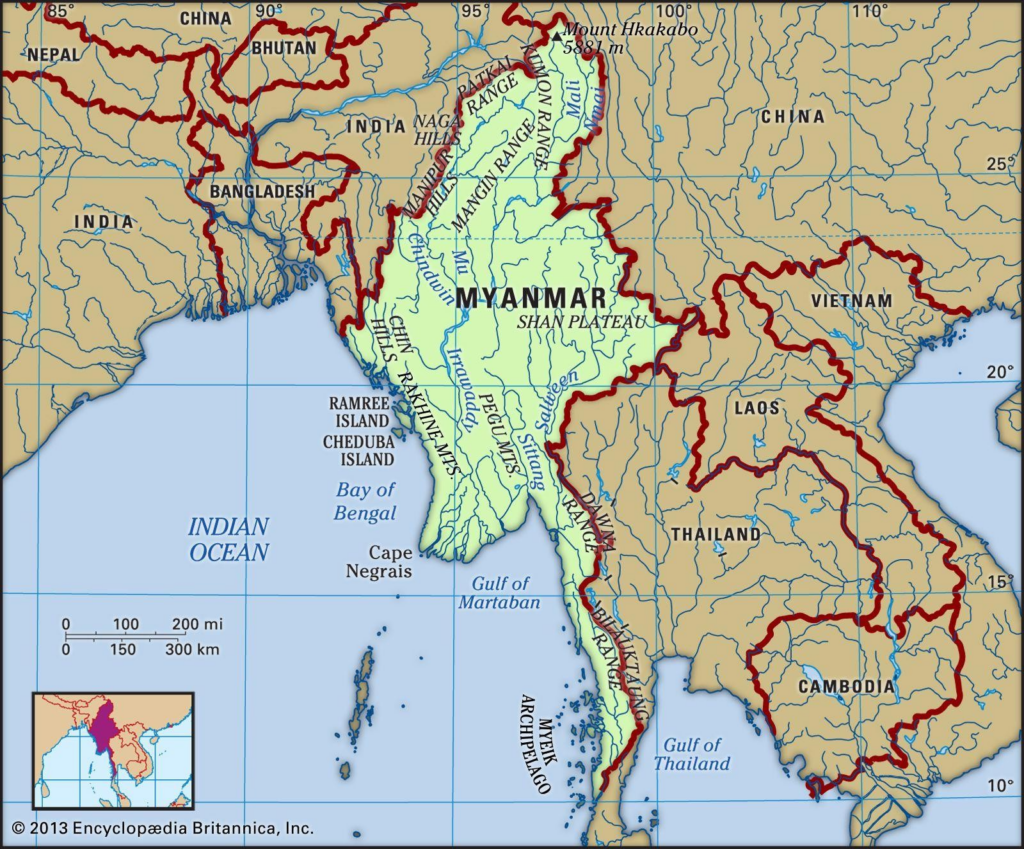
Myanmar Geographical Location
Strategic Geographical Importance
Myanmar’s geography confers strategic advantages that neighbouring powers eagerly seek to leverage. To its west lies the Bay of Bengal (part of the Indian Ocean), positioning Myanmar near vital maritime routes between Asia, the Middle East, and Europe. Historically, even a branch of the ancient Silk Road ran from Myanmar’s shores to China’s Yunnan province, underlining its role as a natural corridor. Today, both China and India view Myanmar as pivotal to their regional aspirations.
In summary, Myanmar’s position at the junction of Asia’s sub-regions lends it significant strategic importance. Geography is the reason a country of 55 million people commands so much attention from global and regional powers. Myanmar is effectively a land bridge and a maritime gateway, one that both China and the West recognise as key to influencing the wider region.
China’s Deepening Influence in Myanmar
China has emerged as Myanmar’s most influential foreign player, especially in the past decade. Geopolitically, Beijing views Myanmar as crucial to its own strategic objectives. China’s southwestern provinces are landlocked, and Myanmar offers a coveted route to the sea. Through its ambitious Belt and Road Initiative (BRI), China has invested heavily in Myanmar’s infrastructure – from ports to pipelines – to secure that route. For instance, China helped build a deep-water port at Kyaukpyu in Myanmar’s Rakhine State, which serves as the starting point for twin oil and gas pipelines running north into China’s Yunnan Province. These pipelines, completed in the 2010s, allow China to import Middle Eastern oil and gas via Myanmar, bypassing the Malacca Strait – a narrow maritime chokepoint that China views as a strategic vulnerability. By using Myanmar as an overland energy corridor, Beijing reduces its dependence on long sea voyages through congested or potentially hostile waters.
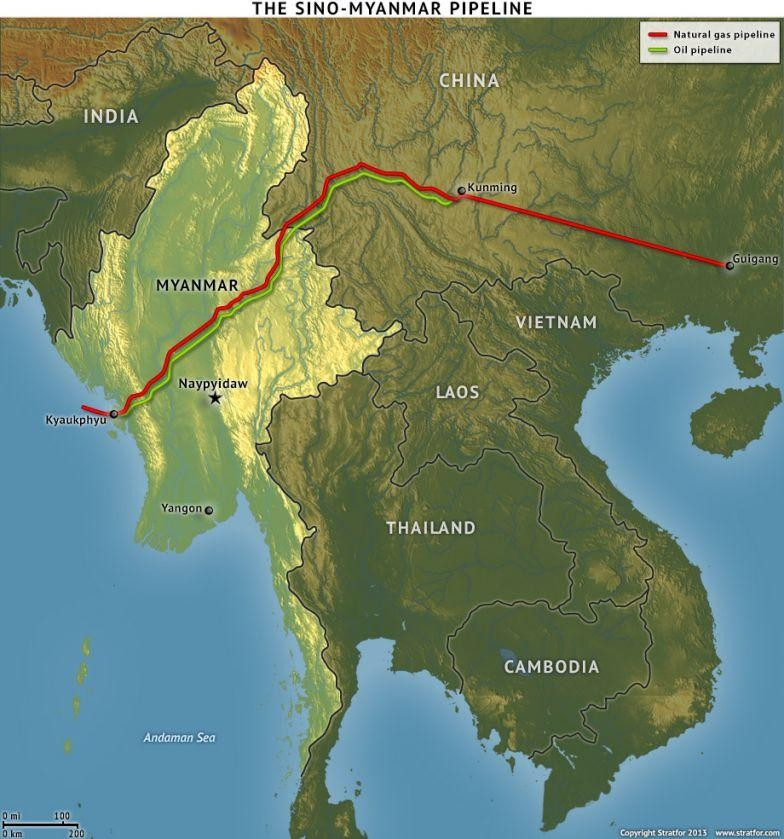
China’s influence in Myanmar extends beyond infrastructure to encompass political and military aspects. During decades when Myanmar was under Western sanctions (due to the former junta’s human rights abuses), China became Myanmar’s closest partner by default. Beijing supplied arms, invested in mining and hydropower, and shielded Myanmar diplomatically at the UN. Even after Myanmar’s brief experiment with democracy, China maintained strong ties with the powerful military (the Tatmadaw). Notably, when the Myanmar army seized power in the February 2021 coup, China reacted with cautious support. Beijing pointedly referred to the coup as a “major reshuffle”, downplaying the overthrow of elected leaders. It continued business as usual – providing weapons to the junta and pushing to continue BRI infrastructure projects – even as much of the world condemned the coup. At the same time, China hedged its bets: it never formally endorsed the military regime and, for a long while, did not allow Myanmar’s coup leader, Senior General Min Aung Hlaing, an official state visit to China. (Beijing even curiously allowed Myanmar’s ousted civilian ambassador to continue occupying Myanmar’s seat at the United Nations, signalling that China hadn’t completely written off the previous government.) This reflected China’s pragmatic approach – engaging the junta to protect its interests, but not fully legitimising it internationally.
However, as Myanmar’s post-coup conflict ground on, China’s stance evolved. By late 2022 and 2023, Myanmar’s internal war was intensifying: ethnic armed groups and new pro- democracy militias were seizing territory, even threatening areas near China’s border. Beijing grew increasingly concerned that Myanmar could descend into chaos – jeopardizing Chinese investments and creating instability on China’s southwestern flank. China’s frustration with Gen. Min Aung Hlaing also mounted, as the junta’s offensives failed to restore order and even hindered Chinese projects (for example, fighting in border regions and a boom in criminal networks there became a headache for Beijing). Fearing a potential collapse of the Myanmar military regime, China decided to double down in support. In late 2023 and 2024, Beijing took a series of assertive steps: it dispatched high-level envoys (including Foreign Minister Wang Yi) to meet the junta, pledged full backing for the junta’s planned 2025 election, and reportedly even helped bolster the Myanmar military’s capabilities (for instance, supplying drone technology). Chinese officials also leaned on various ethnic rebel groups – many of which have enjoyed Chinese cross-border ties – to pause their assaults and cut deals with the military. In November 2023, General Min Aung Hlaing was finally invited to Beijing, signaling China’s renewed embrace of the embattled regime.
It might seem ironic that China, a one-party state, is encouraging Myanmar’s generals to hold an election. But Beijing’s motive is not to foster democracy; rather, China hopes a managed election could “dilute [Min Aung Hlaing’s] power” or produce a more stable, cooperative leadership in Naypyidaw. Analysts note that China dislikes Min Aung Hlaing personally (viewing him as unpredictable and ineffective), so it sees an election as a way to legitimize the junta under fresh faces that might be more amenable to Chinese interests. In other words, China wants a stable partner in Myanmar – it cares less about who wins an election (certainly not pushing for Aung San Suu Kyi’s return, for example) than about ensuring Myanmar doesn’t align with the West or descend into anarchy.
Today, China is arguably the Myanmar junta’s most important patron. It provides economic lifelines (such as trade, investment, and energy revenue) and international cover (for instance, China has vetoed or softened UN resolutions critical of Myanmar). In return, Beijing gains considerable leverage: ongoing access to Myanmar’s resources (like jade, gas, and timber) and strategic infrastructure. If the military regime survives – especially with Beijing’s help – China stands to solidify a “strategic toehold” extending to the Indian Ocean. A friendly Myanmar could host more Chinese projects (such as ports, railways, or even listening posts) that project Chinese influence into South Asia and maritime Asia. This prospect alarms Western strategists, as it would extend China’s reach in a region long dominated by India and watched by the U.S.
In summary, China’s influence in Myanmar is at an all-time high: it has deftly positioned itself as the junta’s indispensable ally, all while framing its involvement as respect for Myanmar’s “sovereignty and stability.”
Western Interests and Involvement
Western nations, notably the United States and its European allies have a significantly different history with Myanmar. During the long years of military dictatorship (from 1962 up until the early 2010s), the West largely treated Myanmar as a pariah state due to its human rights abuses and suppression of democracy. The U.S. and EU imposed tough sanctions for decades, isolating Myanmar’s generals. There was a brief thaw in the 2010s when Myanmar’s military initiated political reforms: the release of Aung San Suu Kyi, elections in 2015, and a quasi-civilian government. At that time, Washington and European capitals rolled back many sanctions and engaged Myanmar with aid and diplomacy, hoping to nurture its transition to democracy – and perhaps to loosen China’s grip by bringing Myanmar into a more liberal, rules-based fold. President Barack Obama even visited Myanmar twice, a symbolic end to its isolation.
That hopeful period did not last. Western relations crashed back down after two events: first, the Myanmar army’s brutal crackdown on the Rohingya Muslim minority in 2017 (which the U.N. later described as “genocidal”), and then the February 2021 coup that ousted the elected government. In response to the coup, the U.S., EU, UK, Canada, Australia and others swiftly re-imposed sanctions on Myanmar’s junta. Within 10 days of the coup, Washington announced a new sanctions regime targeting the generals. Over the next three years, the U.S. piled on nearly 20 rounds of sanctions, hitting top military leaders, their business conglomerates, state- owned oil and gas enterprises (a key revenue source for the regime), and arms brokers. The European Union and Britain similarly enacted multiple waves of asset freezes and travel bans, coordinating to pressure the junta. The intent of these sanctions has been to economically squeeze the military and signal that its illegitimate power grab has severe consequences. Western countries also cut off most development aid and urged foreign companies to divest from Myanmar.
These punitive measures, however, have had limited success in changing the junta’s behaviour. One issue is that Myanmar’s generals are not completely isolated they can still turn to supportive neighbours and great powers to offset Western pressure. China and Russia have provided diplomatic cover (for example, vetoing UN Security Council actions) and continue to trade arms and resources with Myanmar. Neighbouring countries like Thailand and India have also maintained ties with the regime out of pragmatic self-interest. This means Western sanctions, while impactful, cannot totally choke the junta’s lifelines. As one analysis noted, the “junta is far from friendless”: Beijing remains Myanmar’s biggest investor and trade partner, Moscow its arms supplier, and regional governments often prefer engagement over isolation. Hence the generals have (so far) weathered Western sanctions, declaring that they can “handle” international pressure and continuing their brutal crackdowns regardless. Western policymakers themselves acknowledge that, absent more unified global action, sanctions alone are unlikely to force Myanmar’s military to reverse course. Nonetheless, the U.S. and EU see sanctions as a necessary moral stance and a way to deny resources that fuel the junta’s repression (for example, trying to block aviation fuel to hinder the military’s frequent airstrikes on civilian areas).
Strategically, the United States views Myanmar through the lens of its Indo-Pacific competition with China. A Myanmar firmly under Chinese influence (or hosting Chinese bases) would be a setback for the U.S.’s broader regional aims. Thus, even as Washington condemns the coup and human rights abuses, it is also mindful that losing Myanmar entirely to China would harm U.S. interests in the long run. American analysts have warned that if the West remains hands- off, Myanmar could “fall into a protracted state of conflict and fragmentation, supported and dominated by China.” In other words, inaction might cede Myanmar to Beijing’s orbit. This strategic concern is pushing the U.S. to explore creative ways to engage or influence the situation, short of direct military intervention. The U.S. has ramped up humanitarian aid to Myanmar’s refugees and border communities, voiced support for the democratic opposition (the exiled National Unity Government, or NUG), and worked with ASEAN neighbors to push for a peace process. Western countries have also refused to recognize the junta’s planned election, and they continue to call for an inclusive dialogue that involves Suu Kyi and all parties, a call the junta has flatly rejected.
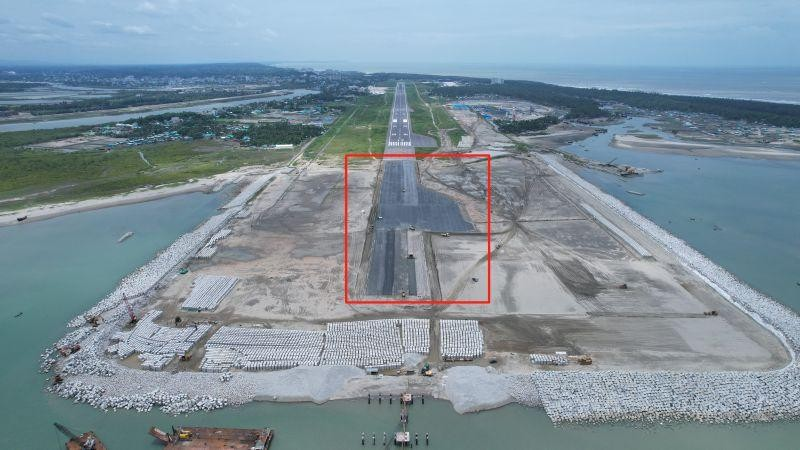
One of the more clandestine efforts attributed to the U.S. and its partners involves Myanmar’s western border. Bangladesh, which shares a border with Myanmar’s tumultuous Rakhine State, has been drawn into the crisis primarily due to the Rohingya refugee exodus. Recently, there has been talk of establishing a “humanitarian corridor” from Bangladesh into Myanmar – ostensibly to deliver aid and possibly facilitate the return of Rohingya refugees. However, reports suggest this corridor concept may double as a channel for Western-aligned support to anti-junta forces. In 2025, investigative reports indicated that the U.S. was quietly working with Bangladesh’s security forces on a plan to support Myanmar’s ethnic rebels in Rakhine State. Under this reported plan, Bangladesh’s army would provide logistical support (but not direct combat troops) to a coalition of anti-junta fighters, including the Arakan Army (an ethnic Rakhine force opposing the Myanmar military). A large supply depot was allegedly being built near Teknaf (Bangladesh’s southern tip) to funnel provisions across the border, effectively
creating a U.S.-backed lifeline into Myanmar. The expansion of Cox’s Bazar airport in Bangladesh was said to be part of this strategy – with the runway extended to accommodate drones, possibly Turkish-made UAVs, that could assist the rebels in Rakhine. All of this was to be done under the guise of an “aid corridor,” separating it from overt military intervention. In fact, Bangladeshi and U.S. officials discussed using the corridor for humanitarian goals, such as returning around 80,000 Rohingya refugees to their homes in Rakhine if the area could be secured by the rebel coalition. On the surface, it sounds like a humanitarian mission – but clearly it has strategic underpinnings, essentially a proxy effort to weaken Myanmar’s junta from the western front.
This so-called Rakhine corridor plan demonstrates the lengths to which Western actors might go to alter the situation in Myanmar without direct intervention. It also puts Bangladesh in a delicate spot: Dhaka is wary of being caught in a great-power proxy war on its border, even as it is under pressure to help resolve the Rohingya crisis. Bangladesh’s government initially gave mixed signals about the corridor, publicly entertaining the idea in early 2025, then voicing caution about being drawn into Myanmar’s civil war. The situation is evolving, but it underscores that Western intervention in Myanmar is no longer limited to speeches and sanctions – there are active efforts to forge new pressure points against the junta, even if under humanitarian auspices. The United States’ overarching goal is to check the Myanmar military’s excesses and prevent China from completely dominating the outcome. Unlike China’s overt state-to- state support of the junta, Western support for Myanmar’s opposition is more covert and framed around democracy and human rights. Nonetheless, both superpowers are now deeply entangled in Myanmar’s crisis, each backing different sides – a classic proxy dynamic that Myanmar’s people ultimately have to bear.
A Turbulent Election and Its Impact
Amid this geopolitical tug-of-war, Myanmar’s internal situation remains explosive, and it is about to reach another critical juncture: a planned national election. The military junta has promised to hold a general election to cement its rule – the first such poll since it grabbed power in 2021. Originally the generals hinted at an election by 2023, but escalating conflict forced repeated delays. As of early 2025, Senior General Min Aung Hlaing extended the country’s state of emergency yet again (citing “security” needs) and indicated an election would occur once “stability and peace” are restored. Observers now expect the junta to attempt a nationwide vote in late 2025. The regime has been feverishly preparing for this faux-democratic exercise: it conducted a census in late 2024 to update voter rolls (an effort that met fierce resistance and violence in rebel-held areas), and it has enacted strict rules to micromanage the election.
However, few believe that what the military calls an election will be anything more than a sham. All credible opposition has been effectively excluded. The junta has dissolved dozens of political parties – including Aung San Suu Kyi’s National League for Democracy (NLD), which overwhelmingly won the last real elections in 2015 and 2020. (In those 2020 polls, the NLD won 82% of the contested seats, a landslide that the generals refused to accept. The military’s justification for the coup was unproven allegations of voter fraud by the NLD.) Suu Kyi herself remains in prison with 33-year sentence, alongside many of her party’s leaders. Independent media is muzzled, and pro- democracy activists are in hiding or exile.
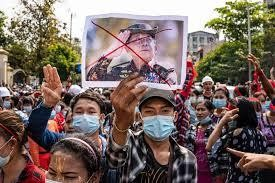
In essence, the junta is arranging an election where the playing field is utterly one-sided – likely handing victory to the military’s proxy party (the USDP) or a slate of military-approved candidates. For Myanmar’s many opposition groups, this vote is nothing but a ploy: “merely an attempt to legitimise the illegitimate regime” that seized power by force. As one spokesperson for the NUG (the opposition government) put it bluntly, “The election will be a sham, it will just be for show.” The military hopes that installing a civilian façade through a controlled election might ease international pressure or domestic dissent. But most Myanmar people are not buying it – and neither are Western governments, which have already declared any junta-run polls to be void of legitimacy.
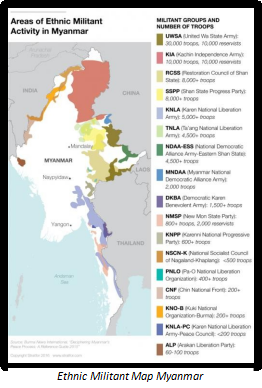
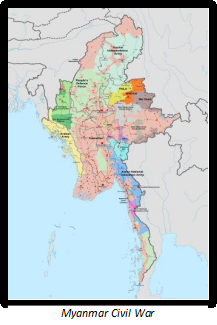
The practical realities on the ground make a free or fair nationwide election impossible at present. Myanmar is in the throes of a civil war; large swathes of the country are not under military control. By the regime’s own admission, voting might be feasible in less than half of Myanmar’s townships. (Some estimates say the junta securely controls only 17% of all village tracts in the country – the rest are contested or held by resistance forces.) In many ethnic minority regions, powerful armies like the Kachin, Karen, and Rakhine’s Arakan Army not only oppose the junta but govern their areas de facto. These groups, along with the NUG’s People’s Defense Forces (PDF militias) across the country, have vowed to disrupt any junta-run election. They see it as a rubber stamp for military rule and have threatened to attack polling stations or convoys. Tragically, this means any election attempt will likely be accompanied by violence and intimidation – and indeed, we have already seen signs of that. During the junta’s census-taking in late 2024 (a dry-run for the voter list), resistance fighters ambushed census workers guarded by soldiers, killing several. The atmosphere is one of fear and defiance; many citizens have said they will boycott the polls if they occur. As one activist observed, it is a “bizarre exercise” to talk of voting while the country is literally at war with itself.
Far from bringing peace, a sham election risks inflaming Myanmar’s conflict even further. The NUG and ethnic rebels have made it clear that they will not recognize the results. Any regime that emerges from this vote will lack credibility in the eyes of a majority of the population, potentially fueling even more resistance. “This election will not lead to stability. It will lead to more instability and more violence,” warned the NUG spokesperson Zaw Kyaw. Unfortunately, that is a very plausible outcome: the act of voting could become yet another flashpoint for clashes, and a new “elected” government dominated by the military might entrench the divide, convincing the opposition that only armed revolution will bring change. In essence, the polls could slam the door on any negotiated solution, hardening the resolve of anti-junta forces to topple the regime by force. Already, since the coup, Myanmar’s conflict has reached “unprecedented” intensity – by 2024 the military was losing territory and seeing record defections. If the junta uses an election to declare itself legitimate, the opposition is likely to double down on the fighting.
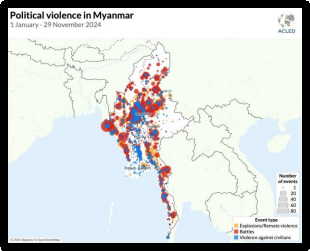
The international response to the planned election is also telling. China, despite having no love for democracy, is paradoxically pushing the junta to hold the vote – but for its own ends. Beijing hopes a new government (even a rigged one) might sideline the obstinate Min Aung Hlaing and install more competent leadership that can stabilize the country (and get Chinese projects back on track). In contrast, Western nations and Myanmar’s neighbors in ASEAN largely view the timing of this election as counterproductive. In January 2025, ASEAN – which usually avoids commenting on members’ internal affairs – urged the junta to prioritize peace over elections, implicitly warning that a vote amid civil war would only make things worse. Western officials have already labeled the planned polls a “sham” and promised to reject the outcome, reinforcing that sanctions will remain or even tighten if the junta proceeds. Thus, rather than opening a path to normalization, the junta’s election could deepen its international isolation (at least with the West), while giving China and a few others an excuse to continue engaging Myanmar on their terms.
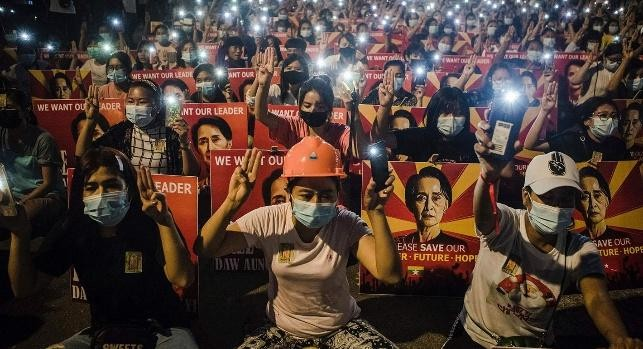
For the people of Myanmar, the immediate impact of these “polls” is unfortunately dire. Many citizens feel disenfranchised – their votes and voices effectively meaningless if the process is fixed. Pro-military factions might use the campaign period to stoke ultranationalism or hatred against minorities (as has happened in past elections), worsening social fractures. Violence is expected to spike around election activities, which could displace even more civilians or result in harsh crackdowns in urban areas. Humanitarian needs – already enormous, with over 3 million internally displaced and half the population in poverty may grow as instability spreads. An illegitimate election also postpones any hope of genuine dialogue between the military and opposition groups, meaning Myanmar’s humanitarian and economic crises will likely grind on.
Outlook: A Nation Caught in Contest
Myanmar’s predicament today is the result of converging pressures: a power-hungry military clinging to control, a determined popular resistance, and competing external powers each trying to secure their interests. The country’s geostrategic position ensures that what happens in Myanmar reverberates beyond its borders – drawing in China’s ambitions, India’s security concerns, Bangladesh’s refugee burdens, ASEAN’s stability worries, and the U.S.’s democratic ideals and Indo-Pacific strategy. This once-isolated nation has become a stage for 21st-century great power rivalry as much as for a people’s struggle for freedom.
In the near term, all eyes are on the junta’s planned election and its aftermath. A forced election could mark a new phase of turbulence. If the military regime manages to hold onto power through brute force and a staged vote, Myanmar may settle into a grim status quo: a fragmented country under a sanctioned dictatorship, increasingly reliant on China and Russia for economic survival and military hardware. Beijing, in that scenario, would likely deepen its footprint –securing its projects and perhaps even gaining a strategic ally on the Bay of Bengal, which would extend China’s influence toward the Indian Ocean in a significant way. Such an outcome would strengthen China’s hand in the region, albeit at the cost of Myanmar’s sovereignty being heavily constrained by Chinese interests. Western countries would probably continue a policy of isolation and pressure, leaving Myanmar largely cut off from global markets and institutions (apart from those aligned with China). The Myanmar people would remain caught in the middle – suffering repression at home and deprived of full engagement with the world.
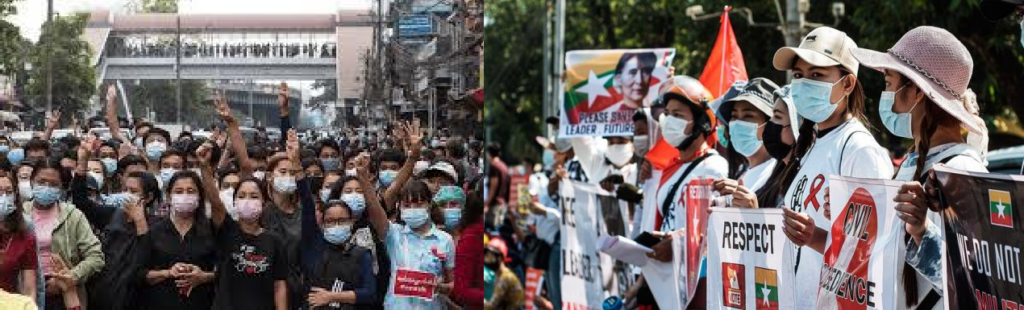
On the other hand, if resistance forces continue to chip away at the military’s control – as they have since 2021 – Myanmar could see a gradual power shift on the ground. Some analysts even suggest the regime’s hold is weakening to the point that a collapse is conceivable if momentum sustains. In that case, the post-election period might bring even more upheaval as the junta struggles to govern and insurgents move in. It’s a dangerous vacuum that could intensify humanitarian suffering, but it might also create openings for a negotiated solution if international mediators step up. The role of outside powers will remain pivotal: China could broker truces (as it did briefly on the China-Myanmar border in late 2023 or conversely ramp up support to prevent its favored side from losing. The U.S. and regional players might increase backing to the opposition in hopes of forcing the military to the table. Bangladesh and India will be carefully watching Rakhine and the north, respectively, to prevent spillover of violence. ASEAN might eventually push harder on its peace plan, especially if the election proves obviously futile in resolving the crisis.
In any scenario, it’s clear that Myanmar’s fate is of global consequence. For the average Myanmar citizen, these geopolitical games mean little if they cannot attain peace and the right to choose their leaders. The promise of Myanmar’s geostrategic potential – as a thriving crossroads of trade between India, China, and ASEAN – will remain unrealized until the political turmoil is resolved. A stable, democratic Myanmar could indeed be a linchpin of regional connectivity and development, benefiting all players. But as of now, that vision is distant. Instead, the country is embattled and divided, a place where outside powers deliver aid or arms to their preferred side while an elected leader languishes in jail. Myanmar is a nation with a prized location and many powerful suitors, yet it is tormented by internal strife and power struggles. China’s influence is strong and growing, as it stakes a claim to a strategic corridor through Myanmar to the Indian Ocean. The United States and Western allies, not wanting Myanmar to become a Chinese client state, are trying to intervene via sanctions and subtle support to the opposition – even exploring bold moves like a Bangladesh- Myanmar aid corridor. And amid all this, Myanmar’s military is pressing ahead with an election that almost no one believes is real, hoping it can entrench itself in power. The likely impact of these polls is not peace, but more conflict – at least in the short term – because the fundamental political disputes in Myanmar remain unresolved.
For now, Myanmar’s people face an uncertain future: will their country remain a pawn in a geopolitical chess match, or can it regain its sovereignty and unity on their terms? The coming year, with its turbulent “election” and international maneuvers, may provide some answers. What is certain is that Myanmar’s geostrategic importance guarantees the world will be watching closely – and both East and West will continue vying for influence – as this drama unfolds. The hope among many Myanmar citizens and friends abroad is that eventually a genuine political solution will emerge, so that this strategically located nation can escape its cycle of turmoil and realize its potential as a prosperous crossroads, rather than a battleground for proxy wars and power plays.
Sources:
-Arun Anand
For over four decades, Pakistan bet its security strategy on one idea: that Afghanistan could be controlled and turned into a “strategic depth” against India. The military and political elite in Islamabad treated Kabul as a buffer and a playground — a state to be manipulated through compliant regimes and proxy jihadist groups.
Militant networks were nurtured as instruments of foreign policy, and Pakistan believed this would secure influence across the region and check India’s power. Instead, the very forces Islamabad once empowered have turned against it. In 2025, the grand doctrine of strategic depth lies in ruins — a self-inflicted disaster now driving Pakistan’s worst security crisis in years.
Rather than securing Pakistan, Afghanistan has become the epicentre of the very dangers Islamabad once believed it could manage or manipulate. What was once perceived as an asset has now become a trap. The transformation of Afghanistan from strategic depth to strategic liability has unfolded gradually, but the past two years have made the shift undeniable.
When the Taliban returned to power in Kabul in 2021, Pakistan was widely seen as the external actor poised to benefit the most. Many within Islamabad believed that a Taliban government, because of historical ties, would be cooperative, deferential, and dependent. But that assumption now looks dangerously misplaced.
The Taliban’s political priorities have changed, their sources of external support have diversified, and their internal legitimacy depends on projecting a strong, independent stance — especially against Pakistan, which many ordinary Afghans still view with suspicion. Instead of shaping Afghan behaviour, Pakistan now finds itself confronting a volatile neighbour whose rulers no longer feel obliged to accommodate Pakistani interests.
Militant Blowback and a Hardening Border
Nowhere is this reversal clearer than in the surge of militant activity targeting Pakistan from Afghan soil. Over the past year, Pakistan has experienced a marked increase in terrorist attacks carried out by the Tehreek-i-Taliban Pakistan (TTP) and associated networks. Security reports from 2024 and 2025 indicated that many attackers either crossed over from Afghanistan or were trained and sheltered there.
Pakistani officials have repeatedly stated that a significant percentage of suicide bombers involved in major attacks were Afghan nationals. The data, while varying between sources, consistently shows a dangerous trend that the Afghanistan-Pakistan border has become increasingly porous to extremist infiltration, and many of these groups feel emboldened by their close ideological ties to the Afghan Taliban.
This is the central irony of Pakistan’s predicament. The militant ecosystem that Islamabad once supported for regional leverage has now splintered in ways that work against Pakistan itself. The TTP, originally an offshoot of groups nurtured under earlier Afghan policies, now treats Pakistan as its primary enemy.
Pakistan’s own creation has turned against its creator. The militancy that Islamabad once believed could be contained beyond its borders has now penetrated deep inside — striking security convoys, police units, and civilian targets with growing regularity. The blowback is undeniable.
In response, Pakistan has increasingly resorted to military actions along — and across — the Afghan border. Throughout 2024 and into 2025, Pakistan conducted a series of cross-border artillery strikes and air raids targeting what it described as TTP safe havens. In several cases, those strikes hit areas inside Afghanistan, killing not only militants but also civilians, including women and children. These incidents have sharply escalated diplomatic tensions.
Kabul has issued multiple condemnations, arguing that Pakistan is violating Afghan sovereignty and inflaming anti-Pakistan sentiment among the Afghan population. What Islamabad once framed as necessary counterterror operations are now seen by many Afghans as external aggression, deepening hostility that already runs high.
Border clashes have also intensified. In late 2024 and through out 2025, firefights between Pakistani forces and Taliban border units became frequent, sometimes lasting hours. Pakistani officials reported significant casualties on their side, and Afghan authorities claimed similar losses.
The AfPak border — once envisioned as a controllable frontier from which Pakistan could extend influence — has hardened into one of the most militarized and unstable fault lines in South Asia. Instead of projecting strength, Pakistan finds itself in a defensive posture, its troops stretched and its internal security architecture under strain.
Diminishing Diplomatic Leverage and Growing Vulnerability
Diplomacy has not eased the tensions. Attempts at negotiation, including several rounds of high-level talks in 2024 and 2025, produced only limited agreements focused on border management and intelligence sharing. These arrangements have struggled to translate into real cooperation on the ground. The Taliban government maintains that it does not control the TTP, insisting that the group operates independently.
Pakistani officials reject that claim, arguing that nothing of significance can operate in Afghanistan without at least tacit Taliban approval. The resulting stalemate has left both countries locked in a cycle of accusation and retaliation.
Pakistan’s broader regional standing has also been affected. The international community has expressed growing concern about the escalating border violence, with several countries calling for restraint and renewed dialogue. Islamabad, once positioned as a key interlocutor between the Taliban and the West, now finds its diplomatic leverage diminished.
Meanwhile, the Taliban have sought new partnerships — particularly with regional powers seeking economic or strategic opportunities in Afghanistan. This reduces Pakistan’s ability to shape events in Kabul and signals a fundamental shift in the balance of influence.
The implications for Pakistan’s internal security are profound. The resurgence of terrorism within its borders has strained provincial administrations, especially in Khyber Pakhtunkhwa and Balochistan. Police forces remain under-equipped, despite repeated calls for better resources. Public frustration is rising, particularly as attacks occur with worrying frequency.
Many citizens question the effectiveness of Pakistan’s long-standing policies toward Afghanistan and ask whether the sacrifices of the past two decades — military operations, casualties, and massive financial costs — have led to greater safety or merely deeper vulnerability.
The broader economic situation compounds the crisis. Pakistan’s financial struggles, including high inflation, energy shortages, and slow GDP growth, make it increasingly difficult to sustain prolonged military readiness along a volatile border. The costs of counterinsurgency operations, refugees’ management, and security infrastructure rise steadily even as state revenues remain limited.
Meanwhile, Afghanistan shows no sign of curbing the groups hostile to Pakistan. This asymmetry — a costly security burden with no cooperative counterpart in Kabul — underscores how Pakistan’s strategic depth has morphed into a strategic trap.
A Strategic Concept in Collapse
Yet the most troubling dimension of this trap is conceptual. Pakistan’s Afghan policy relied on assumptions that no longer hold: that Kabul could be influenced through patronage that militant groups could be calibrated for strategic use, and that Afghanistan’s internal dynamics would remain subordinate to Pakistani interests. The reality of 2025 contradicts each of these assumptions.
The Taliban now make decisions independently. Militant groups have become ideological actors rather than controllable proxies. Afghan nationalism, sharpened by decades of conflict, rejects external interference from any quarter — especially from Pakistan. The strategic logic underpinning decades of policy has evaporated, but its consequences persist.
Pakistan now stands at a critical juncture. It can continue to treat Afghanistan as a battleground, striking across the border and relying on force to push back the militants. But this would deepen the cycle of violence, alienating Afghan society further, and entrenching hostile networks.
Alternatively, Pakistan could pursue a significant recalibration — acknowledging the limits of influence, dismantling the remnants of proxy structures, and treating Afghanistan as a sovereign neighbour rather than a proxy regime. Such a shift would require political courage and institutional consensus, both of which have historically been fragile when it comes to Pakistan. But without such a rethinking, Pakistan risks sinking deeper into the trap of its own making.
The strategic depth that Islamabad long prized has become an illusion. Afghanistan is no longer a pliable sphere of influence but a source of hostility capable of undermining Pakistan’s security from within. The militants once cultivated as assets have become liabilities. The border once seen as a shield has become a wound. Pakistan’s Afghan dilemma is no longer about losing influence; it is about preventing the fallout from a potent threat to its own stability.
The question facing Pakistan in 2025 is not whether Afghanistan can be controlled but whether Pakistan can escape the strategic trap created by decades of miscalculation. Whether it will recalibrate before the trap tightens further is a question that will impact the region’s future also.
-Arun Anand
The idea of reconnecting world’s largest democracy with Central Asia carries deep civilizational resonance. For centuries, merchants, monks, and monarchs traversed the mountain passes of the Hindu Kush and the plains of Bactria, linking the subcontinent to the great cities of Samarkand and Bukhara. Today, that geography survives only in memory. The modern state system — shaped by partition and rivalry — has severed those routes. Despite its significant economic size and cultural reach, India remains effectively walled off from a region with which it shares both history and strategic interests. Persistent hostility with Pakistan, compounded by instability in Afghanistan, has transformed what should be a natural corridor into a geopolitical cul-de-sac.
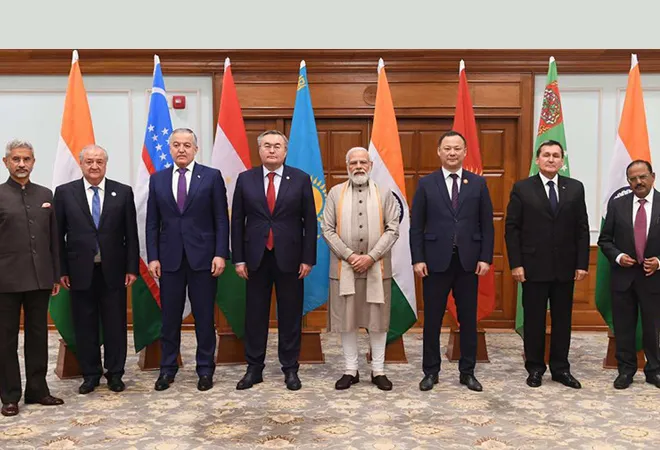
At first glance, the logic of the partnership between India and the five Central Asian republics — Kazakhstan, Kyrgyzstan, Tajikistan, Turkmenistan, and Uzbekistan — appears natural. Central Asia is rich in hydrocarbons, uranium, and fertilisers; India needs all three. India, in turn, produces pharmaceuticals, machinery, textiles, and IT services that the Central Asian economies cannot supply in sufficient quantity. On paper, the relationship should be mutually reinforcing: resources for technology, raw materials for finished goods. In reality, the commercial relationship remains stubbornly modest. India’s total trade with the region barely exceeds $2 billion, representing less than half a per cent of New Delhi’s global trade. The promise exists, but geography and politics have denied it substance.
A Geography of Constraint
The principle obstacle is physical access. India shares no direct border with Central Asia, and its only practical land route passes through China or Pakistan and Afghanistan. Although India’s Himalayan frontier intersects the wider region leading toward Central Asia on the Chinese side, there is currently no usable or politically open land corridor that would allow India direct access through China. Beijing has developed Xinjiang as its own controlled gateway to Central Asia under the Belt and Road Initiative, and granting India transit would undermine China’s strategic advantage in the region.
The Aksai Chin area, where old trade routes once connected Ladakh with Xinjiang, is not feasible today because India still claims the territory while China exercises firm control over it. This ongoing dispute, combined with tense political relations, effectively eliminates any prospect of a functional route through that region.
Meanwhile, Pakistan does not permit Indian cargo to transit through its territory, effectively cutting India off from its northern neighbourhood. Shipments that could travel just over a thousand kilometres instead traverse over five thousand kilometres via Iran and the Caspian Sea. Freight costs through these alternative corridors are estimated to be thirty to forty per cent higher, and delivery times often double. Initiatives such as the development of Iran’s Chabahar Port, the International North–South Transport Corridor (INSTC), and India’s accession to the Ashgabat Agreement in 2018 are important diplomatic signals, but they cannot erase the structural disadvantage of distance.
The economic consequences are measurable. Research by the Institute of Economic Growth suggests that if India had unimpeded access through Pakistan and Afghanistan, trade volumes with Central Asia could be five to ten times higher. The trade potential index — a model that estimates potential trade based on distance and GDP — ranks trade through a direct route from 10 to 15, but with detours through Iran or China, it collapses to just two or three. In concrete terms, the difference between potential and actual trade represents billions of dollars lost annually. India’s exports to Uzbekistan, for instance, are dominated by pharmaceuticals, worth approximately $167 million, as well as machinery and medical equipment. With a viable corridor, those numbers could multiply several times over. Similarly, trade with Turkmenistanstands at a mere $41 million, and with Tajikistan at around $42 million, figures that remain absurdly low for economies of this size and proximity.
The unrealised potential is most visible in the energy sector. The Turkmenistan–Afghanistan–Pakistan–India (TAPI) gas pipeline, once hailed as a flagship of regional integration, was expected to transport 33 billion cubic metres of gas annually to India’s northern markets. Three decades since its conception, it remains unfinished — a monument to regional distrust. A volatile security situation in Afghanistan and the lack of political trust between India and Pakistan has frozen the route, causing Turkmenistan to turn east instead, supplying gas to China through operational and conflict-free pipelines.
China’s ability to move swiftly within the same geography has reshaped regional alignments. Between 2018 and 2023, Chineses trade with Central Asia increased from $40 billion to almost $70 billion, while India’s trade remained stagnant at around $2 billion. The gap is not only one of resources or ambition, but of connectivity. Beijing built the infrastructure — via the Belt and Road Initiative and Central Asia–China gas pipelines —to become the region’s immediate investor and transporter. India remains a distant but friendly partner with limited physical reach.
Diplomatic Pressure Without Strategic Depth
This asymmetry also constrains India’s diplomatic posture. Within multilateral platforms like the Shanghai Cooperation Organisation, where both India and Pakistan sit alongside the five republics, New Delhi’s political bandwidth is often consumed by managing its rivalry with Islamabad rather than cultivating deeper partnerships. Central Asian states — cautious by necessity — avoid choosing sides. For countries like Kazakhstan or Uzbekistan, alienating China or Pakistan is riskier than neglecting India. The result is polite stagnation: strong communiqués but limited implementation.
The gap between potential and reality is evident across sectors. India is among the world’s leading suppliers of affordable medicines; its generics already dominate parts of the Uzbek and Tajik markets. Demand for Indian pharmaceuticals, engineering goods, and educational services could expand tenfold with better logistics. Thousands of Central Asian students study in Indian universities, mostly in medicine and technology but the number could be much higher with cheaper travel. Meanwhile, Central Asia could supply India with oil, gas, uranium, and potash at competitive rates. Since 2015, Kazakhstan has supplied over 5,000 metric tons of uranium to India under a long-term contract, demonstrating that where connectivity exists, cooperation flourishes.
Defense partnerships demonstrate a similar paradox. India has established defense agreements with Kazakhstan and Uzbekistan, and maintains working groups on security cooperation. Yet exercises and exchanges require circuitous routing through Iran or Russia, making sustained engagement slow and costly.
For Central Asian republics, strategic balancing remains paramount. India’s trade potential, educational capacity, and restrained diplomacy are appreciated. But economic and infrastructural dependence lean toward China, Russia, and — via the China-Pakistan Economic Corridor — increasingly Pakistan. Access to the Arabian Sea through Gwadar offers what India cannot: a functional maritime outlet. While New Delhi’s initiatives on digital technology, renewables, and training are well-received, they occupy a secondary layer in the regional hierarchy of partnerships. The Delhi Declaration of 2022, issued at the first India–Central Asia Summit, captured this reality diplomatically, calling for “peaceful resolution of regional conflicts” as a prerequisite for deeper connectivity — a clear reference to South Asia’s unresolved instability.
Time magnifies the challenge. Every additional border and detour not only raises costs but slows delivery. Studies on the INSTC and trans-Iran routes suggest that while these alternatives can reduce transit time by roughly 30–40 per centcompared to traditional Suez-based sea routes, shipments to Central Asia still take several weeks. For example, multimodal services from western India to hubs like Tashkent typically take between two to three weeks, depending on the route and the reliability due to political, security, and infrastructural uncertainties of links via Iran and the Caspian. By the time Indian goods arrive, Chinese or Turkish goods often already stock regional markets. Counter-terrorism and narcotics control cooperation are similarly constrained. While drug trafficking and cross-border extremist movements originating in Afghanistan are a shared concern, yet India’s participation in joint monitoring or training is limited to symbolic exchanges.
Can New Delhi Pursue a Continental Vision While Secluded?
India has responded to a lack of connectivity with creative alternatives. While New Delhi invests in Chabahar and deepens the INSTC through building links through Iran and Azerbaijan, it has also sought to create “digital corridors.” Through tele-education, tele-medicine, and e-governance initiatives, India has found a way to bypass connectivity issues. These initiatives matter, however they cannot substitute for the movement of goods, energy, or large-scale infrastructure. Without even minimal technical dialogue with Pakistan on transit, India’s northern horizon remains closed. Periodic crises — whether the 2019 Pulwama attack, the 2025 Pahalgam incident, or renewed ceasefire violations — only reinforce the perception that South Asia is too volatile to serve as a transit route. For investors and logistics firms, that perception translates into risk premiums and missed contracts.
The strategic price is as much in influence as it is in dollars. Central Asia could have served as India’s strategic depth in the continental balance with China; instead, it is increasingly becoming Beijing’s economic backyard. Each year of inaction entrenches new dependencies that India will struggle to unwind. The contest is not simply about pipelines and trade routes but about whose narrative of connectivity will define Eurasia in the twenty-first century. Ultimately, the struggle is about which great power will set the rules, select the partners, and shape the strategic direction of Eurasian connectivity in the twenty-first century. Connectivity is therefore not merely about infrastructure or trade; it is a vehicle for influence, trust, shared norms, and the broader balance of power across Eurasia. The contest, in essence, is about who will shape the region’s future order as much as about how goods move across it.
A Frontier of Lost Opportunity
India’s exclusion is not dictated by nature but constructed by politics. The Himalayas are real barriers; the Indian-Pakistan border is a chosen one. If even partial normalization were achieved, the geometry of Eurasian trade could shift dramatically. Containers that now take a month to travel from Kandla to Tashkent could arrive in under two weeks. Energy pipelines could flow south. Educational and digital exchanges could scale. Central Asia would gain further diversification beyond China and Russia; India would gain continental reach.
Until that possibility emerges, India’s engagement with Central Asia will remain an exercise in compensating for geography. Trade volumes will remain small, corridors incomplete, and partnerships largely declaratory. Central Asia will continue to view India as a friendly presence in diplomatic forums but an absent partner in markets and infrastructure. The cost of that absence is borne not only by India but by Central Asia itself, deprived of balance and competition.
History offers a quiet irony: lands once united by commerce, culture, and movement are now divided by modern borders. The enduring hostility between India and Pakistan has frozen not only their bilateral future but also the regional one. The numbers are unambiguous: trade that could be ten times larger, routes twice as fast, and energy networks capable of transforming economies all remain unrealized. Until the politics of hostility yield to the pragmatism of connectivity, Central Asia will remain a frontier of lost opportunity — a neighbor that India can see on every map, but cannot yet reach.
-Arun Anand
After the recent protests in Nepal by Gen Z that toppled its government, the global commentaries are raising the question: why aren’t India’s youth taking to the streets? As Nepal’s Gen Z had managed to bring down a government within two days, observers in Western capitals rushed to draw comparisons with calm in India. Across all these Western media coverages, the undertone was unmistakably similar — India’s young citizens are either disenchanted or forcibly silenced as they are not coming out on streets. The question that has been repeatedly asked by the Western media is how could 370 million digitally connected, energetic young people stay quiet while their neighbours erupt in rebellion!
This line of reasoning is not only too simplistic; it reflects a new colonial construct. The same Western lens that once portrayed the “East” as mysterious now depicts it as perpetually unstable. This new form of neo-orientalism associates political maturity with the violent protests on the streets; if there is no unrest, it implies stagnation and not a resilient democracy!
The recent BBC piece questioning why India’s Gen Z is not taking to the streets is a manifestation of this tendency.
It draws parallels between India and smaller countries like Nepal, Bangladesh, and Madagascar, suggesting that the absence of mass uprisings signals a lack of youthful energy or civic courage. The problem isn’t nastiness, it’s method. Comparing India to these states is to misunderstand how democracies operate at a larger scale. Nepal’s protests erupted after a sudden social media ban and amid a fragile coalition government that survives on thin legitimacy. India’s federal and electoral architecture, by contrast, disperses discontent across 1.4 billion people, 28 states, and thousands of local governments.
The design of Indian democracy doesn’t suppress anger; it channels it. Protests in India rarely topple governments because institutions, courts, elections, bureaucracies, and welfare systems absorb the shock. To view the absence of unrest as evidence of apathy is to overlook how political participation actually functions in a robust and mature democracy.
There is an unspoken discomfort in much of Western coverage about how India, despite all its contradictions, remains economically and politically more stable than its peers. It continues to grow faster than most large democracies, sustains multi-party elections with a healthy turnout, and manages one of the world’s most complex social fabrics without systemic collapse. This stability is rarely celebrated in Western media; it’s often treated with suspicion. The reflexive narrative is to ask what might be going wrong beneath the calm rather than what mechanisms have allowed a post-colonial state to sustain democratic continuity and growth at this scale.
Part of this bias comes from habit. The Western media has always treated South Asia as a theatre of crisis. If the story isn’t of famine, coup, or riot, it barely registers. But another part stems from deeper discomfort; India no longer fits neatly into the developmental hierarchies that once defined the global imagination. It’s too chaotic to be treated as Western, too successful to be pitied as “developing”. So, its stability is read as a paradox, not as an achievement.
In Western capitals, protest is considered a hallmark of civic virtue. The French strike, the British march, and the American sit-in—these are viewed as signs of healthy democracy. Yet when the same template emerges elsewhere, it’s often described in different terms: “unrest”, “mob violence”, or “youth instability”. This double standard also extends to its inverse.
When Western societies experience protest fatigue or political disengagement, it is analysed as a sign of post-modern maturity, a democracy that no longer needs the street. When India’s youth turn to the ballot box instead of barricades, it is defined as evidence of apathy. The irony is glaring. India’s 2024 general election saw the participation of nearly a billion voters, more than the population of the entire West combined. If protest is one language of democracy, participation is another. Yet the latter rarely makes headlines.
To describe India’s Gen Z as “silent” is to overlook the forms of politics that do not conform to Western standards. Indian youth are debating, campaigning, voting, volunteering, building businesses, and engaging digitally at an unprecedented scale. Their politics isn’t always radical; it’s often pragmatic, sometimes ideological, occasionally contradictory. But it is politics nonetheless. The idea that activism must take the form of confrontation reflects a narrow understanding of agency. The Indian model of civic participation relies less on disruption and more on negotiation, achieved through social media, student movements, local elections, or NGO networks. Protest here is not a lifestyle choice; it’s a last resort. This doesn’t make India less democratic. It makes it democratic in a more sustainable way.
The Western gaze often operates on two assumptions: first, that Western democracies are the gold standard for political behaviour; and second, that political energy elsewhere must express itself through familiar Western forms to be valid. Both assumptions collapse under scrutiny. The protests in France over pension reform or Britain’s student marches are never compared to “big democratic neighbours.” They are treated as internal expressions of civic strength, not as part of a regional morality play. But when South or Southeast Asian youth mobilise, or don’t, the question becomes comparative and moralising: why don’t others follow? Why isn’t India emulating its neighbours? This reflects ‘projection’ and not ‘analysis’. Western media expects the template in their part of the world to be replicated everywhere. When it doesn’t, they treat it as a sign of deficiency of democratic values.
If we step away from this template, India’s apparent calm begins to look less like resignation and more like resilience. Its youth are not revolutionaries by default because they have grown up inside an established, functioning democracy. They have witnessed for decades that power dynamics can be successfully changed through ballots, not barricades. This generation of young Indians is also smoothly navigating global economic competition, digital transformation, and an aspirational middle-class culture that prizes progress over protest. Their energies are directed toward mobility, not militancy. Far from being depoliticised, they are the inheritors of a political system that has normalised participation so deeply that it no longer requires upheaval to feel real. In that sense, India’s “stability” is not the absence of politics, it’s the maturity of it.
India would never fit into the Western media’s binary of democratic decline or populist revolt. Her story is less dramatic, but more consequential: a multi-ethnic, multi-religious, multilingual democracy that manages to govern, argue, and grow simultaneously. The West often mistakes this for contradiction. It is, in fact, the definition of balance. The time has come for global media to update its interpretive grammar. Not every democracy must protest to prove it’s alive.To understand India, one must abandon the lens of spectacle and learn to see political endurance as a testament to achievement, not an anomaly. The real story isn’t why India’s youth aren’t burning tyres; it’s why, despite every reason to fracture, the world’s largest democracy still holds together. And that story deserves to be told without a Western filter.
It has been more than a year since the interim government in Bangladesh came into being under the leadership of Muhammad Yunus, and the country has gone through a political reset, both internally as well as in its foreign policy. Internally, the largest political party — the Awami League — and its affiliates are banned, Islamists have revived, Sheikh Mujibur Rahman’s legacy downplayed and even attacked, and the history of the 1971 Liberation War is up for debate. Post-Sheikh Hasina Bangladesh, hailed as the “new” Bangladesh, has also been wrought with violence of all kinds — communal, ethnic, gender, mob, and political. Inevitably, the country’s law and order is in a constant state of compromise. However, the interim government, whose prime responsibility behind its establishment was to bring the country’s stability back on track, dodged all accountability via two ways — denial and labelling it a “conspiracy” of “outside influence”.
The ostracisation of Awami League was predictable, considering Yunus’s personal animosity with Sheikh Hasina. This year, therefore, witnessed the interim government, using all means — political, judicial and administrative — to witch-hunt League loyalists and activists on one hand and create a political atmosphere where Bangladesh’s apparent newly-earned democracy is one without opposition.
Human Rights Watch, in May, reported that the interim government has risked Bangladesh’s fundamental freedoms via a series of legislative measures. In a recent report, HRW also accused the interim government of abusing the recently amended Anti-Terrorism Act to target and imprison thousands of political opponents, especially the alleged supporters of the now ousted Awami League, on dubious charges to shut down dissent. Indeed, the report rightly pointed this is not the path to democratic transition. Bangladesh’s own rights groups, too, have been critical of the interim government’s highhandedness—following the script of its predecessor that it claims to be so against, as it observed a disturbing rise in violations of human rights and crimes across Bangladesh under the interim government.
In its efforts to suppress the Awami League and positing itself opposite to everything it stood for, the interim government resorted to keeping a cold distance from its neighbour, India. Calling it a ‘balanced geopolitics’, the Yunus-led interim government and its supporters, including political leaders, manufactured a new narrative—that India is an ‘ally’ of Sheikh Hasina and the Awami League. Through shameless misconstruing of Indo-Bangladesh diplomatic relations, anti-Hasina forces are now competing against each other to appear as the guardians safeguarding Bangladesh’s democracy, one that the country’s so long lacked due to Hasina’s pro-India foreign policy tilt. While political parties, especially opponents of the Awami League, have always used anti-India rhetoric as their election campaign, the same by the interim government reflects its ultimate defence mechanism when faced with accountability.
The Chief Advisor ventured to create a fearmongering attitude among Bangladeshis that India’s ‘hegemony’ is the reason behind its own present political crisis. Oftentimes, especially when the inefficiency of law enforcement forces has been questioned, as in the case of the February Bulldozer Procession of 32 Dhanmondi, the interim government put the blame on “external forces” for its internal crisis. His close associates, along with other advisors of the interim government, too, made provocative remarks targeting India’s border security. Communal attacks have witnessed a surge in Bangladesh since the fall of Hasina. When India raised concern about this worrying trend, the interim government quickly dismissed it as political attacks, and not communal, and even called the reports “exaggerated”. It echoed the same about reports of communal attacks by the Bangladesh Hindu Buddhist Christian Unity Council, calling it “misleading” and “false”.
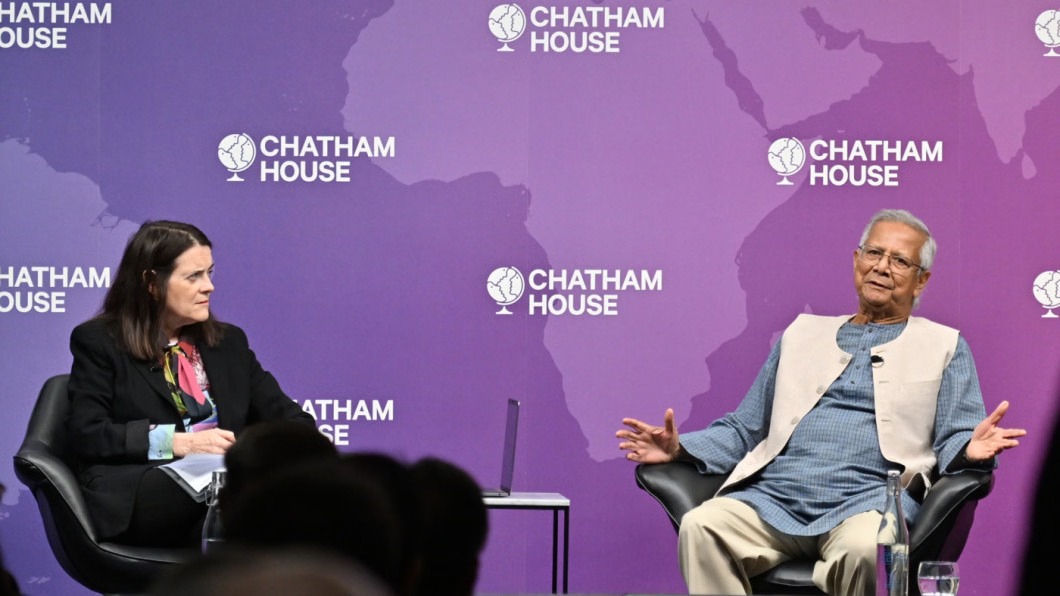
In a recent interview with a US journalist, Yunus took yet another anti-India jibe, calling anti-Hindu violence in Bangladesh “fake news”, one that is a “speciality of India”, whereby Bangladesh remains a “beacon of religious harmony”. This is notwithstanding the US Religious Freedom report that revealed the state of minorities in Bangladesh to be concerning.
Given the collective failure in providing security to Hindus during the celebration of their biggest religious festival, Durga Puja, last year, the same concerns were raised when the media reported a few cases of idol vandalism days before the onset of Puja this year. This year, the home advisor warned to take tough action against those involved in 793 Durga Puja pavilions for allegedly “hurting religious sentiments” and blamed the “neighbouring country” for having a connection behind the falsehood surrounding Durga Puja. Such statements by an advisor were noted to encourage communal violence and persecution of minority populations, minority Hindus being always under the radar of proving their nationalism. This year, at least 49 untoward incidents have taken place at puja mandaps across Bangladesh has been reported during Durga Puja.
The recent ethnic violence in Khagrachhari in Chittagong Hill Tracts, another pressing issue in Bangladesh, showed the systemic nature of violence in the hills, whereby miscreants continue to enjoy a culture of impunity under the interim government. Here too, the government was quick to put the blame on ‘fascist groups’ sheltered in the neighbouring country, who are being allowed to create conditions to destabilise Bangladesh. New Delhi’s response was calling a spade a spade—dismissing the allegation as bizarre and pointing to the interim government’s tendency to shift blame elsewhere to camouflage its own inefficiency in maintaining law and order.
To cover up its failure, despite a year in power, the interim government has been shifting the blame game on India. This is not only an insult to the conscience of Bangladeshis but also to their very democratic aspiration. Through the manufactured narrative of “conspiracy of external force to destabilise Bangladesh”, the interim government is deliberately delaying the democratic transition that its people are desperately awaiting.
Even though India has made it clear that it awaits a smooth, inclusive, just democratic transition in Bangladesh, where New Delhi is willing to work with any government that comes to power (as bilateral relations should be), the interim government is repeatedly resorting to arrogant statements to hold onto the chair. One can only hope for the national election to resolve this deliberate deadlock by the interim government, so that bilateral ties reach new heights in the near future.
–IANS
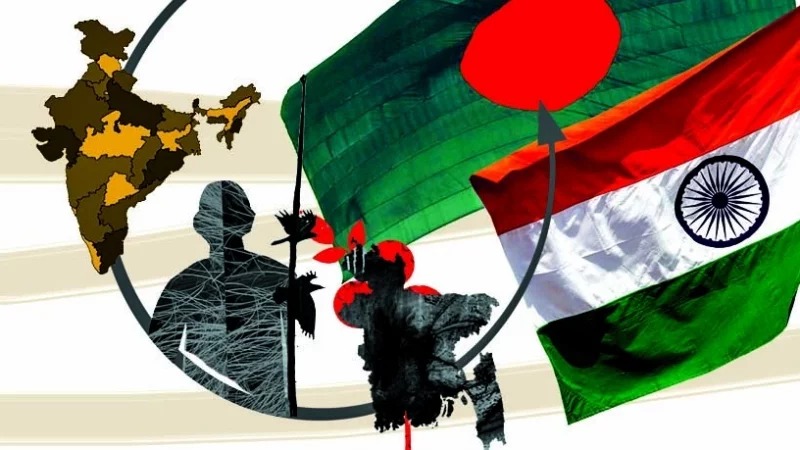
The partition of India has been described by historians as a great misfortune of human civilization. In his book ‘Guilty Man of Partition of India’, Dr. Ram Manohar Lohia argues that the leaders responsible for the partition of India were arrogant, conceited and ambitious. South Asia is still reeling from the aftermath of partition. Bengali Muslims, who accepted Pakistan as Muslims, launched a revolution under the leadership of Sheikh Mujibur Rahman to create Bangladesh for their language, culture and identity. At that time, Pakistan was widely supported and assisted by America and China. India, which was defeated by China in 1962, was isolated from China and America after defeating Pakistan in 1965. Pakistan’s military rulers did not spare any brutality to suppress the movement led by Sheikh Mujibur Rahman. Three million Bengalis were martyred in the eight-month movement. Pakistani soldiers raped three hundred thousand Bengali women to change the Bengali language.
In the history of human civilization, no military force in the world has shown such ruthlessness and brutality. Due to the growing movement, India was forced to feed the Bengali refugees. In the 70s, India received the excellent leadership of Indira Gandhi. Indira Gandhi was a skilled player in diplomacy. She mobilized the Indian army to support the Mukti Bahini soldiers. At that difficult juncture in history, America and China did not hesitate to threaten India.
US President Nixon did not just advocate for Pakistan but also sent a warship with nuclear capabilities to the Bay of Bengal. Similarly, China also used the word war to invade India from the Himalayan region. That was a difficult situation for Indira Gandhi. She traveled to the Soviet Union and succeeded in signing a peace treaty with the Soviet Union in 1971. According to the terms of the treaty, the clause on the invasion of India stated that Soviet Russia would fight alongside India. Due to the aftermath of the peace treaty with Soviet Russia, American pressure and Chinese threats became self-evident. In other words, Indira Gandhi succeeded in becoming the midwife of Bangladesh. Bangladesh was born on the basis of culture. The song written by Rabindranath Tagore became the national anthem of Bangladesh.
In Bangladesh, which was built on the concept of a secular and inclusive society, Sheikh Mujibur Rahman was martyred along with his family in 1975 after being targeted by extremists. Sheikh Hasina was able to save her life because she was in Germany. Over time, she took refuge in India. After 1975, it seems that the rule was in the hands of extremists for a long time. Bangladeshi society is divided into two parts, the Ashraf and the Atarf. The Ashraf community has a large population and this community seems to support inclusiveness and secularism, while the Atarf seems to stand in favor of Islamization and Sharia law. After 1975, the Jamdani rebellion was again in favor of secularism in 1989. In other words, Bengali nationalism seems to have become strong again and managed to hold power for a long time. However, from 2001 to 2006, extremist forces like the BNP and Jamaat-e-Islami succeeded in making Bangladesh a victim of backwardness.
From 2006 to 2008, the nationalist movement in Bangladesh, especially under the leadership of Sheikh Hasina’s party, became successful. Bangladesh began to draw up a roadmap for modernization. In 2012, the movement took shape, taking the decision to transform Bangladesh’s economy under the leadership of Sheikh Hasina. With the arrival of Sheikh Hasina, there was a major change in foreign policy. Resolving the border issue with India was a major success of Bangladesh’s foreign policy. Due to Sheikh Hasina’s strong leadership, Bangladesh became one of the fastest growing economies in South Asia. By importing raw materials from India, Bangladesh succeeded in making a leap in the textile sector in Europe and America.
Bangladesh was able to benefit more from the heat and heat of globalization and open economy. Bangladesh’s modernization journey was not digestible even by America. Due to the geopolitical structure of Bangladesh, America wanted to keep its footprint in Bangladesh, Saint Martin Island. The American base campus on Saint Martin Island was sponsored by the American goal of observing Chinese activities in Myanmar. Sheikh Hasina did not have American conditions. Against this background, an uprising began in Bangladesh with the alliance of America and Pakistan and the goodwill of China. This uprising turned into an explosion. Sheikh Hasina’s working style was also different. Hasina also abused her power to rein in the radicals and suppress the opposition. On August 5, 2024, Sheikh Hasina managed to escape from Bangladesh and took refuge in India.
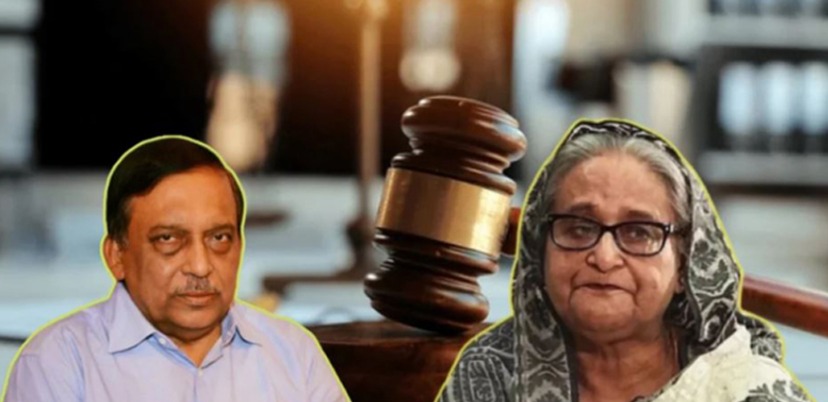
During this long period, the Hindu community of Bangladesh became a scapegoat. The Hindu community had the largest investment in Bangladesh’s textiles. After the Hindu community became the target of radicalism, the textile system was completely destroyed. During the leadership of Bangladesh under Nobel Prize winner Mohammad Yunus, the alliance between Bangladesh and Pakistan seems to have fully increased. Recently, a Bangladeshi court has sentenced Sheikh Hasina to death, and Bangladesh seems to have started diplomatic efforts to pressure India to extradite Sheikh Hasina, who has taken refuge in India.
Bangladesh’s security advisor, who is visiting India, has placed Indian security advisor Ajit Doval in Bangladesh’s favor. Although there is an extradition treaty between India and Bangladesh, its articles 6 and 7 state that the extradition treaty will not be applicable to political charges. Despite the deep influence of the Awami League in Bangladesh, there is silence in civil society due to the rampant extremism. Experts believe that the Hindu community will again be targeted by terrorists in the region where Sheikh Hasina was installed as the protector of the one crore Hindu community, which has had a great impact on the lives of the people of Bangladesh. Experts believe that Bangladesh may become like Afghanistan in the region where the chemistry between Bangladesh and Pakistan has dissolved.
In this sense, international powers and human rights activists have appealed to India not to extradite Sheikh Hasina. It does not seem appropriate to extradite Sheikh Hasina on the basis of democratic values. Since Bengali society is strong in terms of civilization, culture and literature, Bangladeshi society has the ability to defeat extremism. It can be estimated that the Awami League will regain power in the region where democracy is established in Bangladesh. In this sense, it does not seem appropriate to stand under any diplomatic pressure, keeping in mind the broader interests of South Asia. Modi should consider the example of Indira Gandhi and pursue a strategic policy with Bangladesh.
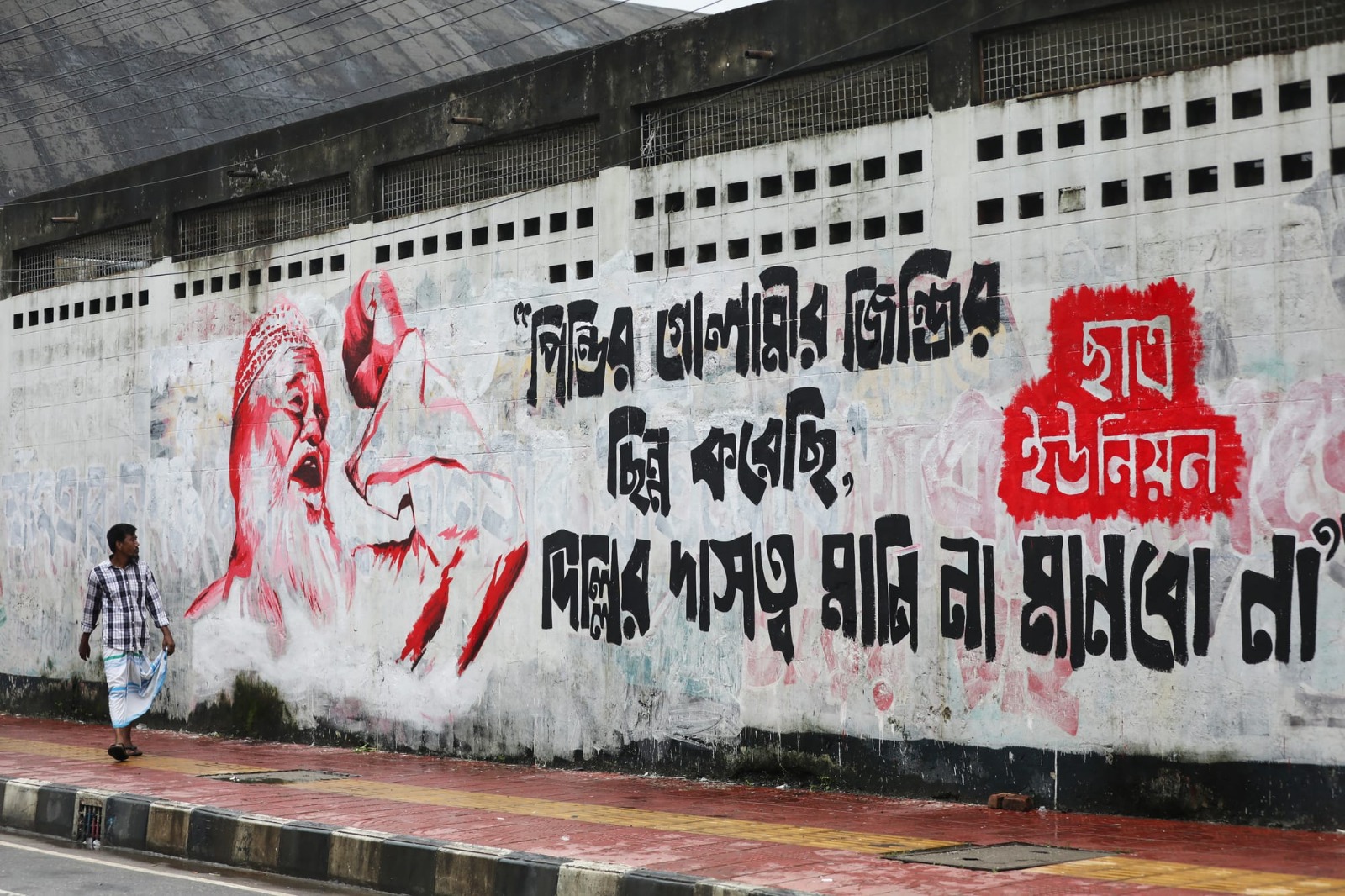
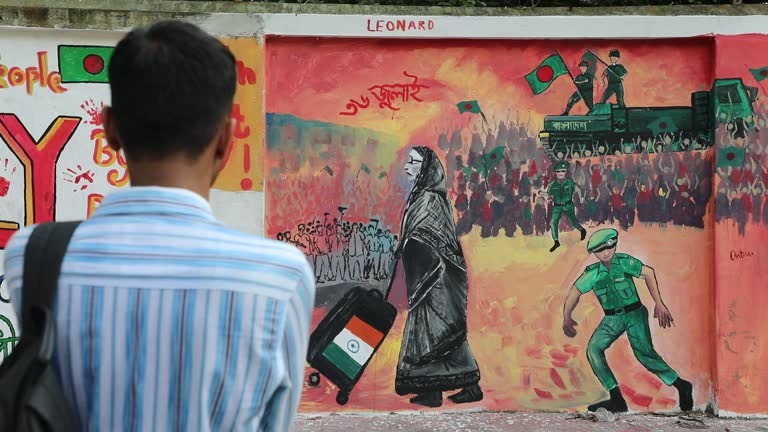
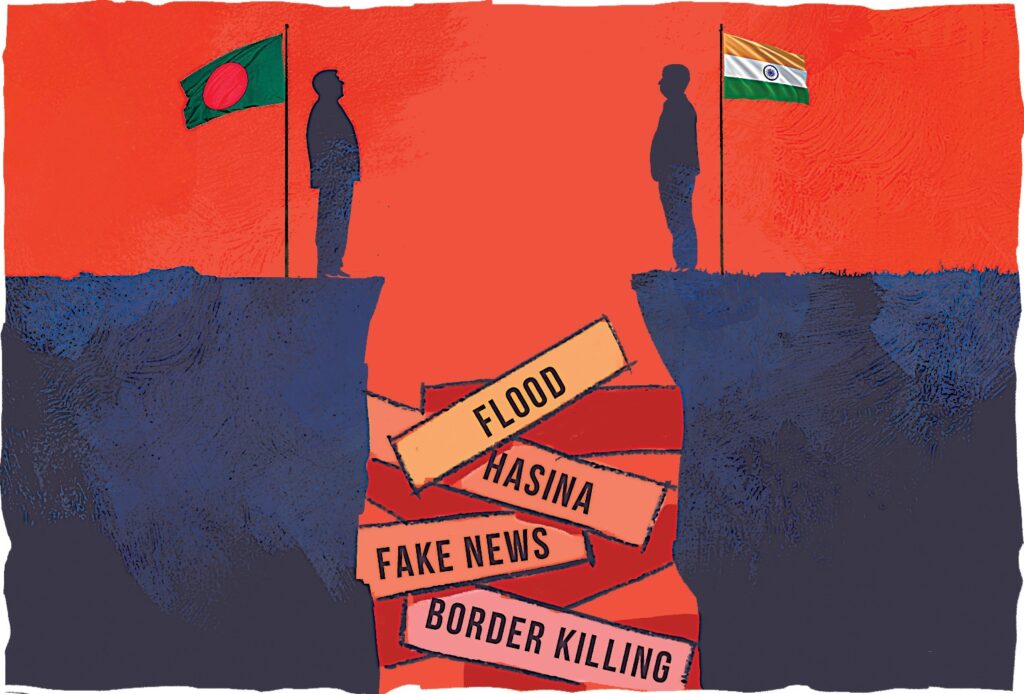
The 2024 July Uprising that ended Sheikh Hasina’s 15-year political tenure transformed Bangladesh’s political landscape. With anti-Hasina forces grabbing power, the political culture shifted and Bangladesh’s foreign policy took a spin as its old friend India came to be seen as an enemy overnight.
Anti-India sentiment was present in Bangladesh even during Hasina’s tenure, especially nurtured by radical Islamists and Pakistan apologists. The reason was heightened bilateral ties reached between India and Bangladesh on multifaceted areas — from cultural diplomacy to reaching understanding on water and land sharing, to new connectivity projects – port, buses and railway – for economic cooperation to greater border security, thanks to joint counter-terrorism measures.
It was also the time Bangladesh’s relations with Pakistan witnessed a thaw as under International Crimes Tribunal, war criminals mostly belonging to Jamaat-e-Islami who collaborated with Pakistan Army during 1971 Liberation War, were given death sentences and life imprisonment on charges of war crimes.
In the domestic sphere, Hasina’s hard dealing of new terrorist offshoots, witnessed during 2013-17, aggravated radical Islamists who openly advocated against Bangladesh being a constitutionally secular state (an ideological stand of Awami League party). All these factors culminated in shaping a new narrative — Hasina “selling” Bangladesh’s democracy to New Delhi.
Soon after the January 2024 election where Sheikh Hasina faced a decisive win, her political opponents doubled down on anti-India propaganda. First, they criticised New Delhi for congratulating Hasina at a time western countries raised concern over Bangladesh’s free and fair election. Then they blamed New Delhi for meddling in Dhaka’s internal affairs, alleging Narendra Modi government to have had a hand behind Hasina’s victory in 12th parliamentary election. All these because New Delhi maintained a non-interventionist approach to any country’s domestic politics, national election being one of them. Thus started the ‘India Out’ campaign in Bangladesh, mirroring Maldives’ drive earlier in 2023. Nevertheless, this did not affect bilateral ties in any way and the campaign soon died because of low popularity.
After Hasina’s deposition, the interim government’s foreign policy recalibration underwent a paradigm shift — moving closer to erstwhile coloniser Pakistan while maintaining a cold distance with New Delhi. The Chief Advisor Muhammad Yunus himself drew attention on many occasions for his provocative speeches antagonising New Delhi — from calling Bangladesh as the only guardian of Bay of Bengal for India’s “landlocked” northeast states during his China visit in March to claiming that New Delhi “disliked” or “disapproved” of student protest in Bangladesh that ousted Hasina and insisting at the UNGA in September that SAARC is nearly defunct because of “politics of one country” (indirectly referring to India).
In this blame game, Yunus conveniently avoided the core issue of SAARC being defunct — the Pakistan-sponsored terrorist attack in India’s Uri that undermined regional cooperation and led to cancellation of 19th SAARC Summit in Islamabad and boycott by neighbouring countries.
India, during the July Uprising, maintained diplomatic communication with Dhaka where it “observed developments closely”. Moreover, New Delhi’s focus during the unrest was to ensure security of Indian nationals, especially students, in Bangladesh and taking measures to avoid any breaches of border security.
It is common knowledge how post-Hasina, Bangladesh splurged into a deep law and order crisis, as violence of all kinds — gender, communal, ethnic, political — engulfed the country.
The consistent security lapse has created deep public distrust towards Bangladesh’s law enforcement forces. The rise in mob violence and rampant acts of vandalism of Sheikh Mujibur Rahman’s murals went unchecked and unnoticed by the interim government. The demolition of Mujib’s private residence -32 Dhanmondi – in February, however, pulled widespread criticism from both within and outside Bangladesh.
Instead of taking accountability for its lacklustre attitude towards restoring law and order, the interim government pointed the finger at New Delhi, for “giving platform” to Sheikh Hasina to give speeches. In fact, this has been the persistent narrative of the interim government, every time it was questioned of lawlessness within the country, from violence in Gopalganj to Chittagong Hill Tract. The justification was always the same — Sheikh Hasina attempting to destabilise Bangladesh “with foreign help”, hinting at New Delhi.
Recently, Bangladesh registered a protest against India for Hasina’s interviews published in Indian and foreign news outlets, alleging India to allow Hasina to make “hate speeches” that risk destabilising Bangladesh. India has reiterated that Hasina’s speeches are not New Delhi’s diplomatic position but one made in her personal capacity. This is because India is a democracy where the press is not controlled, unlike Bangladesh that is going through a democracy deficit.
Moreover, Dhaka foreign advisor recently called India Foreign Secretary’s remarks on hoping to see a “free, fair and inclusive election” in Bangladesh as “completely unwarranted”, claiming the national election as Dhaka’s “internal matter” and hence “not Delhi’s concern”. Bizarrely, Dhaka has been appreciative of Western countries who too expressed hope to see a free and fair election in Bangladesh. The political climate in Bangladesh has turned more volatile because it has banned Awami League from contesting elections, triggering counter protests by party activists and supporters in the nation. The usual jibe of “foreign force destabilising Bangladesh” continues.
Bilateral ties between India and Bangladesh strained not because New Delhi turned its back but because Dhaka, under the interim government, has been weaponizing anti-India sentiment to hide its inefficiency.
In a recent attack on Awami League office in Gulistan, the video of miscreants vandalising a sculpture depicting Pakistan’s surrender to India during 1971 Liberation War became viral. It showed a man saying that if the image remained intact, League’s allies “might return and claim their roles”. Much like Pakistan, the interim government’s attempt at historical revisionism, especially of India’s role in the 1971 Liberation War, through textbook revision is no secret now.
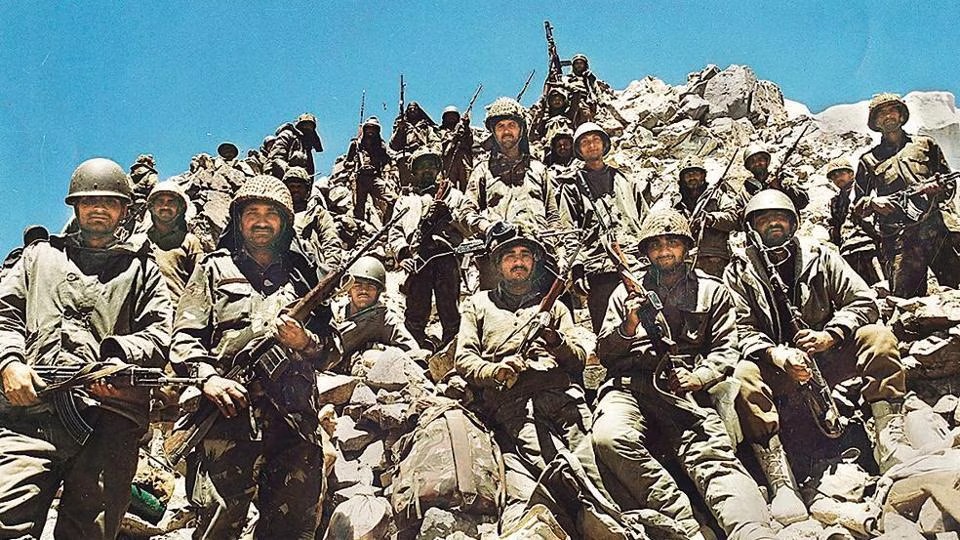
Twenty-six years ago, a bold infiltration in the Kargil region jolted the nation, as armed intruders crossed the border and occupied key high-altitude positions on India’s side of the Line of Control (LoC) in Jammu and Kashmir. Initially believed to be militants, the infiltrators were later confirmed to be part of a carefully planned covert military offensive—Operation Badr—conducted by the Pakistan Army.
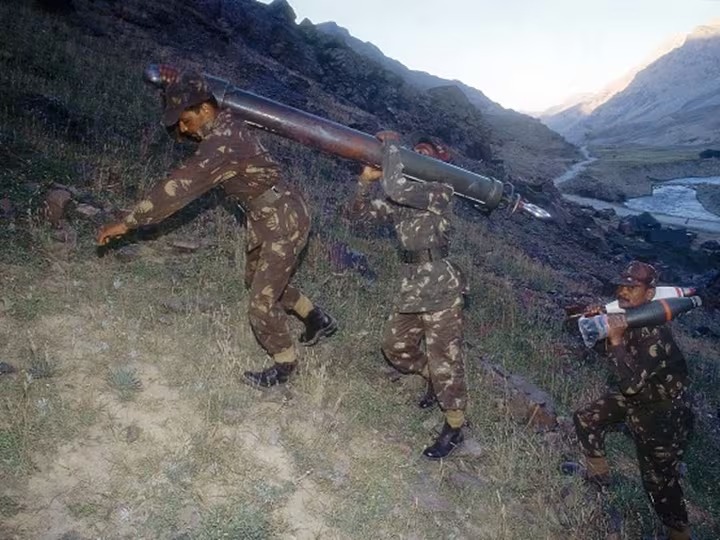
The objective was to secure a strategic advantage in the Kashmir region, sever India’s vital link to Siachen by cutting off Indian troops, compel their withdrawal, and ultimately facilitate the occupation of all of Kashmir. This incursion came just months after India and Pakistan had signed the historic Lahore Declaration, a bilateral agreement aimed at reducing tensions and resolving disputes through peaceful means and mutual respect for territorial sovereignty. The summer of 1999 thus marked Pakistan’s breach of this landmark accord and India’s decisive countermeasure through the launch of Operation Vijay.
The Kargil War of 1999 marked the first conventional conflict between two nuclear-armed states. What distinguishes this war is its conduct at extreme altitudes, spanning a 170-kilometre stretch of the Himalayan frontier, where Indian troops contended not only with hostile forces but also with harsh environmental conditions. Operating in low-oxygen environments, Indian soldiers ascended steep, icy cliffs—ranging between 8,000 and 18,000 feet—under relentless enemy fire to dislodge opposing forces and reclaim Indian territory. This conflict was, therefore, not merely a battle against a hostile adversary, well-entrenched in fortified bunkers with weapons poised, but also a confrontation with the unforgiving forces of nature. Despite the tactical advantage held by the enemy, Indian soldiers exhibited extraordinary perseverance, selflessness, and determination, rendering this military triumph one of the most revered in the nation’s history.
Victory in war is not solely determined by advanced weaponry, and the Kargil conflict serves as a definitive example. Indian troops, in fact, were not equipped with adequate mountaineering gear necessary for scaling the steep, frozen inclines. Despite these material shortcomings, they demonstrated the capacity to improvise, adapt, and overcome the obstacles before them, owing to their rigorous training in high-altitude warfare. Yet, the decisive factor in securing this victory was the spirit of camaraderie, which uplifted morale and inspired Indian soldiers to confront the entrenched enemy positions. This hard-won triumph still resonates through the words “Yeh Dil Maange More,” radioed by Captain Vikram Batra of the 13 J&K Rifles following the re-capture of Point 5140, the highest peak of Tololing. Captain Batra and his men then advanced to reclaim Point 4875 in the Mushkoh Valley, significantly shifting the momentum in India’s favour. It was here that the young officer laid down his life while attempting to save a fellow soldier from enemy fire. Beyond strategic prowess, Captain Batra embodied exceptional courage and leadership at merely 24 years of age, for which he was posthumously awarded the Param Vir Chakra, the nation’s highest military honour.
Grenadier Yogendra Singh Yadav of the Ghatak platoon was merely 19 years old when he sustained at least 15 gunshot wounds from enemy fire while ascending the cliff face during the assault on Tiger Hill. Despite his severe injuries, Yadav continued to advance as the unit’s sole survivor, ultimately destroying enemy bunkers with grenades and engaging in close-quarter combat to eliminate opposing soldiers, thereby clearing the path for his platoon to reclaim the strategic heights. As the youngest recipient of the Param Vir Chakra, Yogendra Singh Yadav recounts his extraordinary feat of courage with profound humility. Others, such as Major Rajesh Singh Adhikari (18 Grenadiers), Major Vivek Gupta (2 Rajputana Rifles), and Naik Digendra Kumar (2 Rajputana Rifles), led their men along the Tololing Ridge, targeting enemy bunkers, eliminating adversaries, and facilitating troop advancement—often at the cost of their own lives. These narratives, among many others, depict valiant soldiers shielding comrades from constant enemy assault, neutralising enemy positions before succumbing to fatal injuries, and enabling the Indian Army to reclaim national territory. Their collective sacrifice and indomitable spirit define the unmatched heroism of Operation Vijay.
The morale of the Indian Army received widespread public acclaim alongside robust institutional backing, standing in marked contrast to the approach adopted by its adversary. Pakistan’s Operation Badr was reportedly conceived in secrecy by a select group of senior military generals, excluding the Nawaz Sharif-led civilian government from the planning process. This not only compromised Pakistan’s democratic framework but also laid bare the entrenched influence of the country’s deep state. The covert nature of the operation and subsequent diplomatic isolation led to severe embarrassment for Pakistan’s civilian leadership, which initially denied the involvement of regular Pakistani troops in Kargil, portraying the infiltrators as ‘mujahideen’. Even after confirmation of identities of deceased Pakistani soldiers, the government refused to claim their bodies, keeping their families uninformed. It was Indian soldiers who performed the burials of many Pakistani troops with full military honours, accompanied by Muslim clerics conducting rites in accordance with Islamic customs. Notably, the body of Pakistani Captain Karnal Sher Khan was returned with a letter from Indian Brigadier M.P.S. Bajwa, commending Sher Khan’s courage and urging Pakistan to bestow military recognition. Although belated, Captain Sher Khan was posthumously awarded Pakistan’s highest military decoration—the Nishan-e-Haider. Twenty-five years later, the Pakistan Army formally acknowledged its involvement in the Kargil conflict, with former Prime Minister Nawaz Sharif publicly conceding the strategic misjudgement.
The Indian Army’s hoisting of the tricolour atop Tiger Hill on 4 July 1999—overlooking National Highway 1D, the vital lifeline of Ladakh—following its recapture from Pakistani forces, endures as a powerful emblem of national sovereignty, safeguarded by the unwavering dedication of Indian soldiers. It continues to stand as a profound symbol of territorial integrity, preserved through the courage and sacrifice of Indian troops. As the nation commemorates Kargil Vijay Diwas on 26 July, it is a moment to honour those who laid down their lives in defence of every inch of our homeland, as well as those who continue to uphold the national flag with unwavering pride.
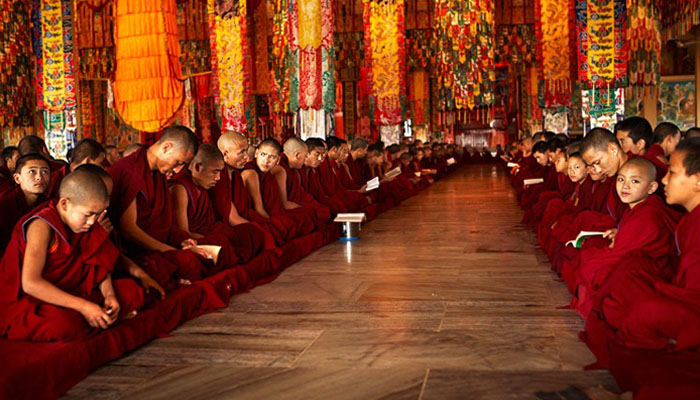
The town of Dharamshala in India’s Himachal Pradesh is bustling with celebration and anticipation as the 14th Dalai Lama is set to turn 90 on July 6. Although as the spiritual and political head of Tibetan Buddhism, the Dalai Lama’s birthday is in itself a hugely significant event, this time, it holds far-reaching importance as His Holiness is expected to share details of his successor.
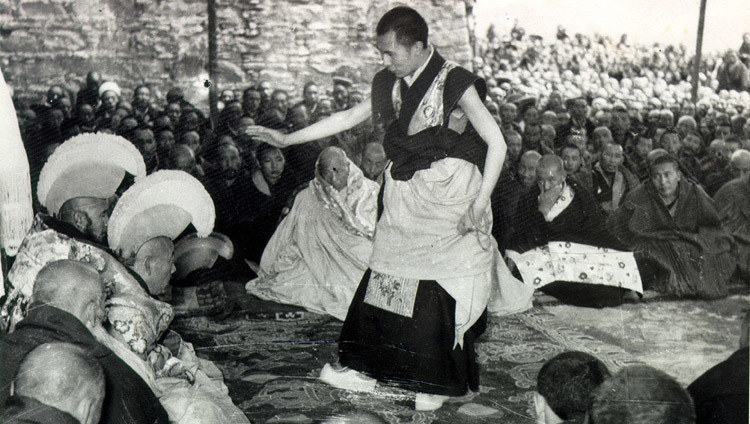
This is not just going to be a spiritually or religiously loaded revelation, but something that the future of the Tibetan people, who have been resisting Chinese control for decades, depends on.
Since the Dalai Lama’s exile into India in 1959, along with thousands of others, in the wake of the Chinese occupation of the Tibetan plateau, he has emerged as a globally recognized and revered embodiment of Tibetan resistance, cultural distinction, and humanitarian values. A Nobel laureate, the Dalai Lama or Tenzin Gyatso was born as Lhamo Dhondup in 1935 in northeastern Tibet, and in two years, he was identified by sacred religious search parties as the incarnation of the 13th Dalai Lama. This is a centuries-old practice within Tibetan Buddhism wherein the reincarnation of top spiritual leaders is decided after their death based on visions and signs interpreted by senior Lamas. This process could take years, resulting in a spiritual and political vacuum of leadership during that time. However, the current Dalai Lama has made a few critical departures in this tradition- firstly, he has suggested that he might give indications regarding his successor while he is alive, a method known as ‘emanation’, and secondly, in his March 2025 book Voice for the Voiceless, he has stated, “Since the purpose of a reincarnation is to carry on the work of the predecessor, the new Dalai Lama will be born in the free world.” By ‘free world’, he is suggesting that his successor will be found outside China, which again, is a divergence from convention.
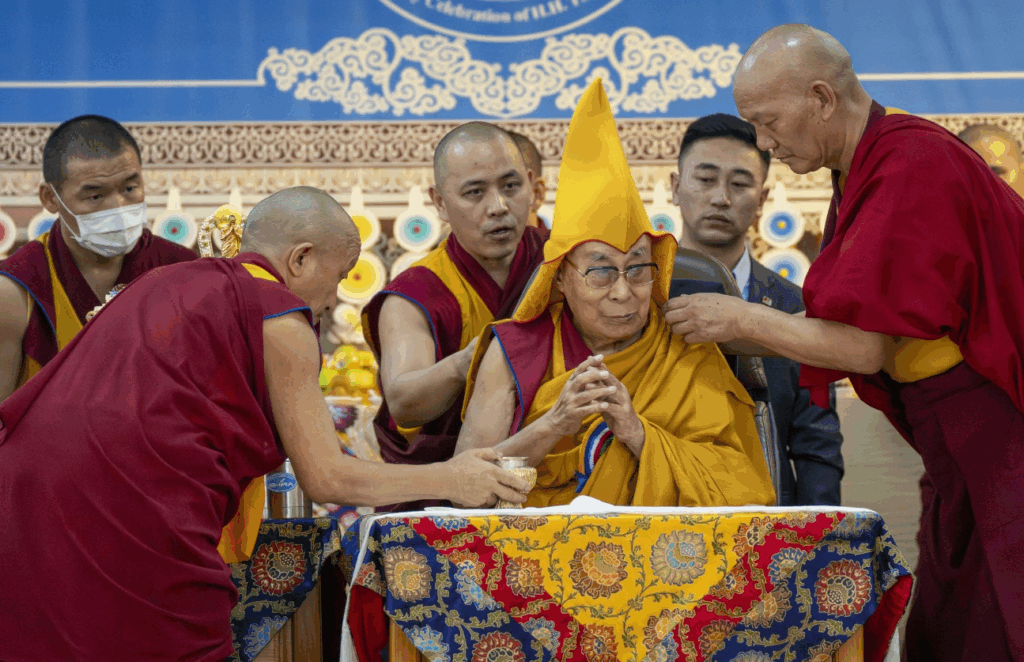
The reasons behind these deviations have to do with the relentless and overwhelming Chinese interference and suppression of Tibetan cultural traditions. The Chinese state, which officially identifies as atheist, has repeatedly declared that it reserves the right to decide on the Dalai Lama’s reincarnation, a practice that it claims to trace to imperial China under the Qing dynasty. To that end, the CCP wants to determine the next Tibetan Buddhist leader through the ‘golden urn’ process (wherein the names of all possible reincarnations are drawn from a golden urn) and to preside over it, it has convened a committee comprising government-selected Tibetan monks and CCP officials.
This is, in no way, the first time that the CCP has attempted to directly intervene in Tibetan Buddhist affairs. In Tibetan Buddhism, the second highest spiritual seat is accorded to the Panchen Lama, who also plays a crucial role in identifying the Dalai Lama’s reincarnation. In 1995, the current Dalai Lama named the 6-year-old Gedhun Choekyi Nyima as the reincarnated Panchen Lama. Within days of the announcement, the boy and his family were abducted, never to be seen again, while the Chinese state propped up their own Panchen Lama, who parrots the party line and endorses Beijing’s sovereignty over Tibet. Therefore, the vital significance of the Panchen Lama in deciding the succession of the Dalai Lama was a chief motivation for the CCP to intercept this seat, which raises anxieties about the future of the figure of the Dalai Lama itself.
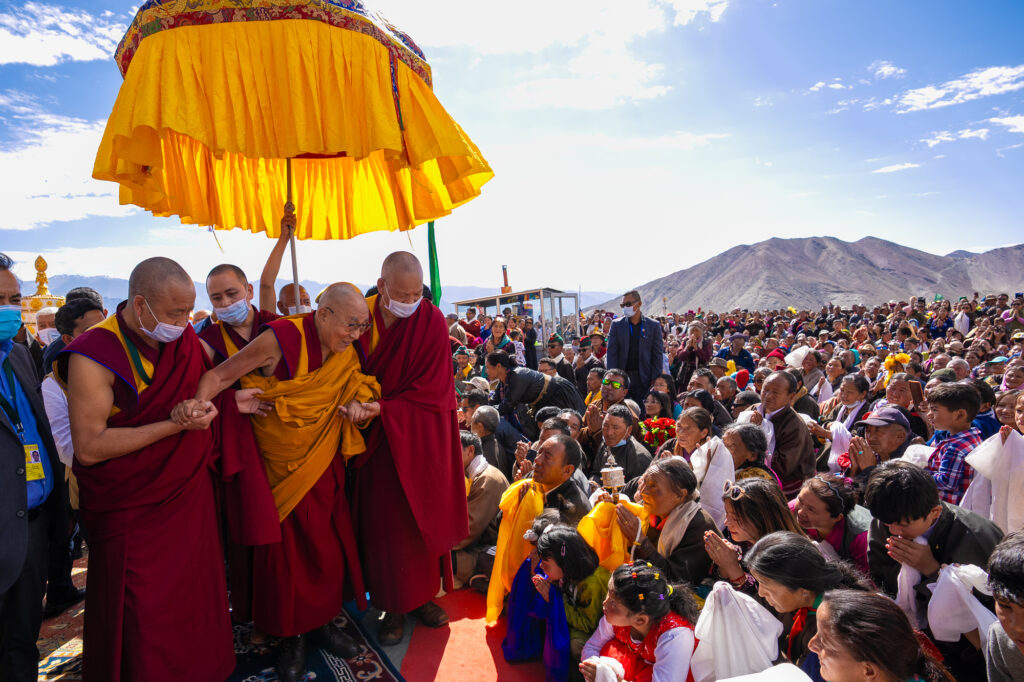
As the Dalai Lama gets older, the apprehension that there might be two Dalai Lamas, one based on suggestions by the current Dalai Lama and another, projected by the CCP, becomes more and more severe. Despite the Dalai Lama’s repeated assertion of fighting for Tibetan autonomy through peaceful means, as opposed to separatism, the CCP has always painted him as a violent secessionist and a threat to Chinese nationhood. As early as 1996, China formally prohibited the display and possession of the Dalai Lama’s images in Tibet, construing it as solidarity with Tibetan secessionism. Over the years, China has intensified its efforts at reshaping Tibetan society, severing the next generation from their language, culture, ways of life, and most importantly, aspiration for autonomy. From uprooting thousands of Tibetans by forcefully relocating their villages, to separating around one million Tibetan children from their families and coercing them into mandatory residential schools designed for their assimilation into the majority Han culture, the CCP has been bent on the cultural and demographic restructuring of Tibet. In fact, since 2023, China has begun referring to Tibet as the ‘Xizang Autonomous Region’ in all official communications, demonstrating its fixation on the cultural erasure of the Tibetan identity.
From this perspective, the Dalai Lama’s 90th birthday, around which he is expected to reveal details on his spiritual inheritance, goes far beyond being an event of spiritual/religious significance, but a critical determinant of regional geopolitics and the direction of the Tibetan movement. As thousands of Tibetans, representatives of several other faiths, celebrated figures such as Richard Gere, and big political names congregate in Dharamshala, all eyes will be on the Dalai Lama or “the protector of the Land of Snows”, as he is hailed by his followers. The world will listen carefully as his words will shape one of the most resilient, enduring, and inspiring struggles of our times.

The Deadly Terrorist attack in Pahalgam on 22nd April claimed the lives of 26 tourists, leaving India as a nation seething with anger at the visuals of the dastardly attack. In the aftermath of the attack, India conducted Operation SINDOOR on the morning of May 6, followed by heavy shelling and killing of civilians by Pakistan in the Poonch area of Jammu and Kashmir. The threat of an all-out war looms large if Pakistan indulges in any bravado.
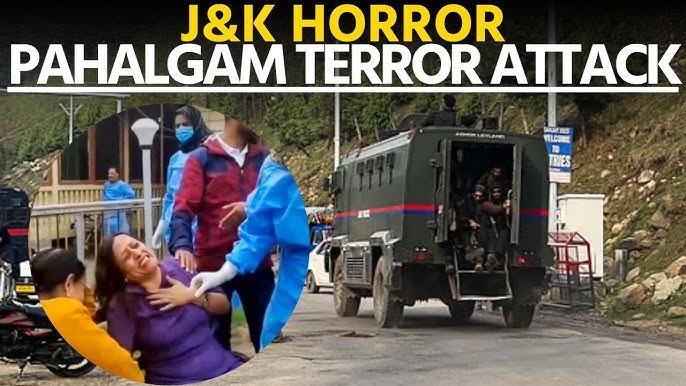
Just a day after the abhorrent attack, a slew of retributive measures was announced after a meeting of the Cabinet Committee on Security (CCS), led by PM Narendra Modi. It was decided to keep the crucial Indus Water Treaty in abeyance, the Attari-Wagah border was shut with immediate effect, Pakistani Nationals were asked to leave India, the Defence advisors of Pakistan in India were declared Persona Non-Grata, and the overall strength of the Pakistani High Commission in India was to be downsized to 30 from the present 55 officials. Pakistan, in response, closed its airspace for Indian airlines and suspended all trade ties with India. Complimenting Pakistan’s retaliatory measures, there was the usual nuclear sabre-rattling as well. Issuing an open threat to India, Pakistan’s Railway Minister Hanif Abbasi said that its 130 nuclear warheads are not only for display and have been kept for India, and if India tries to stop Pakistan’s share of water from the Indus, then the former should prepare for a full-scale war.
While on the surface, it may seem like a routine bilateral escalation between India and Pakistan, it wouldn’t be unreasonable to think that there may be some deeper strategic motives at play. Recently, US President Donald Trump slapped massive up to 245 percent tariffs on all Chinese imports, reacting to which the Chinese took up similar measures and raised the tariffs to 125 percent on American goods from the current 84 percent. The Trade war between the two biggest economies of the world sent ripples across the world, and India too was concerned as its manufacturing, mainly steel, auto, electronics, and pharmaceutical industries are heavily reliant on China for raw materials, and any disruptions in the supply chain could prove detrimental to the Indian economy and its consumers. But just as every cloud has a silver lining, so too does this trade war.
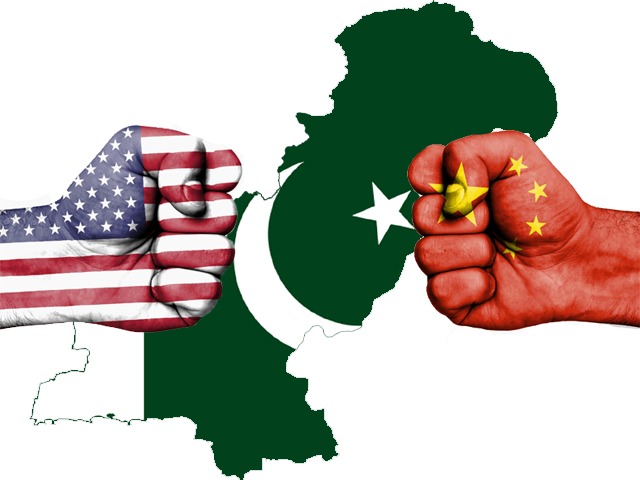
In a recently published report in the Indian Express, Richard Baldwin, a professor of Economics at IMD Business School, said that Middle power countries like India could secure a substantial foothold in global supply chains because of the US-China Trade War. He emphasized that if US tariffs persist on China, it could be beneficial to emerging markets as businesses would look to diversify and relocate, and India presents itself as a preferred destination for the same. It wasn’t just a speculation; this resonated on the ground as well, as Apple laid out its ambitious plan to shift all US-bound iPhone production from China to India by 2026. According to the Financial Times Report, Apple aims to produce more than 60 million iPhones annually in India to meet its demand back home in the US.
India was also actively involved in identifying and attracting several companies that were looking to shift their operations away from China. It tried to position itself as a natural alternative for companies moving away from China by portraying itself as a safe, secure, and stable democracy that offers a conducive environment for businesses.
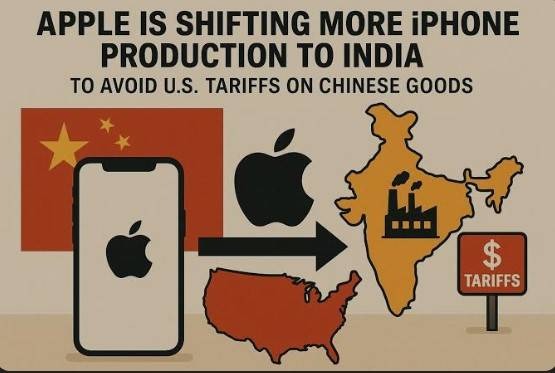
But the recent Pahalgam attack and the escalation that followed between India and Pakistan gave China exactly what it needed. It was a chance for China to showcase the risk factors involved for businesses that were looking to relocate to India. The conflict served as an alarming reminder to the world, especially businesses, that the situation between the two South Asian arch-rivals is still volatile and could explode at any moment. The Chinese social media, in the recent past, has been flooded with the narrative of how this trade war between them and the US has given an undeserving opportunity for India to attract businesses and investments. Though Beijing openly urged both India and Pakistan to act with restraint, behind the curtains, it was actively pulling the strings to encourage Pakistan to escalate and stretch the confrontation with India. China also extended support to Pakistan’s demand for an impartial probe into the Pahalgam Terror attack.
Currently, Beijing is dealing with an economic slowdown, and the situation has only gotten worse after the trade war with the US. It wouldn’t be imprudent to guess that an active Chinese role is at play behind the scenes, as it would be in China’s interest to portray India as an unstable, unfavourable, and unsafe alternative to thwart the relocation efforts of various businesses. Using Pakistan as a proxy to further its objective by offering diplomatic and even military support, China has tried to spoil India’s image as a safe investment hub. Additionally, the terrorist attack in Pahalgam’s Picturesque Baisaran Valley has allowed India’s adversaries to cast doubt on the claims of the Modi government that the situation has drastically improved in Jammu and Kashmir post the abrogation of Article 370. India has been trying hard to build the narrative that the abrogation has ushered in an era of peace and progress for Jammu and Kashmir, and the recent attack challenges this claim of the Indian government. The attack directly hits the core of Jammu and Kashmir’s economic recovery, especially its tourism sector.
(The writer is a political strategist with expertise in media relations and geopolitical developments)
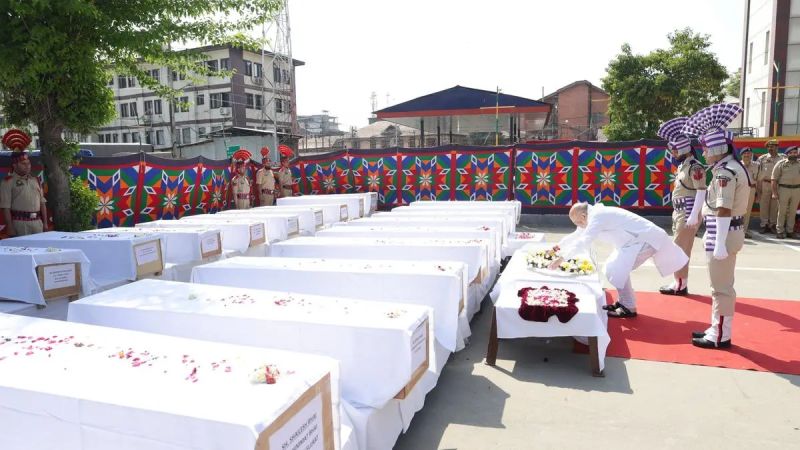
In a turn of events that lays bare the enduring proclivity of Pakistan’s military-intelligence apparatus for perfidious adventurism, the subcontinent has once again been plunged into the vortex of tragedy and retribution. On 22 April, the scenic tranquillity of Pahalgam in Jammu and Kashmir was shattered by a heinous act of terror—an attack carried out by assailants of Pakistani provenance, leaving in its wake a trail of innocent blood, most of it that of unsuspecting tourists.
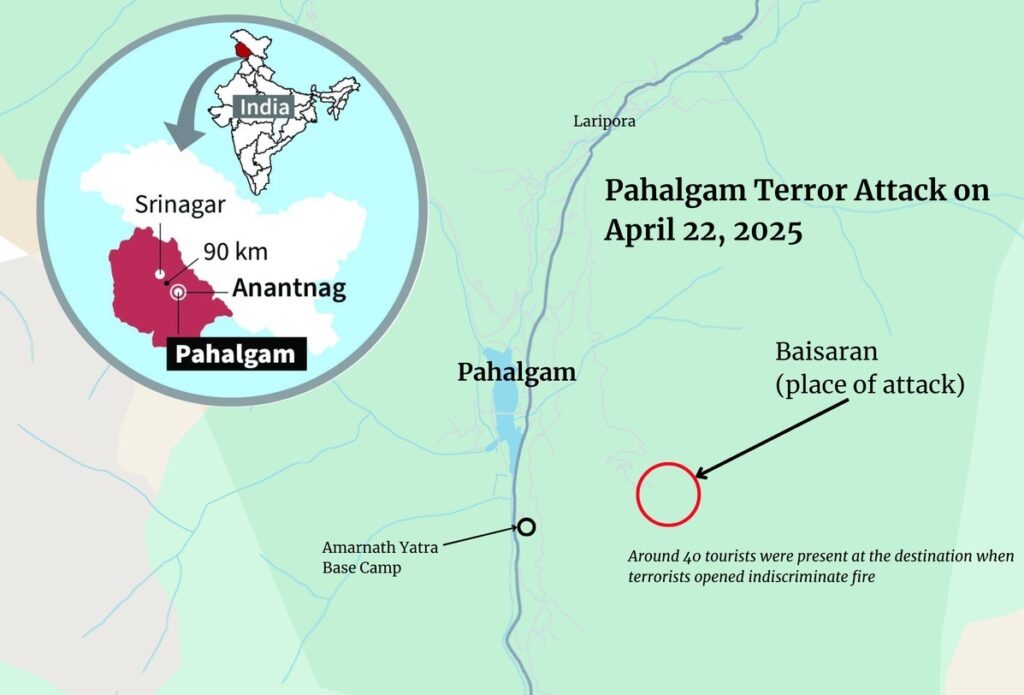
This egregious violation of human sanctity provoked an unequivocal and resolute response from New Delhi. In a swift Cabinet Sub-Committee review chaired by Prime Minister Narendra Modi on 23 April, the Indian government charted a bold course of action, announced by India’s Foreign Secretary Vikram Misri. Among the arsenal of retaliatory instruments under consideration, it was the suspension of India’s obligations under the Indus Waters Treaty (IWT) that emerged as the most telling—and symbolic—rebuke to Islamabad.
This abrupt departure from what has long been a pillar of regional diplomacy signals a watershed moment—both literally and metaphorically—in South Asia’s geopolitical tapestry. For more than six decades, the IWT has served as an improbable exemplar of bilateral cooperation, a rare artefact of amity amidst a chronically discordant relationship. That India should now suspend this treaty reflects a fundamental recalibration of its strategic posture, particularly vis-à-vis Pakistan’s sustained dalliance with proxy terrorism. But before one delves into the ramifications of this audacious move, one must first examine the edifice of the Indus Waters Treaty—its origins, its operational architecture, and the significance it has come to assume in both geopolitical and existential terms.
A Riverine Pact Forged in Discord
Conceived in the crucible of Cold War anxieties and brokered under the watchful eyes of the World Bank, the IWT was inked in 1960 after an arduous nine-year negotiation. At the heart of the agreement lay the equitable distribution of the six rivers of the Indus basin—the Indus, Jhelum, and Chenab in the west; and the Ravi, Beas, and Sutlej in the east.
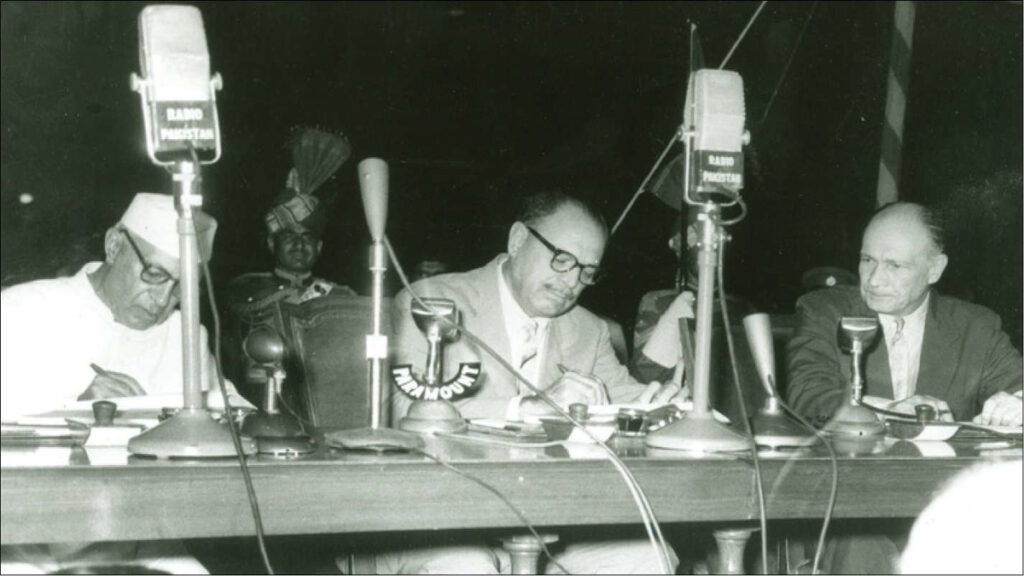
In what can only be described as an act of magnanimous restraint, India ceded exclusive control over the three Western rivers—comprising nearly 70% of the total water volume—to Pakistan, while retaining dominion over the three Eastern ones. This asymmetry, while glaring, was accepted in the spirit of regional stability and the hope that water, the most elemental of life’s resources, might also irrigate the parched soil of subcontinental peace. But alas, that noble aspiration has withered. Successive regimes in Islamabad have weaponised non-state actors, cultivating a cottage industry of jihadist terror that has repeatedly spilled across the Line of Control and stained Indian soil with blood. And yet, even amidst war and vitriol, India abided by the treaty, honouring its commitments with a stoic discipline that belied the provocations it endured. This forbearance, however, is not inexhaustible.
The Cost of Generosity
To understand the magnitude of India’s concession, consider the numbers. The Eastern rivers—Ravi, Beas, and Sutlej—over which India has unfettered rights, collectively yield about 41 billion cubic metres of water annually. The Western rivers, gifted to Pakistan, deliver nearly 99 billion cubic metres—more than double the volume under Indian control. This hydrological largesse has become the very artery of Pakistan’s survival. In a nation where agriculture constitutes over 25% of GDP and sustains approximately 70% of the populace, water is not a mere resource—it is an existential imperative. The Indus basin fuels its farms, powers its turbines, and feeds its people. To perturb this flow is to imperil the nation’s economic equilibrium and societal cohesion.
And yet, Pakistan’s security establishment has long treated this precious accommodation as a given—immutable, untouchable, and immune to the vagaries of geopolitical conduct. This misplaced confidence has emboldened it to pursue a duplicitous doctrine—of nurturing militant proxies even as it benefited from the benevolence of Indian water diplomacy.
The Straw That Broke the Canal
By suspending the IWT, India is sending a message steeped in symbolism but not lacking in substance. This is not merely an outburst of indignation—it is a calibrated policy shift. The message is unequivocal: India shall no longer subsidise its adversary’s antagonism with strategic concessions. If Pakistan insists on fomenting unrest through insidious means, it must also be prepared to forfeit the privileges accorded to it under treaties predicated on good faith.
One may argue, with some justification, that India’s current water infrastructure lacks the immediate capacity to divert or fully harness the Western rivers. The requisite reservoirs, barrages, and canal systems for such a hydrological overhaul are still under development. But in geopolitics, perception often precedes practice. The very act of invoking the treaty’s suspension has rattled the strategic calculus in Islamabad and laid bare the fragility of its assumptions.
For decades, Pakistan has operated on the belief that India’s strategic restraint—especially in the hydrological domain—was sacrosanct. It misread India’s civility as weakness. That illusion has now been spectacularly shattered.
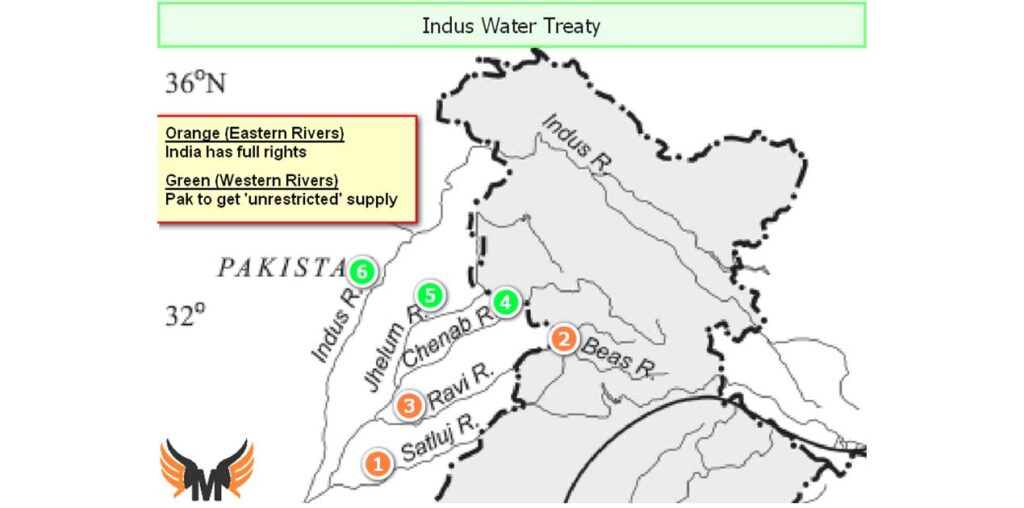
A Faustian Bargain That Failed
What, then, has Pakistan gained from its Faustian pact with terror? Has its strategy of bleeding India through a thousand cuts yielded dividends? On the contrary, the costs have been profound and self-defeating.
Far from “liberating” Kashmir or coercing India into negotiations on its own terms, Pakistan finds itself internationally isolated, diplomatically suspect, and economically anaemic. Worse still, the terror groups it once mentored have now metastasised, turning their guns inward and threatening the cohesion of the Pakistani state itself. The logic of proxy warfare—premised on the deniability of violence and the expendability of cannon fodder—has unravelled. In its place stands a polity riddled with extremism, plagued by economic fragility, and mired in geopolitical ignominy. The international community, once indulgent of Pakistan’s strategic anxieties, now views its double game with growing exasperation.
The Geopolitical Ripple Effect
India’s suspension of the IWT, while unilateral in action, has multilateral implications. It signals to the world that New Delhi is prepared to reframe the contours of South Asian diplomacy. Water—long considered sacrosanct—can no longer be divorced
To paraphrase the ancient wisdom of the East, one cannot bathe twice in the same river—because the water has moved on, and so has time. Pakistan, too, must now move on—from the shackles of militancy, from the dogmas of military overreach, and from the delusion that duplicity can be a permanent policy.
If it fails to do so, history may not be as forgiving as the Indus once was.