
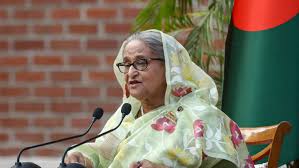
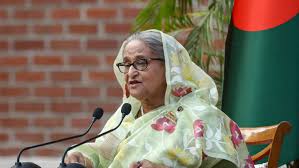
Former Bangladesh prime minister Sheikh Hasina has issued a sharp warning about the state of democracy in Bangladesh, arguing that the country is being governed without legitimate public mandate and that political stability will remain elusive unless inclusive elections are restored. Speaking in a wide-ranging interview, Hasina reflected on the political unrest that led to her departure from office in 2024 and offered a critical assessment of the current interim administration. She said the protests that began as student-led demonstrations were later overtaken by radical elements, resulting in widespread violence, destruction of public property and attacks on law enforcement personnel.
Hasina said her decision to leave the country was taken to prevent further bloodshed as the situation deteriorated. She rejected claims that her government suppressed peaceful dissent, stating that her administration initially allowed protests and sought accountability through judicial mechanisms. The former prime minister was particularly critical of the interim government led by Muhammad Yunus, arguing that it lacks democratic legitimacy because it was not elected by the people. She said banning the Awami League — a party that has won multiple national elections — and detaining its leaders undermines the foundations of democratic governance.
According to Hasina, meaningful political normalisation in Bangladesh requires the lifting of restrictions on political parties, the release of political detainees and the holding of free, fair and inclusive elections. Without these steps, she warned, any future government would struggle to gain domestic or international credibility. Hasina also accused the interim administration of dissolving inquiry processes into the 2024 violence and of empowering extremist groups, alleging that such actions have weakened law and order and endangered minority communities. She expressed concern that the current political climate has discouraged investment and stalled economic momentum built over the past decade.
Defending her own record, Hasina highlighted her role in restoring democratic institutions after periods of military rule and pointed to sustained economic growth, infrastructure development and poverty reduction during her tenure. She maintained that democratic governance requires both strong institutions and the participation of all major political forces. On foreign policy, Hasina cautioned against major strategic realignments by a government without an electoral mandate, arguing that long-term national interests should reflect the will of the people rather than interim political arrangements.
Her remarks come as Bangladesh prepares for national elections amid heightened political polarisation and questions over inclusivity. Observers note that the exclusion of major political parties could undermine voter confidence and deepen instability. As debates over Bangladesh’s democratic future intensify, Hasina’s comments underscore the central question facing the country: whether political order can be restored without broad public participation and electoral legitimacy.
The interim government has now been in power for nine months, yet Bangladesh remains trapped in a cycle of political turmoil and uncertainty. On one side, political parties are more fragmented than ever before, while on the other, the interim administration continues to struggle with addressing the country’s persistent socio-economic and political challenges.

Although interim government was established with broad consensus among civil society, political leaders, and the military following the mass uprising of 2024, the interim government under Dr Yunus has faced considerable difficulties since its formation. Indeed, much of the disorder that has engulfed the nation since last August can be attributed to the Yunus administration. While there was initial enthusiasm for a reformed Bangladesh, free from its authoritarian legacy, the interim government has largely proven to be a passive administration, repeatedly mired in controversy.
It could be argued that the criticisms directed at the Yunus administration originate from remnants of the deposed Hasina regime. Dr Yunus has secured considerable support from global leaders, thereby legitimising the interim government and receiving strong endorsement primarily from Western countries in its pursuit of reforms and conduct of elections. Nonetheless, domestically, the legislative initiatives intended to implement reforms have encountered opposition not only from some of the very factions that contributed to the establishment of the interim government but also from international human rights organisations. Key legislative measures include the Cyber Protection Ordinance, amendments to the International Crimes (Tribunals) Act, and the Anti-Terrorism Act.
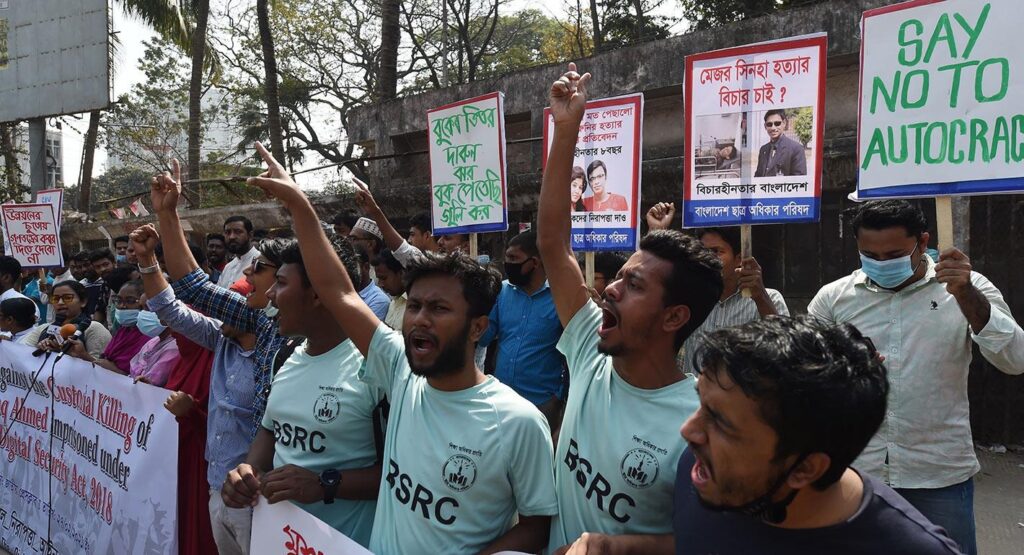
The state of media freedom in Bangladesh remains deeply concerning, with numerous reports of violence, harassment, censorship, and prosecution of journalists and media outlets. Often these outlets are being accused by the interim government as collaborators with the Awami League—contradicting its commitment to uphold press freedom. The introduction of the Cyber Protection Ordinance, which replaced the contentious Cyber Security Act (CSA), quickly sparked apprehension regarding the government’s surveillance practices under the guise of enhancing cyber security. Organisations such as Transparency International Bangladesh (TIB) criticised the ordinance for being approved without adequate public consultation and for retaining CSA’s surveillance provisions, thereby posing a potential threat to media freedom in the future. This development coincided with the interim government’s cancellation of press accreditation for 167 journalists and the filing of charges of “crimes against humanity” against 25 journalists due to their alleged links with the Awami League government, provoking condemnation from human rights groups. Media freedom remains a critical concern, exhibiting patterns reminiscent of the previous administration. The most recent report by the Rights and Risk Analysis Group (RRAG), published on World Press Freedom Day 2025—when Bangladesh ranked 149th out of 180 countries—revealed that in the eight months under Dr Yunus’s interim government, 640 journalists were targeted. The administration’s efforts to suppress media critical of Yunus have involved not only branding them as pro-Awami League but also revoking press accreditations, resorting to violence, and levying criminal charges including money laundering, criminal offences, and terrorism. Consequently, urgent media reforms demand serious and immediate attention.
The amendment of the International Crimes (Tribunals) Act through an ordinance extended the powers of investigative offices to conduct searches and seize evidence without prior approval from the tribunal. Additionally, the new ordinance authorised the tribunal to freeze and confiscate the assets of the accused. More recently, a second amendment introduced provisions allowing the trial and punishment of ‘organisations’ for crimes within the tribunal’s jurisdiction. In essence, these amendments enhanced the tribunal’s authority to ban organisations, confiscate their properties, and suspend their registration if found guilty of crimes against humanity. Initially, political parties were included in the ordinance, but this was subsequently removed to avoid political controversy. Nonetheless, these amendments—particularly the second—have attracted significant criticism from human rights organisations such as Human Rights Watch (HRW), which argue that they undermine fundamental human rights. Concerns have been raised that these changes could be exploited as tools for political repression of opposition groups, lacking adequate accountability, thus posing a threat to democratic principles. The ban on the Awami League has only reinforced this scepticism.

On the 11th of this month, the interim government approved the draft ordinance of the Anti-Terrorism (Amendment) Act, introducing a new provision to prohibit activities of individuals or ‘entities’ involved in terrorism, thereby granting the government extensive powers to regulate political activities. Just one day earlier, the interim government imposed a ban on the “activities” of the Awami League amid increasing pressure from the Nationalist Communist Party (NCP) and Islamic parties. The ordinance, approved overnight, revised the existing Anti-Terrorism Act of 2009 and was subsequently used on 12 May to officially disband the Awami League, providing a clear indication of arbitrary targeting and suppression without accountability. This action provoked widespread condemnation from foreign governments, international human rights organisations, as well as domestic political leaders and analysts. The systematic targeting of Awami League leaders, activists, and supporters—who have faced mob violence over the past nine months—has sparked concern and criticism over the interim government’s failure to prevent the country’s descent into lawlessness. Instead, through the launch of Operation Devil Hunt aimed at curbing mob attacks, the interim government appeared to be settling political scores by arresting a disproportionate number of League sympathisers. The banning of a political party mirrored the authoritarian tactics of the deposed government, now widely labelled ‘fascist’, fuelling fears of a further erosion of democratic space. Moreover, the interim government’s ordinance on enforced disappearance has also faced criticism for lacking public consultation, accountability measures, and failing to address past abuses.
The interim government’s recent legislative initiatives, presented as reforms, amount to little more than old wine in new bottles. While political parties in Bangladesh remain divided on the issue, international human rights organisations have been unequivocal in their criticism—these measures pose a significant threat to fundamental human freedoms. The interim government’s political vendetta has become increasingly apparent, as has the growing shadow of disapproval cast over the Yunus administration.