
Pakistan’s Finance Minister Muhammad Aurangzeb has become one of the busiest travelers in global finance. One week he’s in Washington, lobbying the International Monetary Fund (IMF) for yet another tranche of emergency funding; the next, he’s in Riyadh or Abu Dhabi pitching the sale of Pakistan’s national assets from Pakistan International Airlines (PIA) to airports and energy infrastructure.
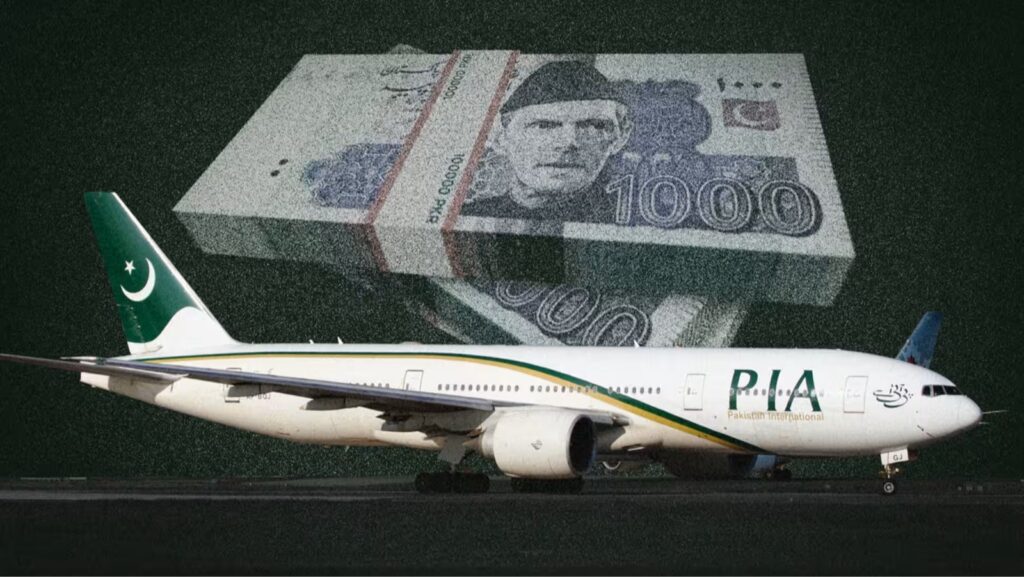
In many ways, Aurangzeb is less a finance minister than a broker of desperation, auctioning off what remains of Pakistan’s economic sovereignty. The country’s fiscal crisis is not new but continues to be in a risky phase. Pakistan is no longer merely borrowing to stay solvent; it is now being compelled to sell off the remnants of its public sector to keep the economy breathing.
Yet, despite repeated bailouts and promises of reform, the fundamental ailments of Pakistan’s economic system, that is entrenched elite capture, structural inefficiency, and the outsized role of the military in its financial life, remain untouched. Pakistan’s economy has teetered on the brink of default for over three years. In April 2022, the country narrowly averted a sovereign debt crisis. Its inflation skyrocketed to approximately 38 per cent in May 2023 while foreign exchange reserves dropped exponentially to $8.7 billion by February 2023.
Since then, Islamabad has received two IMF bailout packages, multiple loan deferments from China and oil and gas deferred payment options from the Gulf states. But these have merely bought time, not transformation. The numbers tell the story. Pakistan’s external debt has hovered above $130 billion for over a year, while foreign exchange reserves remain dangerously thin, currently at around $19 billion which can cover only a month and half of its imports.
Inflation has oscillated between 3 and 38 per cent, which has qualitatively eroded the purchasing power of ordinary Pakistanis. The rupee continues to slide with 1 USD priced at over 285 PKR whereas energy prices remain high with petrol priced at PKR 265 per liter and diesel at PKR 275 per liter have soared. Moreover, the unemployment rates are only increasing and are currently recorded at around 8 per cent whereas nearly 40 per cent of people battle multidimensional poverty as per latest statics from UN Development Programme (UNDP).
Yet, what stands out is not the depth of Pakistan’s economic pain but the shallowness of its political will to reform. Each IMF program since the 1980s has come up with a familiar checklist of reducing subsidies, broadening the tax base and improving fiscal transparency. And each time, Pakistan has promised compliance but never moved beyond policy rhetoric. The current government’s “reform agenda” under Prime Minister Shehbaz Sharif and Finance Minister Aurangzeb has been no different. While the rhetoric of “structural transformation” fills speeches and communiques, but the reality is cosmetic tinkering.
Take the case of broadening the taxation base of the country. Despite years of IMF insistence, Pakistan’s tax-to-GDP ratio remains stuck at around 9 per cent, which remains one of the lowest in Asia. Its situation has been worsened by the fact that the wealthy elite, including feudal landlords, industrial magnates, and military-linked conglomerates, have largely found ways to escape the tax bracket. Meanwhile, the burden falls disproportionately on the salaried middle class and consumers through indirect taxes.
–IANS
A new 186-page report by the International Monetary Fund (IMF) has again highlighted an uncomfortable reality: Pakistan’s economic troubles are mainly the result of internal weaknesses, not outside pressure.
The report says corruption, weak institutions, and powerful vested interests have pushed the country to the edge of economic collapse, according to Pakistan Observer website.
According to the IMF, corruption affects almost every level of governance in Pakistan. Policymaking is often controlled by influential groups that use state institutions for personal gain. The report said Pakistan has no reliable system to measure corruption, but one indicator is the National Accountability Bureau’s recovery of 5,300 billion rupees in just two years. Even this massive figure, the IMF says, represents only a small part of the bigger problem, as per the report.
The report states that ordinary people face corruption in everyday services, while the judiciary is widely seen as compromised. Public trust in state institutions has been steadily falling. It also notes how powerful business and political groups manipulate regulations and laws to protect their interests. The IMF cites the 2019 sugar crisis as a clear example. Influential business networks hoarded sugar, increased prices, and moved billions through fake accounts, while the state did little to stop them. Beyond such scandals, the IMF points to deeper structural issues such as a complicated tax system, weak financial management, non-transparent government buying processes, and poor performance in public institutions. It says Pakistan could add 5 to 6.5 percent more GDP growth over five years if it implements serious governance reforms.
The IMF report also highlights that corruption in Pakistan is not new. Both civilian and military governments have promised reforms but ended up creating new forms of misuse. Many leaders dismiss corruption allegations as political attacks, which allows the problem to continue unchecked. The IMF’s findings, however, cannot be brushed aside as political — they are based on independent analysis. The report warns that unless Pakistan breaks the power of strong business families, political dynasties, and elite groups, the country will remain in crisis. Citizens pay heavy taxes and high utility bills, yet public wealth benefits only a small group. The IMF says this imbalance harms not just the economy but also the moral foundation of the country. The report also points to global examples where strong action against corruption led to major reforms.
Countries like China, Japan, South Korea, Singapore, Saudi Arabia, the UAE, Malaysia, Indonesia, and Rwanda have punished powerful officials, business leaders, and even former presidents. Their common principle is that no one is above the law.For Pakistan to follow the same path, the report suggests that accountability institutions must work independently, without political control. Judicial appointments need transparency. Political influence in state departments must end. Taxes should be simplified, government procurement must be transparent, and political financing must be regulated so that policymaking reflects public interest, not elite pressure. The IMF says its report is not meant to punish Pakistan, but to give it one last opportunity to fix its governance system. If Pakistan continues to borrow from the IMF, then it must also implement the governance reforms recommended in the report. Those responsible for the current crisis must show restraint and accept accountability.
–IANS

Pakistan’s enduring economic difficulties are well recognised globally. In recent years, the nation has experienced alarming inflation, an ongoing crisis in foreign exchange reserves, and an overwhelming debt burden. These issues have led to widespread unemployment, increased poverty, and daily hardships for a population already caught in the crossfire of recurring terrorist violence and military operations ostensibly aimed at countering it. Nevertheless, despite this worsening scenario and the harsh effects of austerity measures imposed by the IMF on the populace, Pakistan’s disproportionately large military appears unaffected and is, in fact, gradually expanding its share of the national economy.
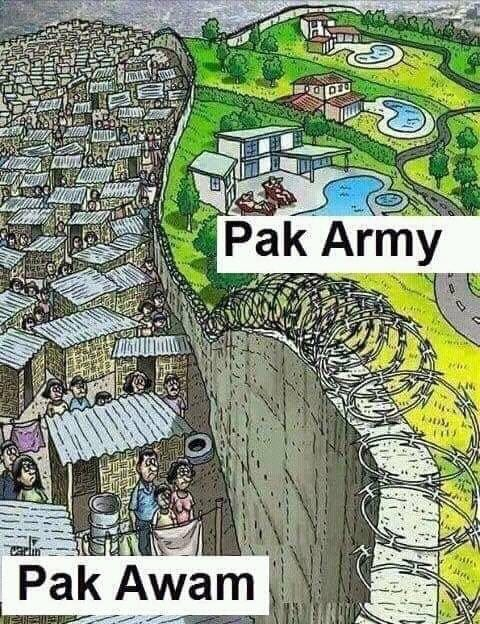
The expansive role of the military in Pakistan’s domestic affairs extends beyond politics and foreign policy, significantly permeating the economic sphere. To begin with, the military absorbs a substantial portion of the GDP—Pakistan’s defence expenditure for FY2025 stood at 2.3% of GDP, exceeding equivalent figures for India, China, and the European Union. According to a study by Moneycontrol, Pakistan’s defence budget experienced an annual growth rate of 12.6% between FY17 and FY25, compared to India’s 8%. In contrast, education and healthcare were allocated merely 2% and 1.3% of the GDP, respectively.
In addition, the military has developed an extensive private conglomerate, commonly referred to as the ‘milbus’ (military business)—a term introduced by prominent scholar Ayesha Siddiqa in her seminal work Military Inc.: Inside Pakistan’s Military Economy. Through a network of commercial enterprises, including the Fauji Foundation, Army Welfare Trust, Shaheen Foundation, Bahria Foundation, and the highly contentious Defence Housing Authority (DHA), the military has embedded itself across numerous sectors such as real estate, banking, manufacturing, agriculture, shipping, education, and media. Some estimates suggest that the military controls approximately 12% of the nation’s land.
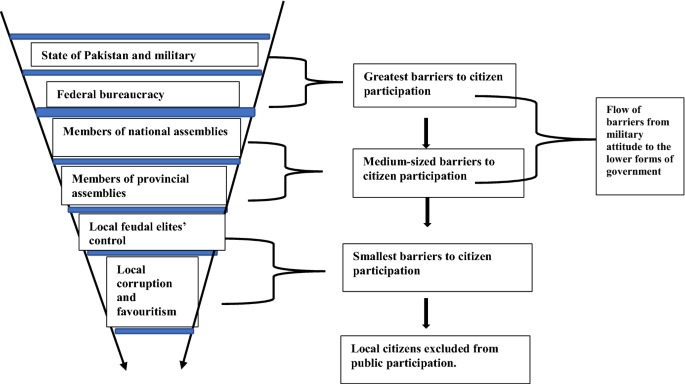
Although the military and its proponents contend that the professionalism, stability, and efficiency it represents are reflected in its economic endeavours, many critics challenge the monopolistic, expansive, and opaque nature of this military dominance. Defence-operated industries suppress local competition and private enterprise, while benefiting from tax concessions and minimal regulatory oversight. By blurring the boundary between protector and profiteer, the military prioritises strategic positioning and its own commercial gain over public welfare and principles of market equity. These concerns are amplified when certain ventures become entangled in corruption scandals, such as the DHA Valley Islamabad fraud, or disregard public interests, as seen in the Indus canals initiative. The DHA—initially established to offer affordable housing for retired military personnel but now catering to elite residential projects—has faced widespread criticism over questionable land acquisitions and community displacements to benefit the privileged. Moreover, the inclusion of senior military officials in the 2021 Pandora Papers exposed the extent to which they funnel vital national assets through offshore financial channels.
The ‘milbus’ in Pakistan has not only exacerbated the persistent and severe underinvestment in human development, but the military’s substantial economic influence also reinforces its political dominance within the country. It is well established that the military remains the most powerful institution in Pakistan, having governed directly for nearly three decades and exerting significant influence behind the scenes during periods of civilian administration. Given the military’s pervasive control over the economy, civilian governments are largely stripped of the ability to make independent decisions based on the needs and interests of the populace.
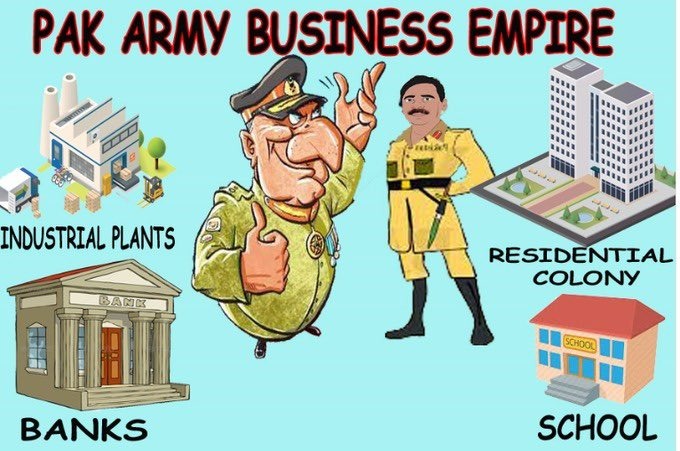
Thus, the expansive economic domain of the military in Pakistan has a direct impact on the nation’s socio-economic stability. On one hand, defence-operated enterprises—shielded from public audits and regulatory scrutiny—create monopolies that undermine local businesses, deplete public resources, and significantly intensify inequality. On the other hand, the ‘milbus’ entrenches authoritarianism, rendering civilian governments largely symbolic. At a time when the country’s economic crisis continues to spiral, inflicting severe hardship on ordinary citizens, it is essential to critically reassess the allocation of national resources, particularly those directed towards the military. The military’s vast commercial ventures must be brought under the same regulatory framework as civilian enterprises, and its market dominance restricted. Achieving this requires a fundamental recalibration of civil-military relations, along with a reflective discourse on the appropriate role of the military within a democratic framework.