
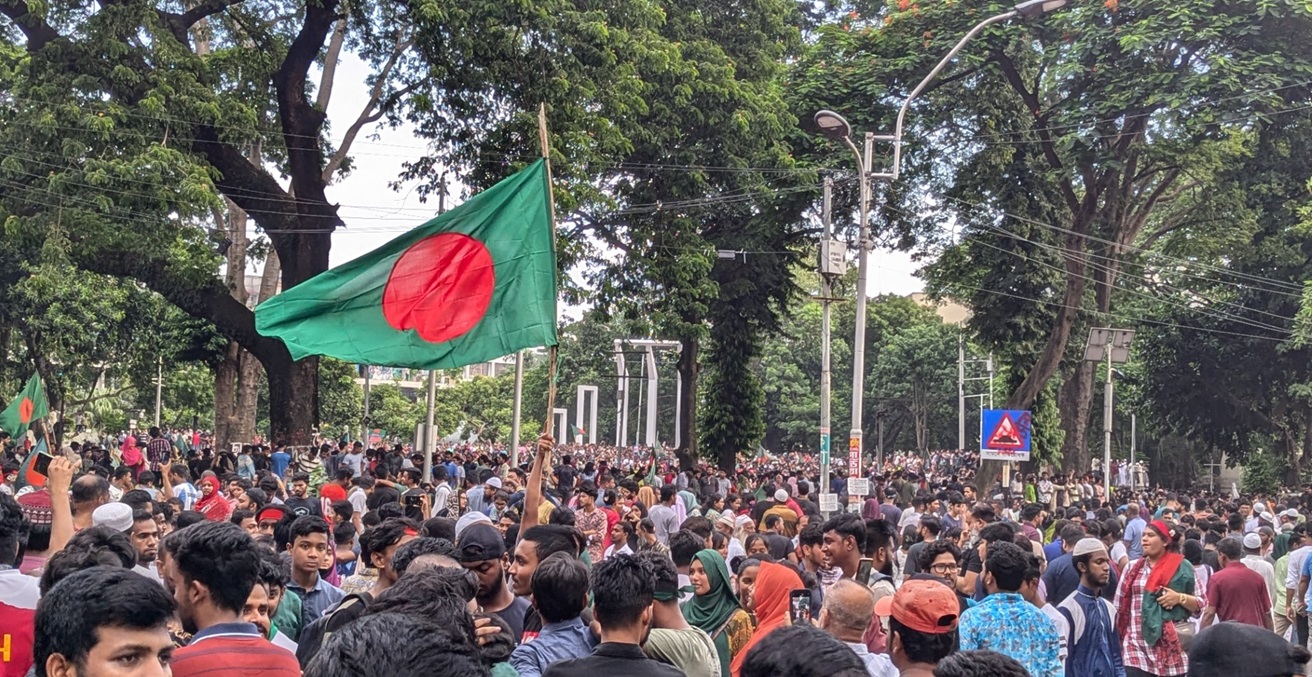
Eight months have elapsed since the resounding crescendo of civic unrest reverberated through the streets of Dhaka and beyond—a movement now etched into contemporary Bangladeshi history as the transformative July Uprising of 2024. The student-led revolt, galvanised by a weary citizenry exhausted by fifteen uninterrupted years of Sheikh Hasina’s increasingly authoritarian reign, precipitated the fall of a regime many had come to regard as synonymous with unbridled majoritarianism and the erosion of democratic norms.
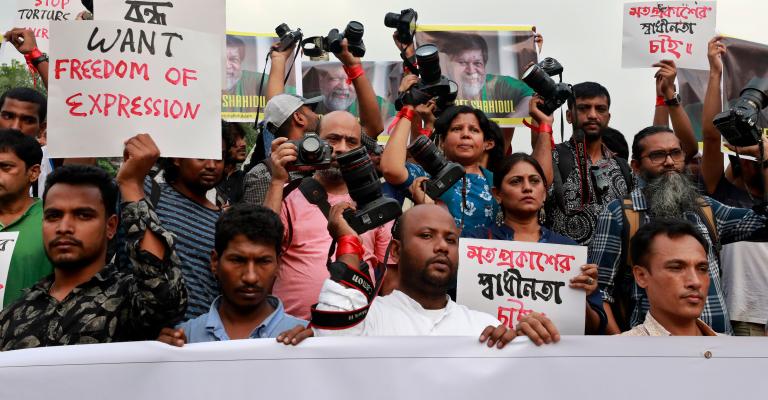
To fill the ensuing political vacuum, and ostensibly to shepherd the country through an equitable and peaceful democratic transition—something many Bangladeshis believe has been perennially elusive—a provisional apparatus of governance was constituted. Thus, on the 8th of August 2024, the Interim Government was born, led by none other than the venerable Dr Muhammad Yunus, Nobel Laureate and paragon of ethical capitalism. He assumed the mantle of Chief Advisor, entrusted with the Herculean task of stabilising a beleaguered state, instituting crucial reforms, and, most crucially, preparing the ground for a free and fair general election that would usher Bangladesh from the throes of perceived fascism into the luminous embrace of democratic revival.
Commencing with a retinue of sixteen advisors—a council subsequently expanded to twenty-one to reflect the national appetite for reform and rejuvenation—the interim regime drew cautious optimism both domestically and abroad. Dr Yunus was even featured in Time magazine’s list of the 100 most influential people for his pivotal role in “steering Bangladesh toward democracy following last year’s student-led uprising.” And yet, beneath this veneer of progress, the state of the nation has grown only more labyrinthine, with multiple fault lines deepening. As we stand at the octagonal milestone of this transitional government, it is both timely and imperative to evaluate its performance through several key prisms.
Of Persecution and Prejudice: Minorities under Siege
One of the most tragic ironies of this so-called democratic rebirth has been the abrupt surge in attacks on religious minorities. Far from heralding a new era of inclusivity, the post-Hasina epoch has witnessed a disturbing uptick in communal hostilities—many of which are allegedly orchestrated by groups vehemently opposed to the former regime. Between the 5th and 25th of August alone, over a thousand communal incidents were recorded, including acts of arson, looting, desecration of places of worship, and targeted violence against individuals from religious minorities.
While communal violence is regrettably not a novel phenomenon in Bangladesh’s socio-political landscape, the interim government’s response—or lack thereof—has been particularly dispiriting. Rather than acknowledging the sectarian undertones of these attacks, the authorities have consistently downplayed them as “politically motivated incidents,” even going so far as to label the media’s coverage as “exaggerated”. This obfuscation culminated in October during the sacred Durga Puja celebrations, when a spate of violent attacks against Hindus drew national and international opprobrium. The interim government’s rather sheepish declaration of “collective failure” offered scant solace to the victims.
To compound the travesty, when Hindu communities rallied in protest, several of their spiritual leaders were unceremoniously detained on charges of sedition. This chilling sequence of events exposes the interim authority’s alarming refusal to confront what appears to be a systemic pattern of persecution—raising profound concerns about the fate of minorities in the so-called “New Bangladesh.”
Unrest in the Hills: The Forgotten Frontiers
Parallel to the plight of religious minorities is the deteriorating condition of Bangladesh’s ethnic communities, particularly those inhabiting the restive Chittagong Hill Tracts (CHT). Since September of last year, the CHT has become a crucible of ethnic tension and conflict, with over 200 documented instances of human rights violations. The alleged complicity of the Bangladesh Army, which is believed to be tacitly supporting the interim regime, adds a sinister dimension to this unfolding crisis.
These violations include unlawful land grabs, destruction of indigenous properties, and systemic harassment by Bengali settlers and law enforcement agencies. Despite repeated calls for action, the interim government has remained conspicuously inert, preferring instead to label the crisis as an “internal administrative matter”—a semantic sleight of hand that serves only to trivialise the gravity of the situation.
While the 1997 Peace Accord promised autonomy and protection to the indigenous populations, its implementation remains elusive. The government’s reluctance to engage indigenous leaders or uphold their cultural and political rights betrays a troubling inclination to placate fundamentalist factions at the expense of pluralism. Recent incidents, such as the abduction of five university students and the rape of an ethnic minority girl, have further inflamed tensions. Yet, Home Advisor Lt Gen (Retd) Md Jahangir Alam Chowdhury blithely claimed that “the hills are more peaceful than ever”—a statement that borders on Orwellian absurdity.
A Mobocracy in the Making
The culture of lawlessness has not restricted itself to minority communities. Indeed, the entire country seems to be held hostage to a rapidly metastasising mob culture. Vigilante groups—emboldened by a palpable sense of impunity—have been marauding through cities and towns, targeting anyone perceived to be an affiliate or sympathiser of the erstwhile Awami League regime. Acts of vandalism and public lynching have become grotesquely normalised, and the interim government has responded with a silence that is deafening.
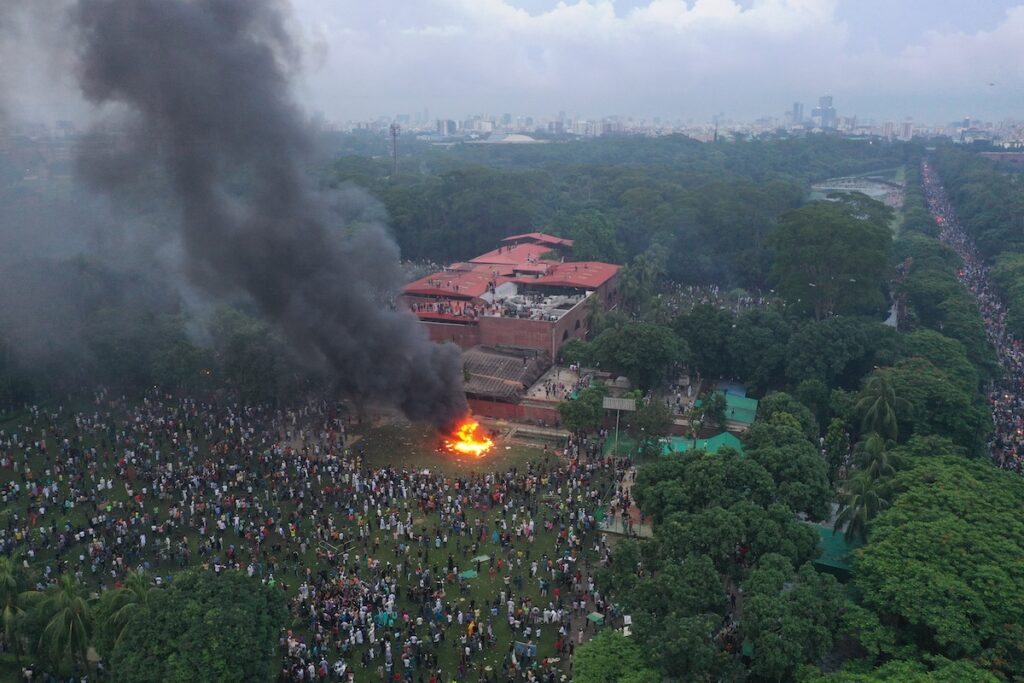
Perhaps the most symbolic manifestation of this new anarchy was the “Bulldozer Procession” that desecrated 32 Dhanmondi—the erstwhile residence of Bangabandhu Sheikh Mujibur Rahman. Rather than issuing a robust denunciation, the interim regime deflected blame onto the fallen Prime Minister herself, accusing her of provoking the unrest. When voices from civil society rose in protest, the government responded not with contrition but with coercion, launching the ominously titled “Operation Devil Hunt.”
This sweeping initiative purported to neutralise disruptive elements. In reality, it served as a mechanism to incarcerate scores of Awami League loyalists under flimsy pretexts. Far from curbing mob violence, the operation revealed a thinly veiled vendetta masquerading as law enforcement. The Home Advisor’s assertion that “law and order remains satisfactory” is not only disingenuous but dangerously delusional.
Theocratic Tendencies: A Secular State in Peril
Perhaps the most alarming transformation under the interim dispensation has been the creeping ascendancy of religious fundamentalism. Groups like Towhidi Janata, believed to be fronting for the ultra-conservative Hefazat-e-Islam, have taken to the streets with disturbing regularity, disrupting cultural festivals and imposing their puritanical mores upon the public sphere. Events celebrating Lalon Shah, Basanta Utsav, and even Pahela Baishakh have come under attack, derided as “un-Islamic” by these self-styled guardians of morality.
Even more perturbing is the group’s open advocacy for the replacement of Bangladesh’s secular legal framework with an interpretation of Sharia, and, more audaciously, the establishment of a Khilafat—a theocratic caliphate—in place of the current democratic system. The interim government’s reaction? Tepid at best, complicit at worst! There has been a conspicuous absence of any concrete initiative to counteract these regressive forces.
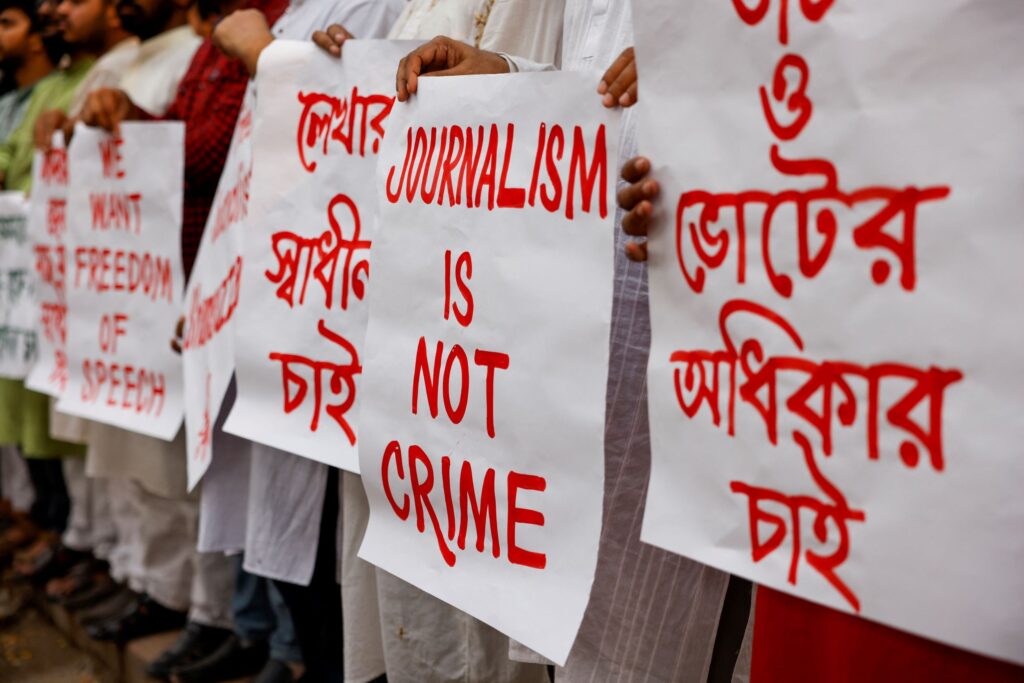
In fact, the government’s acquiescence has emboldened fundamentalist demands, which are now influencing constitutional reform dialogues. Proposals to remove secularism, socialism, and nationalism as foundational tenets of the state are reportedly on the table—an alarming development that threatens to dismantle the very ethos upon which Bangladesh was founded.
An Election Deferred? The Mirage of Democratic Transition
And what of the interim government’s raison d’être—its solemn promise to oversee a timely and transparent general election? Here, too, there is more ambiguity than assurance. Dr Yunus recently floated a tentative window for the polls—between December 2025 and July 2026—following increasing pressure from political quarters. Yet, no definitive electoral roadmap has been divulged.
The Home Advisor’s controversial statement that the people are “requesting” the interim government to remain in power for an additional five years has only intensified suspicion. Is this interim arrangement morphing into a pseudo-permanent regime? Political parties have already begun voicing their discontent, arguing that reforms must follow elections, not precede them. After all, the interim government, lacking constitutional legitimacy, was never intended to substitute a democratically elected dispensation.
A Promise Deferred, a Nation in Flux
After eight months of governance, the interim government finds itself on precarious terrain. Far from guiding Bangladesh towards the promised land of democratic rejuvenation, it has instead presided over an era marked by increased intolerance, emboldened fundamentalism, and institutional inertia. Minority groups are under siege, mob rule festers, and the secular fabric of the nation is unravelling thread by thread.
Without swift course correction, the vision of “Bangladesh 2.0”—a vibrant, pluralistic democracy—risks becoming a mirage in a desert of disillusionment. The interim government must remember that it was borne out of revolution, not resignation. The people did not depose a despot only to be ruled by the shadows of chaos and indecision. The hour is late, the stakes are high, and history shall not be kind to procrastinators.
As Bangladesh stood poised on the cusp of Eid festivities, an ominous pronouncement by Army Chief Waqar Uz-Zaman cast a shadow over the jubilations. With the gravitas befitting his station, he forewarned the nation of an imminent terrorist strike, alluding to intelligence reports that hinted at an insidious conspiracy brewing in the nation’s underbelly. This revelation, however, was neither unheralded nor unprecedented; it merely underscored the prescience of his earlier exhortations, wherein he had urged the polity to desist from internecine strife, cautioning that such acrimonious discord not only debilitates national unity but also imperils the very sovereignty of Bangladesh. His trepidations, as it now transpires, were not misplaced.
The eminent New York Times, in a recent exposé, corroborated his forebodings, asserting that Islamist hardliners were emboldened by the nation’s prevailing political lacuna and were making audacious forays into the public domain, unabashedly seeking to resurrect their ideological dominion. Indeed, this resurgence is but a macabre reprise of Bangladesh’s long and troubled entanglement with Islamic extremism, which first took root in the twilight years of the twentieth century.
The radical outfits operating within Bangladesh have, over the decades, drawn sustenance from transnational terrorist syndicates, most notably the Taliban, al-Qaeda, and, more contemporaneously, the Islamic State of Iraq and Syria (ISIS). Their nefarious machinations, invariably, orbit around a singular and unrelenting objective—the imposition of Islamic rule in Bangladesh, a nation whose constitutional secularism stands in stark opposition to their theocratic aspirations. In pursuit of this ignoble end, their targets have been carefully calibrated: secularists, religious minorities, and any entity or individual whose existence or expression is perceived as inimical to their rigid dogma.
The annals of Bangladesh’s contemporary history bear grim testament to their ruthlessness. From the turn of the millennium, the nation has been buffeted by a series of sanguinary terror attacks, each meticulously orchestrated to instill fear and assert dominion. The apogee of their savagery, perhaps, was the ghastly carnage perpetrated at the Holey Artisan Café in 2016. The grisly hostage crisis that unfurled therein claimed twenty-two lives, the majority of them foreign nationals, and indelibly etched itself into the collective consciousness of the nation. What rendered this atrocity particularly disquieting was its modus operandi, which bore an uncanny resemblance to the tactics deployed by ISIS. This harrowing episode marked the first incontrovertible indication that ISIS’s baleful influence had penetrated Bangladesh’s borders, dispelling any lingering skepticism regarding its reach.
The digital realm has, unsurprisingly, proven to be a fecund battleground for the dissemination of extremist propaganda. With an astuteness that belies their medievalist ideological underpinnings, ISIS operatives have harnessed the far-reaching tentacles of cyberspace, employing indigenous linguistic mediums to indoctrinate and recruit. The dissemination of their pernicious rhetoric in Bangla—a language spoken by nearly 99 percent of Bangladesh’s populace—has served to extend their tentacular grip into the remotest corners of the nation. This calculated exploitation of cyber radicalism has precipitated a perceptible ideological shift among Bangladesh’s homegrown extremist factions, who now increasingly subscribe to the doctrinaire vision of an Islamic Caliphate—a vision assiduously cultivated and propagated by ISIS.
A glaring exemplar of this ideological metamorphosis is the trajectory of the Ansarullah Bangla Team (ABT), a militant conglomerate that initially operated under the aegis of al-Qaeda. Formed in 2007, this nefarious syndicate orchestrated a series of targeted assassinations against secular bloggers, writers, and activists between 2013 and 2015. However, in the aftermath of ISIS’s ascension to prominence on the global jihadist stage, ABT unequivocally pledged allegiance to its cause, a testament to the latter’s magnetic pull in radicalizing impressionable minds.
While the erstwhile government had, to a considerable extent, managed to curb the proliferation of violent extremism, the political upheaval engendered by the ouster of Sheikh Hasina in August last year has catalyzed an alarming re-emergence of these insidious forces. In the wake of her departure, a disquieting lawlessness has permeated the polity, affording these extremist factions an unprecedented opportunity to reassert themselves.
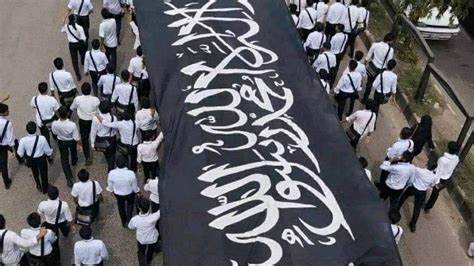
Of particular concern is the resurgence of Hizb ut-Tahrir Bangladesh, an organization that has long been proscribed in the country due to its seditious proclivities. Notorious for its abortive coup attempt in 2011, this transnational jihadist outfit has ideological congruence with ISIS and has now re-emerged with newfound fervor. The immediacy of its resurgence—mere days after Hasina’s deposition—raises perturbing questions about the efficacy of state mechanisms in preempting such resuscitations. In recent months, its adherents have mounted vociferous demonstrations, brazenly demanding the rescission of the ban imposed upon them and clamoring for the establishment of an Islamic Caliphate in Bangladesh. The most conspicuous manifestation of this effrontery was the ‘March for Khilafat’ protest in Dhaka, an event that saw a congregation of ‘Conscious Teachers and Students’ bearing flags uncannily reminiscent of ISIS’s insignia and chanting incendiary slogans. That such a spectacle transpired within the nation’s capital—drawing participation from sections of the educated elite—ought to serve as a dire warning of the extent to which cyber radicalism has permeated urban echelons.
This resurgence of Islamist militancy is not merely an ephemeral phenomenon; it constitutes a structural threat to Bangladesh’s democratic fabric. The re-emergence of Hizb ut-Tahrir, which remains proscribed in thirteen nations, should serve as a cautionary tale. The situation is further exacerbated by the unsettling decision of the interim government, helmed by Nobel laureate Muhammad Yunus, to release several individuals previously convicted of terrorism-related offenses. Such a move, particularly against the backdrop of a deteriorating law and order situation, rampant mob violence, and escalating cases of sexual aggression, augments the prevailing atmosphere of apprehension.
The interim government’s apparent apathy towards this burgeoning menace has not gone unnoticed, least of all by the military establishment. Army Chief Waqar Uz-Zaman’s palpable discontent is emblematic of the growing dissonance between the state apparatus and the armed forces, particularly as Pakistan’s Inter-Services Intelligence (ISI) purportedly amplifies its covert operations on Bangladeshi soil. Should this inertia persist, the Army Chief’s cautionary pronouncement may well transmute into a catastrophic reality—one that Bangladesh may find itself ill-equipped to surmount.