
–Aminul Hoque Polash
A recent report in The Washington Post cited a US diplomat working in Bangladesh, claiming Washington wants to build “friendly relations” with Jamaat-e-Islami. The diplomat reportedly made the remarks in a closed-door discussion with a group of Bangladeshi women journalists on 1 December. The newspaper’s report, we are told, was built around an audio recording of that conversation.
In that recording, the diplomat expressed optimism that Jamaat would perform far better in the 12 February election than it has in the past. He even suggested the journalists invite representatives of Jamaat’s student wing to their programmes and events.
When the journalists raised a fear that Jamaat, if empowered, could enforce Sharia law, the diplomat’s response was striking: he said he did not believe Jamaat would implement Sharia. And even if it did, he added, Washington could respond with measures such as tariffs. He was also heard arguing that Jamaat includes many university graduates in leadership and would not take such a decision.
The Washington Post further quoted multiple political analysts suggesting Jamaat could achieve its best result in history in the 12 February vote and might even end up in power.
So, is this report simply the product of an “audio leak” published just 20 days before the interim government’s election? I don’t think so.
First, it stretches belief that Bangladeshi journalists would secretly record a closed conversation with a US diplomat and then pass it to The Washington Post. Second, The Washington Post would almost certainly have cross-checked the audio with the diplomat concerned. If the diplomat had objected, it is hard to imagine the paper moving ahead in this way. My conclusion is blunt: this was published with the diplomat’s planning, or at least with the US embassy’s consent.
Call it what it is: a soft signal. A carefully calibrated message designed to project reassurance about Jamaat and to normalise the idea of Jamaat as a legitimate future governing force.
And then came the echo.
At the same time, two other international outlets, Reuters and Al Jazeera, also published reports about Jamaat-e-Islami. Both pointed towards the possibility of a strong Jamaat showing in the 12 February election. Al Jazeera’s tone, heavy with praise, makes it difficult not to suspect paid campaigning. More tellingly, an Al Jazeera poll recently put Jamaat’s public support at 33.6 per cent, compared with 34.7 per cent for the BNP.
The goal is obvious: to “naturalise” Jamaat’s pathway to power. To make what should shock the public feel ordinary. To convert the unthinkable into the plausible, and the plausible into the inevitable.
Which brings us to the unavoidable question: can Jamaat really win?
History says no. The highest share of the vote Jamaat ever secured in a normal election was in 1991: 12.13 per cent. In the next three elections, Jamaat’s vote share fell to 8.68 per cent, 4.28 per cent, and 4.7 per cent. In a genuinely competitive election, Jamaat is not a double-digit party.
But Bangladesh is not heading into a normal election. An unelected, illegitimate interim administration is preparing a managed vote while keeping the country’s largest political party, the Awami League, effectively outside the electoral process. In that distorted arena, behind-the-scenes engineering is underway to seat Jamaat on the throne. The diplomat’s “leak”, the favourable international coverage, and the publication of flattering polls are not isolated incidents. They are the components of a single operation.
If anyone doubts the direction of travel, they should remember what happened after 5 August. In his first public remarks after that date, the army chief repeatedly addressed Jamaat’s leader with reverential language, calling him “Ameer-e-Jamaat”. From that moment onwards, Jamaat has exerted an outsized, near-monopolistic influence over Bangladesh’s political field.
Yes, Khaleda Zia’s illness, Tarique Rahman’s possible return, and even the prospect of Khaleda Zia’s death have periodically given the BNP a breeze at its back. But the reel and string of the political kite are now held elsewhere. Jamaat controls the tempo.
And it did not happen in a vacuum. The Awami League has been driven off the streets through mob violence, persecution, repression and judicial harassment. With its principal rival forced away from political life, Jamaat has been able to present itself not merely as a participant, but as an authority.
Now look at the state itself.
Every major organ of power, it is argued, is being brought under Jamaat’s influence. Within the military, “Islamisation” is being used as a cover for Jamaatisation. Fifteen decorated army officers are reportedly jailed on allegations connected to the disappearance of Abdullah Hil Azmi, the son of Ghulam Azam, widely regarded as a leading figure among the razakars. Yet it remains unclear whether Azmi was even abducted at all.
The judiciary, too, is described as falling almost entirely under Jamaat’s control. Key administrative positions, especially DCs, SPs, UNOs and OCs, are increasingly occupied by Jamaat-aligned officials.
On campuses, the story repeats itself. Through engineered student union elections, Jamaat’s student organisation, Islami Chhatra Shibir, has established dominance in Dhaka University and other leading public universities. Even vice-chancellor appointments are described as being shaped by Jamaat-friendly influence.
And while this internal consolidation accelerates, external courtship intensifies.
Since August 2024, Jamaat leaders have reportedly held at least four meetings in Washington with US authorities. Their close contact with the US embassy in Bangladesh continues. Meanwhile, the British High Commissioner has held multiple meetings with Jamaat’s ameer, widely reported in the media. Jamaat’s ameer has also visited the United Kingdom recently.
In short, Jamaat has reached a level of favourable conditions never seen since its founding. Not even in Pakistan, the birthplace of its ideological ecosystem.
So why would sections of the Western world want Jamaat? What does the Yunus-led interim administration gain from this? What role is it playing?
The answer offered here is uncompromising: the current interim government has signed multiple agreements with Western powers, particularly the United States, including an NDA arrangement and various trade deals that are described as being against public interest. Some may be public. Much remains opaque. The government wants these agreements protected. It also wants long-term leverage over Bangladesh’s politics and territory.
From a broader geopolitical perspective, Bangladesh’s land matters. It sits at a strategic crossroads. For those intent on consolidating dominance in the Asia-Pacific and simultaneously containing the influence of both China and India, Bangladesh is useful. This is part of a long game.
And if Jamaat, with weak popular legitimacy, can be installed in power, external agendas become easier to execute. The argument is stark: Jamaat, as a party of war criminals and anti-liberation forces, has no natural sense of accountability to Bangladesh’s soil or its people. In exchange for power, it would hand foreign actors a blank cheque.
Now to Dr Yunus.
The claim here is that since taking power, Yunus has already fulfilled his personal ambitions. He has rewarded loyalists with state titles and positions, creating opportunities for them to accumulate money. He has satisfied the demands of the “deep state” that installed him. In doing so, the country’s interests have been sacrificed at every step.
And throughout, Jamaat has offered Yunus unconditional support.
After the election, Yunus’s priority will be survival: a safe exit for himself and his circle. That is tied to securing the future of the student leaders who claim to have been the principal stakeholders of July. In this narrative, Jamaat is stepping in again. The NCP has already aligned with Jamaat. To maintain international lobbying strength, Jamaat will ensure Yunus’s safe exit. It may even install him in the presidency if that serves the arrangement.
So what will the BNP do?
The answer given is grim: very little. Blinded by the hunger for power, the BNP has nodded along as Yunus and his circle pushed forward actions described as hostile to the national interest. Mirza Fakhrul has publicly claimed to see Zia within Yunus. Tarique Rahman has repeatedly been seen praising Yunus. All of it, the argument goes, for a single purpose: to reach power.
But the BNP, it is suggested, failed to understand the real game. At the grassroots, many of its leaders and activists have become disconnected from the public through extortion, land-grabbing and violent intimidation. Even when visible irregularities occurred in student union elections at universities, the BNP’s student wing, Chhatra Dal, either did not protest or could not.
If Jamaat takes power through a staged election on 12 February, the BNP will have no meaningful recourse left.
And the country?
The conclusion is bleak: Bangladeshis should not expect their suffering to end any time soon. Just as a meticulously designed operation removed an elected Awami League government, another meticulous design is now being finalised to seat Jamaat-e-Islami, a party branded by the author as one of war criminals, with the backing of foreign powers.Yunus’s anti-national agreements, it is argued, will be implemented through Jamaat’s hands. Independence, sovereignty and the constitution will be thrown into the dustbin. Secularism, women’s freedom, and minority rights will be locked away in cold storage. The destination is spelled out without ambiguity: Bangladesh will become the Islamic Republic of Bangladesh.
(Disclaimer – Aminul Hoque Polash is a Bangladeshi political activist, researcher, and former government official with experience in national security, diplomacy, and state institutions. Views expressed in the above piece are personal and solely those of the writer. )
Bangladesh today stands on the brink of an unprecedented national catastrophe. Under the guise of reform and accountability, the pro-Islamist regime of Muhammad Yunus has begun dismantling the nation’s most vital institutions – the Armed Forces and the Directorate General of Forces Intelligence (DGFI). What appears to be a judicial process is, in reality, a political purge aimed at replacing the patriotic guardians of Bangladesh’s sovereignty with a militant, ideologically driven “Islamic Revolutionary Army”. In doing so, the Yunus regime risks transforming Bangladesh from a moderate Muslim democracy into a jihadist state – a South Asian version of Iran or Afghanistan.
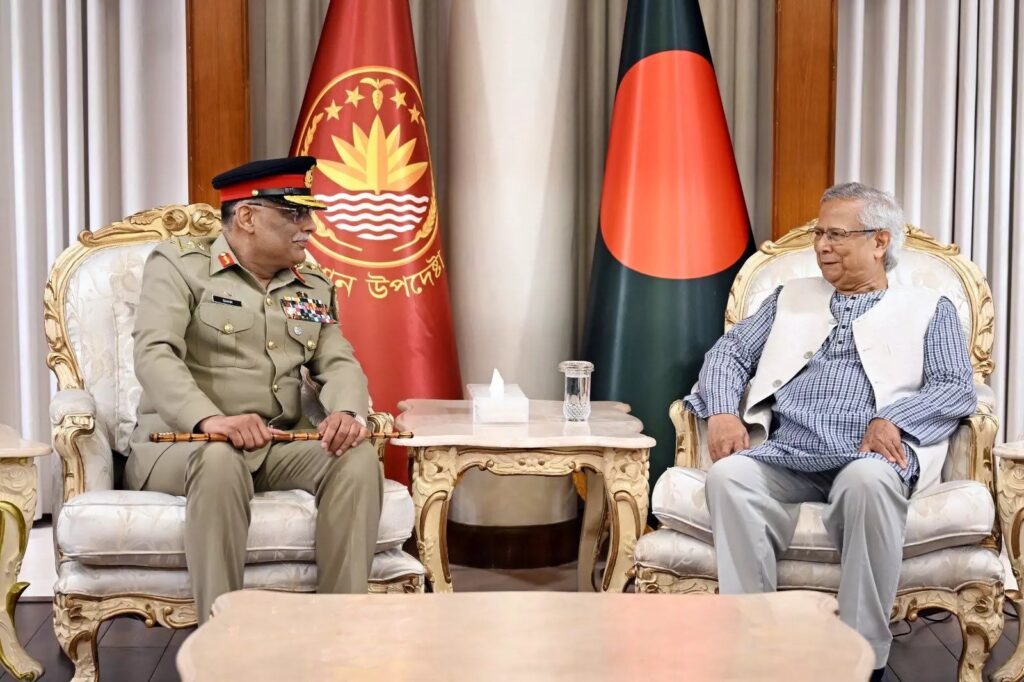
As anticipated, the regime in Dhaka, led by Muhammad Yunus has begun implementing its blueprint to create an Islamic Revolutionary Army (IRA) by disbanding the Bangladesh Armed Forces and the country’s primary intelligence agency, the Directorate General of Forces Intelligence (DGFI).
According to credible media reports, investigators have submitted a chargesheet against 11 army officers, including eight Generals, accusing them of committing “crimes against humanity” – offences carrying the death penalty. The charge sheet also names former Prime Minister Sheikh Hasina as the principal accused. Simultaneously, the regime has launched legal measures to permanently outlaw the Awami League, Bangladesh’s oldest and largest political party, in a move clearly engineered to eliminate any chance of an inclusive national election, which Yunus intends to stage in February 2026 under his absolute control.
The accused listed in the chargesheet include: former Prime Minister Sheikh Hasina, former National Security Advisor Tarique Ahmed Siddique, former DGFI Director General Lt. Gen. (retd) Mohammad Akbar Hossain, former DG Major General (retd) Saiful Abedin, Lt. Gen. (retd) Md Saiful Alam, former DG Lt. Gen. Tabrez Shams Chowdhury, former DG Major General (retd) Hamidul Haque, Major General Towhidul Islam, Major General Sarwar Hossain, Major General Kabir Ahmed, Brigadier General Mahbubur Rahman Siddique, Brigadier General Ahmed Tanvir Majhar Siddique, and Lt. Col. (retd) Makhsurul Haque.
Among them, four are currently in active service. However, under the amended International Crimes Tribunal Act, serving officers accused in such cases are suspended from holding official positions, according to Chief Prosecutor Tajul Islam.
The entire case behind this chargesheet accusing senior military officers originates from a dramatized “documentary film” funded by the National Endowment for Democracy (NED) – an organisation that has, for several years, played an active role in defaming the Bangladesh Army and DGFI.
Unfortunately, during this massive propaganda campaign, both institutions failed to mount an effective counter-narrative. Even after Sheikh Hasina’s ouster, when Yunus and his allies intensified their attacks on DGFI — particularly through claims of detentions inside “Aynaghar”, an imaginary facility invented by a NED-funded, overseas-based media outlet – the disinformation continued unchecked. The so-called “documentary” presented fabricated testimonies from alleged victims, serving as the foundation for the current legal onslaught.
Most importantly, the Bangladesh Armed Forces and DGFI had played a crucial role in the 2024 anti-Hasina protests, which ultimately enabled the US Deep State’s regime-change operation to succeed. More than 14 months after Sheikh Hasina’s removal and the installation of the Yunus regime – a transition initially supported by segments of the military – it has become evident that the ultimate goal of Yunus and his foreign backers is to completely dismantle Bangladesh’s Armed Forces and counterterrorism institutions to pave the way for transforming the country into an Islamist Caliphate.
It was earlier reported that Pakistan’s Army Chief General Asim Munir has been orchestrating this plot to dismantle the Bangladesh Army and DGFI, working in concert with key figures of Jamaat-e-Islami, Ansar Al-Islam (the local franchise of Al-Qaeda), and several high-ranking members of the Yunus regime. Although the current chargesheet targets former DGFI chiefs and counterterrorism officials, credible intelligence sources suggest Islamabad’s ultimate goal is to implicate Army Chief General Waker Uz Zaman, accusing him of “enforced disappearances and unlawful detentions”.
Muhammad Yunus and at least two of his close foreign-linked advisors are believed to be quietly assisting this effort, providing legal and diplomatic cover to neutralise Bangladesh’s last line of defence against Islamist expansionism.
Commenting on this alarming development, noted military analyst M A Hossain stated, “This is possibly the first-ever case in any country where top officials of a national intelligence agency have been prosecuted for defending their nation from terrorism. It defies logic. How can a judiciary target its own security defenders in a case clearly masterminded by Pakistan’s military establishment and its local proxies? The next step, inevitably, will be implicating Army Chief General Waker Uz Zaman – the ultimate command authority – to decapitate the Armed Forces entirely”.
Defence expert Damsana Ranadhiran, a special contributor to Bangladesh’s Blitz media outlet, warned: “This legal ambush targetting Bangladeshi Generals will have dire consequences. It will weaken the military’s command structure and open the door for Pakistan-backed officers to take charge. This is a textbook ISI strategy – a blend of legal warfare, psychological manipulation, and political subversion – identical to what Pakistan executed in Afghanistan and Kashmir”.
Ranadhiran further cautioned that Bangladesh’s sovereignty and regional stability are now at stake.
“Bangladesh did not endure the genocide of 1971 only to be subdued again by Pakistan’s puppeteers and Islamist collaborators. If Pakistan’s designs are not countered immediately through diplomatic, military, and legal means, South Asia may descend into chaos – a region overrun by proxy wars, terror networks, and narcotics-driven insurgencies”.
These fabricated charges against senior military officers are designed to discredit and paralyse the Armed Forces, paving the way for Yunus to replace them with a new paramilitary militia modelled after Iran’s Islamic Revolutionary Guard Corps (IRGC). The envisioned Islamic Revolutionary Army (IRA) will be ideologically loyal to the regime rather than to the nation – a hallmark of theocratic authoritarianism.
The motive behind Yunus’s hostility toward the military lies in its potential to resist his project of selling out Bangladesh’s sovereignty for personal and foreign gain. Much like his political idol Hamid Karzai, Yunus seeks to maintain power through foreign patronage rather than public legitimacy.
Analysts estimate his genuine domestic support at no more than five per cent. His crusade against the Awami League, with its 45 million supporters, is part of a larger design to eliminate all political opposition. After banning the Awami League, the regime now aims to suppress smaller parties such as the Jatiya Party and left-leaning groups to cement a one-man rule under the pretext of “national reform”.
Alongside institutional purges, Yunus has unleashed a campaign of terror against journalists, intellectuals, and dissenters. Hundreds have been imprisoned, and at least 266 journalists face fabricated murder charges – making Yunus arguably an even greater oppressor of the press than Turkey’s President Recep Tayyip Erdogan.
Meanwhile, the regime is rapidly replacing the national police with an “Auxiliary Police” modeled on Iran’s morality police. Recruited from Hizb ut-Tahrir, Hefazat-e-Islam, and Ansar Al-Islam, this force enforces Taliban-style dress codes and harasses women in traditional Bengali attire. Reports of hijab-clad patrols intimidating citizens are becoming alarmingly common.
For decades, DGFI played a pivotal role in fighting terrorism and militancy, dismantling insurgent networks, and shutting down foreign-backed terrorist training camps – including those of India’s United Liberation Front of Assam (ULFA). Its success in keeping Bangladesh free of transnational terrorism made it a target of Islamist extremists and the Pakistani ISI, who now see an opportunity for revenge under the Yunus administration.
Since last year’s Jihadist Coup, Bangladesh has been slipping rapidly toward Islamist rule. Top jihadists – including Ansar Al-Islam leader Jashimuddin Rahmani – were released from prison and now allowed to operate freely. Rahmani has publicly vowed to attack secular voices and bloggers, branding them as “enemies of Islam”. Shockingly, the regime has made no effort to re-arrest such fugitives or curb their militant propaganda.
If this trajectory continues unchecked, Bangladesh may soon cease to exist as the secular republic envisioned by the martyrs of 1971. The systematic destruction of the Armed Forces, intelligence services, and democratic institutions is not merely a domestic tragedy – it is a regional security crisis. South Asia cannot afford another failed state governed by zealots and manipulated by Pakistan’s ISI. The international community, especially India and democratic allies, must recognise that defending Bangladesh’s Armed Forces today is equivalent to defending the last line of resistance against the spread of militant Islamism in South Asia. Silence is complicity – and complicity, in this case, could be catastrophic.
–IANS