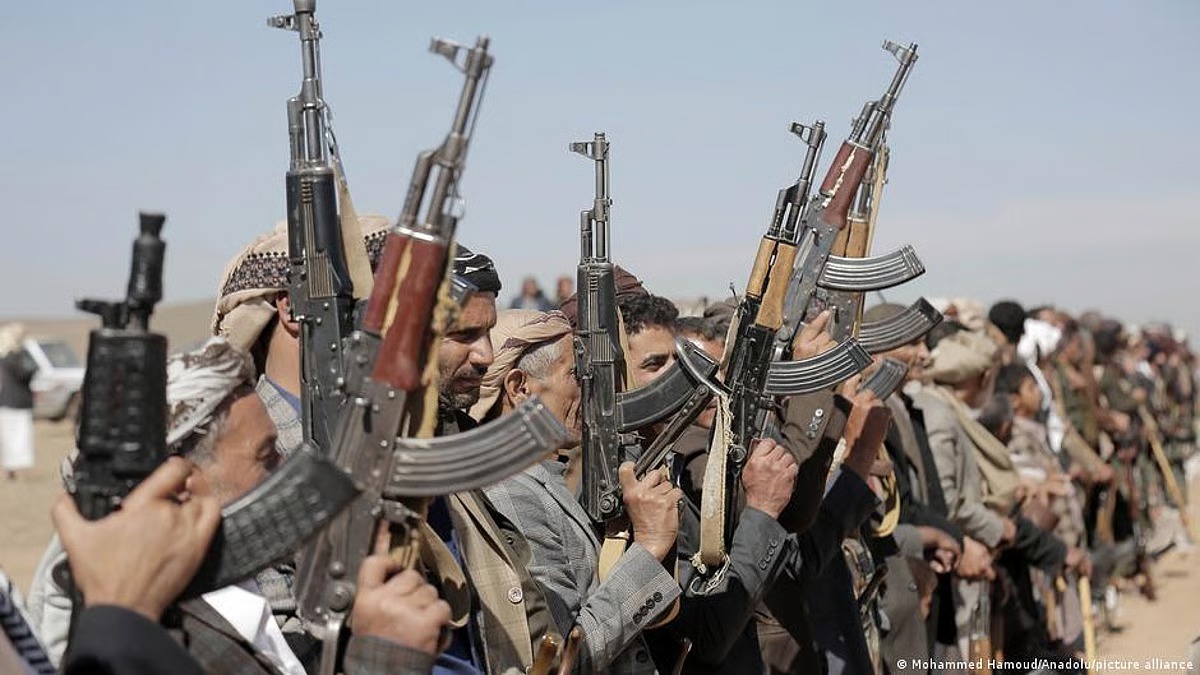
In the aftermath of India’s Operation Sindoor on May 7, which targeted militant infrastructure in Pakistan and Pakistan-occupied Kashmir, a familiar cycle of accusations and denials has resumed. Pakistani officials immediately labelled the operation a strike on civilians insisting that places of worship, and religious schools, were among the many targets.
Particular attention has been drawn to Markaz Subhan Allah in Bahawalpur, a facility long known as the headquarters of the Deobandi militant group Jaish-e-Mohammed (JeM).
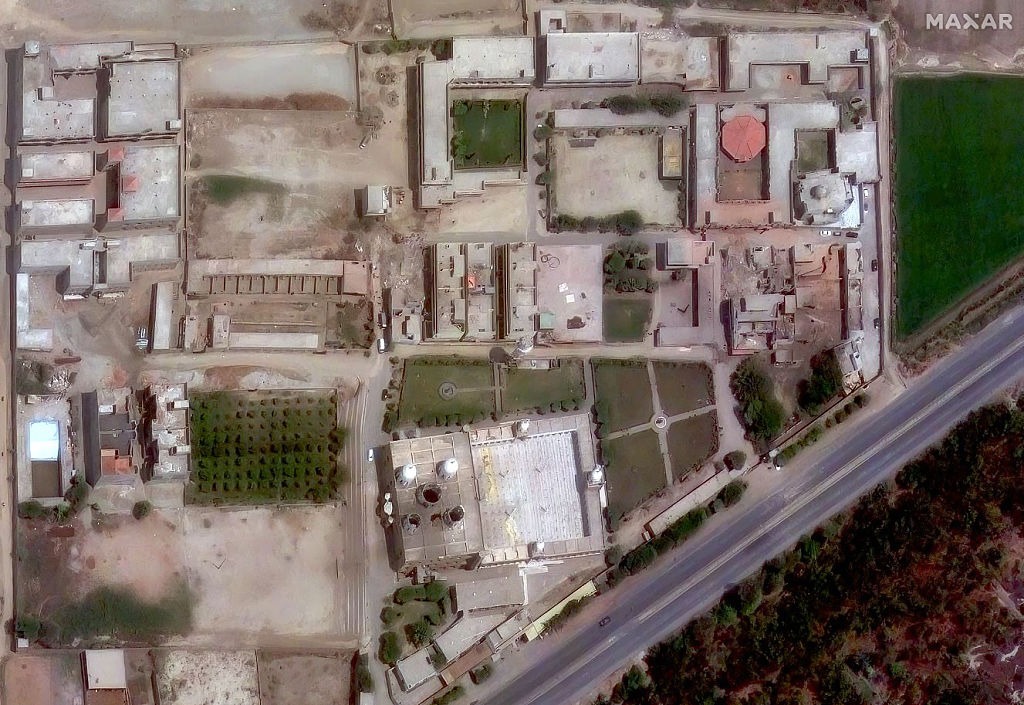
It was here, notably, that Masood Azhar, the proscribed group’s founder, reappeared in December 2024 after years of purported house arrest, a stark reminder of how Pakistan’s most dangerous extremists often operate with impunity, even when officially designated as threats by the international community.
This narrative may resonate in some quarters of the international community, but it masks a deeper, long-running reality which is that many of Pakistan’s religious seminaries, or madrassas, have long played a central role in incubating violent extremism. While not all madrasas are complicit, thousands have served as ideological and operational feeders for some of the region’s most dangerous militant groups.
The connection between Pakistan’s madrassa network and its decades-old strategy of cultivating proxy groups is well documented. And yet, it remains largely absent from current discourses on terrorism globally. To understand the roots of regional instability and why efforts to counter terrorism often flounder, the international community needs come to terms with this institutional reality.
An Infrastructure of Indoctrination
Since the 1980s, after President General Ziaul Haq thrust Pakistan into the frontline of global jihad against Soviet Communists in Afghanistan with the support of United States and Saudi Arabia, the country’s intelligence services, particularly the Inter-Services Intelligence (ISI), have cultivated relationships with a range of militant groups. As the anti-Soviet jihad in Afghanistan folded in the late 1980s, Pakistani Army, having adopted the doctrine of “strategic depth,” the notion that non-state actors could serve as force multipliers in conflicts with neighboring states, redirected these Afghan Jihad returnees to Kashmir. Moreover, an umbrella of Kashmir-centric anti-India groups, such as Hizbul Mujahideen (HM), Lashkar-e-Toiba (LeT), and Jaish-e-Muhammad (JeM), were created to sustain the insurgency in Kashmir. It is instructive when Former President General Pervez Musharraf acknowledged as much in 2010 admitting how Pakistan had supported militant groups to “pressure India.”
But the more pressing question is how Pakistan’s military and its Inter-Services Intelligence (ISI) continue to sustain such a vast militant ecosystem. The answer lies in the decades-old nexus between militant outfits like Lashkar-e-Taiba and Jaish-e-Mohammed, and a wide network of religious seminaries (madrassas) that serve as sources of both ideological indoctrination and recruitment.
While madrassa system of education is not new to Pakistan, but their explosive growth over the last few decades has altered the country’s educational and religious landscape. From just a few hundred at independence in 1947, their numbers have ballooned to more than 30,000 today, a conservative estimate, with nearly half of these operating without state oversight.
While some offer basic religious instruction, many propagate an austere, puritanical version of Islam, often influenced by Saudi Wahhabism and Deobandi orthodoxy — that fosters sectarian intolerance and glorifies armed struggle. For instance, many of these madrassas, as highlighted by M. W. Malla (2020), have relied on curriculum which emotively glorifies “jihad – Islamic holy war – through vivid imagery for whom alif (A) was meant Allah, be (B) meant Bundook (Gun), jim (J) meant jihad, and ha (Ha) meant hathiyar (arms) and likewise.”
A Pipeline to Militancy
In theory, madrassas are meant to provide education and social support to the underprivileged. However, in case of Pakistan, a significant proportion of these Islamic schools serve as gateways to radicalization. The situation is compounded by lack of governmental oversight. For instance, while the officially registered madrasas, numbering nearly 17500 as per governmental statistics, cater over 2.2 million students, millions more are enrolled in the unregistered ones. Consequently, orphaned and impoverished children, often with no other schooling options, are drawn into a closed system where anti-Western and anti-Hindu narratives are presented as divine truth. Recruitment for jihadist groups often begins in these classrooms.
Incidentally, some of the most prominent Islamic religious seminaries of Pakistan such as Jamia Ashrafia in Lahore, Dar-ul-Uloom Banori Town in Karachi, and Jamia Haqqania Akora Khattak have been repeatedly linked to known extremist organizations. Take the case of Jamia Haqqania, which has been referred to as the “University of Jihad” and its former Vice Chancellor Maulana Samiul Haq as the “Father of Taliban.” Much of the Haqqania network leadership and cadre, which is part of Afghan Taliban, has received their religious training from these institutions with a number of them currently surving in the transitional government of Taliban in Afghanistan.
Even as international pressure has mounted, reform efforts have faltered. It is instructive how Pakistan’s current government quietly abandoned the 2019 requirement for madrassas to register with the Ministry of Education, a modest reform that aimed at bringing religious seminaries under state oversight. The reversal came in December 2024, as part of a political bargain with Jamiat-e-Ulema-e-Islam (Fazl), Deobandi religious party led by Maulana Fazlur Rehman, to secure the party’s support for a constitutional amendment that expanded the powers of the military establishment while curbing the judiciary’s independence. Pakistan’s leaders have often found it easier to co-opt these groups than to challenge them — a compromise that comes at significant cost.
Beyond the Madrassa
The culture of radicalization in Pakistan does not stop at religious schools. State-run public schools often include textbooks that promote intolerance, framing India and the West as existential threats. Clerics like Maulana Abdul Aziz, once the head of Islamabad’s infamous Lal Masjid, openly issue calls to violence. He has faced little accountability despite repeated clashes with the state.
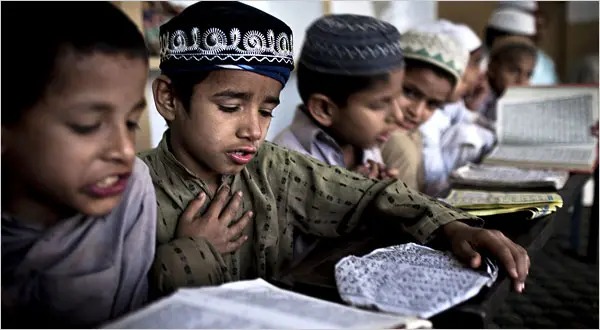
This radical ecosystem is self-reinforcing. With 39 percent of Pakistan’s population living below the poverty line, many families have little choice but to send their children to madrassas that offer free food and shelter. But the pattern is not limited to the poor. In recent years, Pakistan has witnessed recruitment by extremist groups among the educated elite, including medical students and professionals drawn to the ideology of ISIS and its affiliates.
This widening appeal underscores that extremism in Pakistan is not simply a problem of poverty or illiteracy — it is one of systemic indoctrination and strategic tolerance. The madrassas are just the most visible node in a much broader network of radicalization.
The Global Dimension
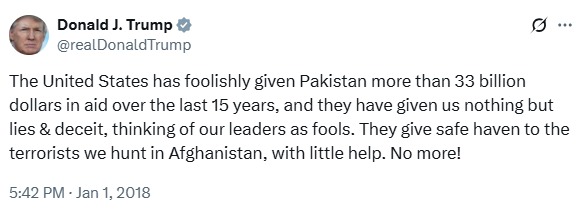
That Pakistan has managed to sustain this infrastructure with relatively few consequences is, in part, a reflection of international inconsistency. During the U.S.-led war in Afghanistan, Islamabad was seen as a necessary, if difficult, partner. More than $33 billion in U.S. aid flowed into Pakistan post-9/11, even as evidence mounted that its military continued to support insurgent groups like Afghan Taliban, LeT, HM and JeM.
What is more problematic is how China, too, despite vying for the global leadership and having endured terrorism in its Xinjiang province, has largely refrained from pressuring Pakistan. This is being justified by its investment in the China-Pakistan Economic Corridor (CPEC) and its geopolitical competition with India. Moreover, while the state patronage of funding conservative religious education from Gulf countries has gone down, the role of religious groups has continued to foster this ecosystem.
In addition, in terms of global oversight, even the Financial Action Task Force (FATF), the global watchdog on terror financing, has struggled to enforce long-term compliance. Though Pakistan was removed from the FATF’s “grey list” in 2022, much of the underlying infrastructure remains intact.
A Familiar Playbook
The claims that India’s recent strikes targeted civilian infrastructure follow a well-established script. In 2019, following the Balakot airstrikes, it denied that any militant camp had been hit, despite independent verification of the target’s history as a JeM facility.
What makes Operation Sindoor different is not the nature of Pakistan’s response, but the context in which it occurs. Militant violence inside Pakistan has surged, with a 79 percent increase in attacks in 2023 alone. Many of these attacks have been carried out by groups the state once sheltered. The Tehrik-i-Taliban Pakistan (TTP), now re-empowered by the Taliban’s return in Afghanistan, has turned its guns inward.
In effect, Pakistan is now haunted by its own proxies, groups once deployed as strategic assets have grown autonomous and hostile. The madrassas that fed them remain largely untouched, a sign of the state’s reluctance, or inability, to dismantle the very apparatus it helped create.
The Consequences of Denial
The madrassa-militancy nexus is not the only reason for instability in South Asia, but it is a critical one.
As long as Pakistan continues to shield this infrastructure behind religious rhetoric and claims of victimhood, genuine counterterrorism cooperation will remain elusive.
For the international community, the lesson is clear: treating Pakistan as a willing partner while ignoring its internal contradictions only delays the reckoning. Madrassa reform, state accountability, and a broader ideological shift are not just domestic imperatives for Pakistan, but they are regional and global necessities.
Until then, any claims of targeting civilians in strikes like Operation Sindoor must be weighed against a broader, uncomfortable truth: some of the very institutions Pakistan defends as sacred have long functioned as sanctuaries for those who preach and practice violence.