
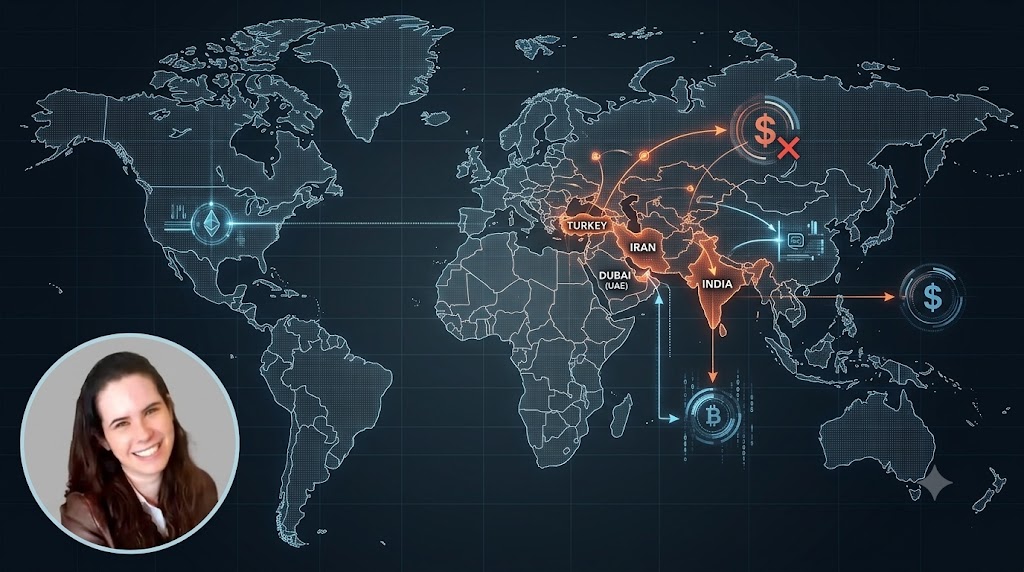
In this exclusive interview, Ella Rosenberg, Head of Program for Counter Terrorism Funding (CTF) at the Jerusalem Center for Security and Foreign Affairs (JCFA), speaks with Arun Anand, editor of Globalnationalist.com, about how Iran moves money to Hezbollah, the Houthis and other aligned groups, why sanctions are issued far more often than they are enforced, how the UAE’s role as a financial hub has been shaken since Iran began firing on Gulf states, what Turkey’s naval buildup and financial practices signal, and how India and Israel could deepen cooperation in trade and banking.
Ella Rosenberg is Head of Program CTF at the Jerusalem Center for Security and Foreign Affairs (JCFA) and a board member of the Dvorah Forum. A graduate of Maastricht University and Erasmus University Rotterdam, she has worked extensively on AML/CTF regulation, crypto-forensics, illicit asset tracking and international investigations. Her experience includes strategic roles at the Israeli Ministry of Defence and advising governments and financial institutions on complex cross-border financial investigations, including efforts to disrupt Iran-linked illicit finance networks.
Q: To begin with, how is Iran financing and sustaining its wider regional network, including Hezbollah, Hamas and other Iran-aligned groups? And how effective are international efforts to disrupt these channels, especially given everything that has been happening recently?
Ella Rosenberg: First, I would make a distinction between the proxies and the groups that merely receive some funding from Iran. When it comes to the proxies, the predominant ones are Hezbollah, the Houthis and the Iraqi militias, and you also have some very minor groups in other parts of the Middle East. Hamas is not a real proxy of Iran. It is an independent terror group that receives some sort of funding from Iran, so it belongs in the “Iran-aligned” category you mentioned.
Regarding the funding itself, you need to bear in mind that the money going to these organizations is sanctioned. Once you transfer funds to a designated organization, you are breaking the law. You are not allowed to fund them under American law, European law, or the sanctions regimes of other jurisdictions.
Sanctions are imposed the moment you move money from A to B in that way. But the most critical question is whether those sanctions are enforced. This is a point I have tried to convey many times: you can designate a specific organization, but the ways to enforce a sanction against it are very basic.
Western sanctions are enforced through the private sector. That means banks, money managers and companies providing services. Those companies need to be aware that they are enabling an illegal transfer.
On the other hand, you have the other system, which you probably know very well: hawala. In essence, funds are deducted at one point and paid out at another, to the person who is supposed to carry out the job. In this case, the job is terror. Because hawala is not connected to the traditional banking system, sanctions are very difficult to enforce against it.
The only way to tackle hawala is to tackle the enablers: the lawyers, the accountants and the money firms. That takes time and a very strong emphasis on those people, whether by disqualifying their licenses or by making sure they cannot access their bank accounts.
In my opinion, these efforts should be directed by a dedicated enforcement agency, and currently you don’t have one. You only have sanctions being issued. You don’t have them being enforced.
Q: We have spoken about sanctions, but sanctions are also evaded. How important are evasion, front companies, trade networks, cryptocurrency and informal financial systems when it comes to Iran’s ability to finance itself and project influence across the region? There have been claims over the past several months that Iran’s capabilities have been crippled to a large extent. In that context, how important are these routes still?
Ella Rosenberg: I would answer from the perspective of the offender, the origin state, and I’ll use a household as an analogy. A household needs multiple streams of food coming in, whether that is milk, eggs, vegetables or something else. When one commodity runs short—say there is a shortage of milk in the supermarkets for a family with children and parents—they won’t simply go without. They buy a substitute, or use more of something else.
That very basic concept explains how the Iranian regime works. When one channel is blocked, whether it is crypto, shipping, oil or human trafficking, they push money through the others. I see five main types of funding: crypto, oil, human trafficking, front companies and forex.
Suppose you block forex and shipping. The other methods then carry a larger load, and the regime focuses on bringing in more funds from those areas. During the crisis of the past few months, in which the payment world was largely hindered, you could see a surge in human trafficking into Iran from Pakistan and Afghanistan.
If you wanted to dismantle the regime’s financing as a whole, I wouldn’t say “strangle” it; I would say dismantle. The only way is not to rely on one type of measure. You have to close all five channels at once, because then they would be in much, much more dire straits. Currently, two of the types are largely closed, two are slightly open, and one is fully open. And that picture keeps changing, as we have seen over the past few months.
The reason is that terrorist financing is essentially money laundering, and the people moving the money are professional launderers. It is their job to know how to smuggle money from one point to another. When one route is stopped, they are able to create another.
So I would build a two-level system. On one level, I would stop all types of transactions coming into the regime. On the other, I would enforce sanctions against the people who enable the evasion. That is how I would do it.
Q: Let me ask about the news you may have heard buzzing around the UAE, and Dubai in particular. It is said to have played a major role in routing funds for the Iranian regime, because of its shadow banking and the fact that few questions are asked. And while Iran is attacking Saudi Arabia, there seems to be a back-channel understanding between the UAE and Iran. Do you think that financial architecture is still functioning in the UAE and helping Iran?
Ella Rosenberg: I’ll give you a very unpopular answer. First, let me go back a step and explain how the financial regulatory framework in the UAE works as a whole.
The UAE is essentially seven city-states that together form a federation. Each of them, whether it is Dubai, Sharjah or Abu Dhabi, has its own mainland, its own area of commerce. Then, within each of those cities, you have additional areas called free zones.
Historically, the free zones offered 0% tax to attract foreign investors. That let them work through the UAE globally, with the emphasis on globally. If a free-zone company wanted to buy an apartment in Dubai, for example, it had to transfer the company to the mainland and pay 5% VAT. That was the rule for years, and it worked without any problem.
Beyond foreign investors, expats and shipping magnates, you also had parts of the Iranian regime operating in those zones, for three main reasons.
First, company registration was closed, so you couldn’t look it up. It offered protection and a way to hide your dealings.
Second, banking was easy. There were changes to the tax regime over the years, including a move to a 9% rate, but at the time you could do your banking there, open accounts for different UAE companies, and open accounts with banks worldwide. As a whole, it was a very easy solution.
Third, you could hire people to do the work for you. Iran used a lot of local workers, and also a lot of people of Indian descent, to handle a couple of registration processes.
This worked perfectly for years. Then came the recent war between Iran and the United States, and something happened that the Emiratis were not used to: Iran began shooting at the UAE.
It is also worth remembering that the UAE and Iran have long had disputes, including over specific islands and over oil. They preferred to do their business in the background, so it was never a fully cooperative relationship, but it was a status quo.
Then Iran began firing, apparently expecting that the Gulf states would pressure President Trump to stop the strikes. In the short term that happened, but in the long run it did not, and it left the Emiratis deeply distraught. They are a very proud nation. You let certain people come and work within your regulatory system, and this is what they do. It creates distrust, distaste, and a kind of bitterness between the two.
The UAE is also influenced to a degree by Saudi Arabia. Up until now, and even within the past week, the Gulf leaders have asked President Trump several times for help, and he has not given it. That leaves the Gulf states, led by Saudi Arabia, sitting on the fence. They don’t know whether they will receive the appropriate amount of military aid, and at the end of the day they don’t know what will happen with Iran, because geographically it is their neighbor and a threat that is immediate.
This is where Israel comes into play, as a state that is able to assist the Gulf states. But they are not running into Israel’s open arms. They are being pushed. This is not a matter of will. It is a matter of need.
So that is the geopolitical situation behind the regulatory framework. Now, to your question of how I see things evolving in the engagement between Iran and the UAE: the honest answer is that the old arrangement doesn’t continue, and I’ll explain why.
To understand how this operates, you need to understand the Emiratis. I have worked with Emiratis and have a lot of friends there. I have worked in this space for the past six years, and it is a dream of mine to work more with the UAE, just as it is a great joy to work in India.
But I can tell you they are confused. They don’t really know how to change the regulatory system now. They have already passed their international evaluations and stayed out of the risk of being grey-listed, and now they find themselves in this situation with the Iranians. Even the Iranians are starting to see the consequences.
It is a very complex situation. I would take a closer look at the UN session on crime and global crime that is due to take place next week in Abu Dhabi. These sessions can also be followed from afar, online. I know there is a specific session on terrorist financing. It was very important for the UAE to bring this global conference to the country, to show that it is not being ousted, to show that it is a major player, and to make sure its success story is not tarnished.
Q: Let me now come from Dubai to Turkey, which is becoming an increasingly important power in the Middle East, or what we call West Asia. Erdogan, it is well known, wants to set up a caliphate. That is his real objective. The Muslim Brotherhood is flourishing under his patronage, and Hamas and many other organizations are, in one way or another, ideological offshoots of the Brotherhood. Turkey has also been very aggressive toward Israel, its neighbor. Given all this, how do you see Ankara’s relationship with Iran, Pakistan and the Gulf states, and how do you see Turkey emerging?
Ella Rosenberg: I look at this from a maritime and military perspective. Historically, the Ottoman Empire had a very strong maritime fleet. When the Ottoman Empire collapsed and the Republic came to power, the most important development I see is that Turkey built an immense fleet.
When I say immense, I mean it. By my account, the size of Turkey’s fleet is significantly larger than the British Navy, and certainly larger than Israel’s and other navies in the region. It hasn’t been used in a major conflict yet, but the signal is quite clear.
Why does this matter? Because it shows you the imperial wishes Turkey has for the region. Erdogan wants to create allies and to be the leader of a new empire. That enables a number of things, including the enabling of the Muslim Brotherhood in Turkey, and it creates multiple issues around money laundering. This is one of the reasons Turkey is so often blacklisted or scrutinized by international organizations.
If you go to Northern Cyprus, which is occupied by the Turks, and you want to buy a house, you can do it with Bitcoin. Just come with Bitcoin. That tells you something about the entire way of thinking about Turkey’s financial influence, and how large the money-laundering issue is there.
I think the next large enemy Israel will have is Turkey. It is also close in proximity. We have seen this several times with so-called humanitarian flotillas. Behind that facade, if they want to launch their ships, they can. Luckily for us, Israel has capable people who can monitor those ships from the air.
But as I mentioned, I would look at Turkey’s grand plans, at its Navy, and at how Erdogan’s thinking is developing in the region. I would also look at how the banking system is developing in Turkey and how money laundering is handled there. IRGC funds are funneled through Turkey, and there are certain connections between Turkey and Iran.
At the same time, they are frenemies. They are states that compete with each other. People looking at the Middle East through Western eyes often think everyone is the same, but Turks and Persians are not Arabs, and they have historically competed for many years over who has more control in the region.
So they negotiate on certain things and collaborate on others, but in the long run I do see some sort of clash between the two.
Q: Given India’s close relationship with Israel, how do you see India’s role in this emerging regional structure, what many are calling the redrawing of the Middle East? There are also the geopolitical shifts we are seeing, especially with Pakistan throwing its hat into the ring, with Turkey standing behind it. That is a separate discussion, but how do you see India’s role in this emerging scenario?
Ella Rosenberg: Funny enough, a situation has been created in which Israel and India are, in a sense, the only similar states in the region of Asia as a whole. We share a common outlook on many things. People like to describe Israelis as aggressive, but we mostly want to live our lives.
Someone I greatly admire said yesterday on a panel I was part of that Israel and India are two neighbours sitting next to each other in the same jungle, in the same neighbourhood. Let me put it that way.
I think it is crucial that we create more integration in banking, which would create a stronger bond between us, and also in maritime goods, in commerce and in trade.
At the end of the day, the problem our neighbouring states have with us is basically jealousy of how successful we have been over the years. I feel India suffers from some of the same jealousy. Once you are successful in a specific field, other states feel the need to have the same, but they don’t want to say so, and that creates rivalry.
To be honest, if we can create better harmony in trade and banking, I believe it would be very beneficial. I am talking about a trade agreement rather than any kind of union. I have mentioned this several times before.