
-Arun Anand
Pakistan has a knack for arriving at the wrong place at precisely the wrong time. When Russia attacked Ukraine in February 2022, its then prime minister, Imran Khan, was seated in the Kremlin, smiling and shaking hands for cameras. And when Saudi Arabia and the United Arab Emirates, Islamabad’s most important Middle Eastern patrons, found themselves at odds over Yemen last week, it was once again caught in the crossfire. This time Emirati President Sheikh Mohammed bin Zayed Al Nahyan was on his hunting trip to Pakistan. These moments are not mere coincidences but rather symptoms of a deeper strategic malaise of a military-dominated foreign policy that repeatedly entangles Pakistan in conflicts it neither controls nor fully understands.
Over the past decade, Pakistan has drifted from being a peripheral player in the Middle East to an increasingly exposed one. As the shift has been shaped by transactional military diplomacy as signified by recent Strategic Mutual Defence Agreement with Saudi Arabia, the result is a country wedged uncomfortably between rival power centers with China and the United States on one axis globally, and Saudi Arabia and the UAE on another at the regional level. While each of its allies expects loyalty, no one offers insulation when loyalties collide.
That collision is now visible in Yemen and most likely in Libya. On December 30, Riyadh announced that it targeted a weapons shipment at Yemen’s Mukalla port, claiming the arms originated from the Emirati port of Fujairah. Riyadh alleged that weapons were destined for the Southern Transitional Council (STC), a UAE-backed separatist group seeking to carve out an independent state in southern Yemen.
It made Pakistan to tread an uncomfortable line. Though Islamabad expressed “complete solidarity” with Saudi Arabia, reaffirming its support for the kingdom’s sovereignty and Yemen’s territorial integrity, what it did not do was just as revealing. Pakistan avoided naming the STC, sidestepped Abu Dhabi’s role in nurturing Yemeni separatism, and refrained from any criticism that might upset the Emirati leadership.
However, it should be known that diplomatic hedging has its limits. On the very morning Saudi Arabia carried out strikes against what it described as Emirati-linked weapons shipments, Pakistan’s prime minister, Shehbaz Sharif, along with senior cabinet members, including Deputy PM and Foreign Minister Ishaq Dar, was meeting Sheikh Mohammed bin Zayed at his family’s palatial estate in Rahim Yar Khan. The optics were ironic with Pakistan professing solidarity with Riyadh while hosting the very leader Riyadh was pressuring militarily. There have been unsubstantiated reports that Saudi Arabia declined a request for a meeting by Pakistan’s powerful army chief, Field Marshal Asim Munir, thereby reinforcing the impression that Islamabad’s balancing act was wearing thin.
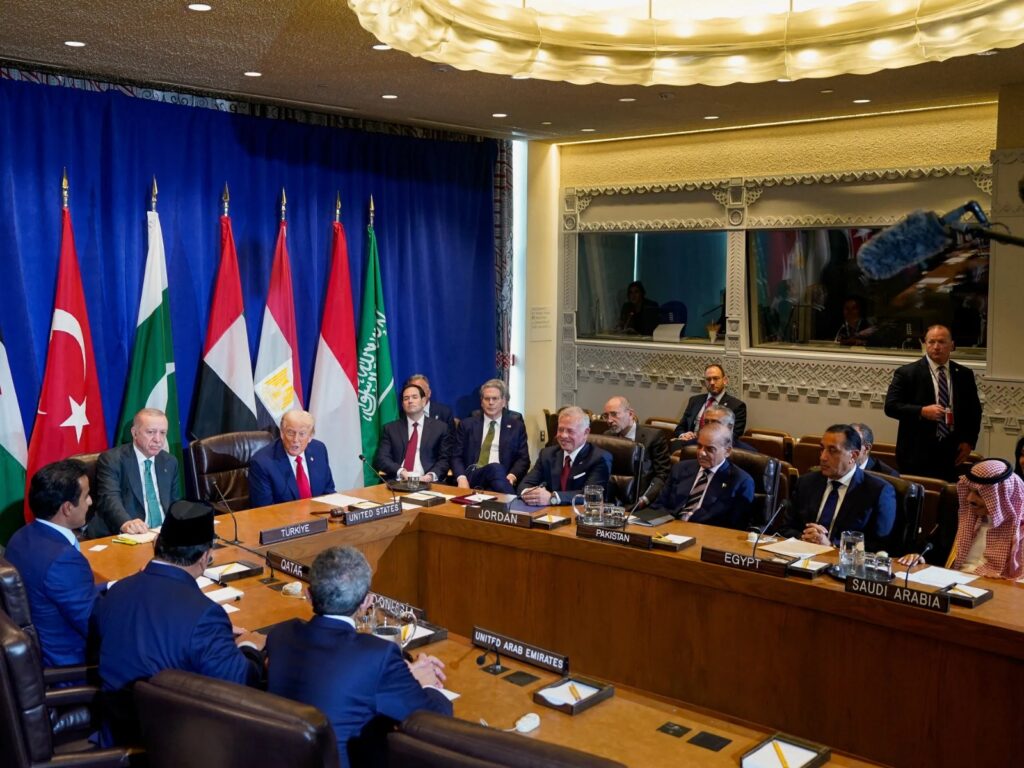
This episode underscored a broader truth that Pakistan was no longer merely navigating Gulf rivalries but was being shaped by them. And nowhere is this more dangerous than in Gaza. As US President Donald Trump pushes his vision of post-war Gaza governance under an international body, he has publicly sought Pakistan’s commitments to contribute troops to his envisioned security or stabilization force for the territory.
For Islamabad, the proposition is fraught with peril as deploying Pakistani troops to the war-battered Palestinian region would not be a neutral peacekeeping mission. As the Gaza stabilisation force would almost certainly involve disarming Hamas, enforcing cease-fire arrangements, and operating under an American or Israeli security framework, such a role would place Pakistan at odds with popular sentiment at home, where sympathy for the Palestinian cause runs deep. Moreover, it would also damage the country’s standing in the broader Muslim world, where participation in what many would view as an externally imposed security regime or forced disarming of what many consider a Palestinian resistance group would be seen as complicity with Israel.
However, if Pakistan Army assumes such a role, it won’t be its first as it has a history of renting its role to the regional players. Pakistani military officers played a role in assisting Jordan’s Hashemite monarchy during the 1970 Black September crisis by helping violently crackdown on Palestinian fighters. The Pakistani contingent in Amman was overseen by Brigadier Mohammad Zia-ul-Haq, who would later seize power in 1977 and rule as a military dictator. That episode left a lasting scar on Pakistan’s image among Palestinians and repeating such a role in Gaza would be exponentially more damaging.
Yet Gaza is not the only front where Pakistan’s Middle East policy is unravelling. On December 21, Army Chief Asim Munir signed what was touted as a $4.6 billion defense deal with Khalifa Haftar in Benghazi, from where the Libyan military strongman controls eastern part of the country through the Libyan National Army (LNA). The agreement reportedly included the sale of JF-17 Block III fighter jets and Super Mushshak trainer aircraft, making it the largest arms deal in Pakistan’s history.
Though the deal on paper signifies Pakistan’s strategic reach, however, in reality, it was a diplomatic misstep of the highest order. Firstly, Libya is a divided country with rival governments governing it in parts. There is Abdul Hamid Dbeibeh’s internationally recognised Government of National Unity (GNU) in Tripoli and then the other, Haftar’s Benghazi-based unrecognised Government of National Stability (GNS). Secondly, Libya remains under an international arms embargo imposed by the United Nations in 2011. Therefore, any major weapons transfer and that too to an unrecognised entity risk undermining of the international law.
This deal does not only fly in the face of UN sanctions; it also puts constrains in Islamabad’s regional policy. By publicly aligning itself with Haftar, Pakistan effectively chose sides in a complex regional proxy contest as the military strongman is backed by the UAE and Egypt whereas the GNU, by contrast, enjoys the support of the United Nations and Saudi Arabia. Islamabad’s outreach to Benghazi thus undercuts its relationship with Riyadh, at precisely the moment when Saudi goodwill is most needed.
These choices cumulatively result in what can be described as a strategic overextension without any strategic clarity. It is evident that Pakistan is trying to achieve a role of indispensability in the region, but forgets that it does not possess the diplomatic leverage for the same. It can offer nothing than renting its military against a price. Its military leadership appears to believe that visibility equals influence, that being “in the room” guarantees relevance. In practice, it has made Pakistan vulnerable to pressure from stronger powers with clearer agendas. And at home, the risks are just as severe. In a country grappling with severe economic crisis, political instability, and militant violence, such a diplomatic overstretching cannot be afforded.
As such, Pakistan is on a path of pursuing a foreign policy driven less by national consensus than by the ambitions of a security establishment which is eager to project power abroad, even as stability at home remains elusive. And if Pakistan continues down this path and gets entangled in Gulf rivalries, is pressured to send troops to Gaza, and aligns with contested actors like Khalifa Haftar, it risks becoming a pawn that a mediator its elite envisions. In the Middle East’s unforgiving geopolitical chessboard, pawns are easily sacrificed.