
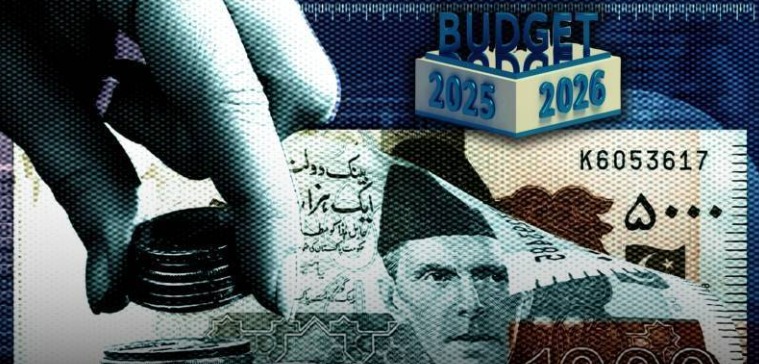
The presentation of Pakistan’s Federal Budget for the fiscal year 2025–26 on 10 June serves not only as a financial outline for the nation but also as a telling indicator of the entrenched power dynamics within its political economy. With total federal spending amounting to Rs 17.57 trillion, the budget is framed in official discourse as a pathway to economic recovery and national security. Yet, a more critical and nuanced examination exposes these narratives as concealing a heavily militarised fiscal framework, wherein the Pakistan Army emerges as the primary beneficiary—frequently to the detriment of democratic institutions, inter-provincial fairness, and the country’s long-term developmental prospects.
A particularly striking illustration of this military-oriented strategy is evident in the federal government’s distribution of resources through the National Finance Commission (NFC) Award. Of the Rs 8.21 trillion allocated for provincial transfers, Punjab—widely regarded as the military establishment’s political bastion—receives Rs 4.25 trillion, constituting 51.74% of the total. Sindh is granted 24.55% (Rs 2.01 trillion), Khyber Pakhtunkhwa 14.62% (Rs 1.20 trillion), while Balochistan—the nation’s most underdeveloped and marginalised province—receives a scant 9.09% (Rs 0.75 trillion).
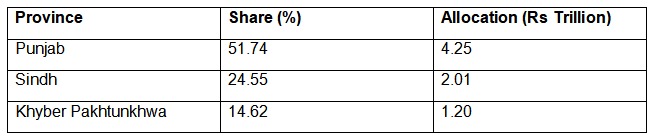
This distribution highlights not merely economic partiality, but also the military’s entrenched involvement in shaping inter-provincial fiscal allocations to favour compliant constituencies while marginalising dissenting regions. The reality that Punjab receives more than double the funds allocated to Sindh and almost six times that of Balochistan—without any remedial provisions to address the latter’s enduring underdevelopment—raises significant concerns regarding the military’s opaque yet enduring influence over federal policy formulation.
The situation in Balochistan is especially grave. Despite its abundant natural resources, the province has endured persistent economic neglect, political exclusion, and military repression. In the 2025–26 budget, Balochistan has once again been overlooked in terms of significant federal development projects. This fiscal marginalisation is no coincidence—it exemplifies a wider securitisation agenda, wherein the state, under military dominance, views Balochistan more as a geostrategic asset than as a population entitled to governance and service. Military cantonments continue to proliferate across the region, yet essential infrastructure such as schools, hospitals, and roads remain scarce. The Army’s approach to calls for enhanced resource autonomy and local governance remains rooted in coercion rather than dialogue.
In Sindh, and particularly in Karachi—the nation’s economic hub—the disparity in budgetary allocation is equally evident. Although the province is a significant net contributor to Pakistan’s overall revenue, its share of federal resources remains disproportionately low. The limited federal expenditure on Sindh’s urban infrastructure and rural healthcare or education reflects Islamabad’s wider policy orientation: maintain centralised authority and channel resources towards regions aligned with military interests, while penalising areas that challenge the establishment’s dominance. Sindh’s increasing political divergence from military-sanctioned narratives likely accounts for its persistent fiscal sidelining.
Khyber Pakhtunkhwa (KP), despite serving as a frontline region in Pakistan’s so-called war on terror and enduring the harshest impacts of military operations and their humanitarian fallout, is allocated a mere 14.62% of the federal divisible pool. The irony is stark—the province has borne immense human cost in service of the Army’s security objectives, yet receives scant developmental assistance in return. This inconsistency highlights the military’s instrumentalist approach toward peripheral regions: exploit them for strategic leverage while withholding the benefits of federal investment and post-conflict reconstruction.
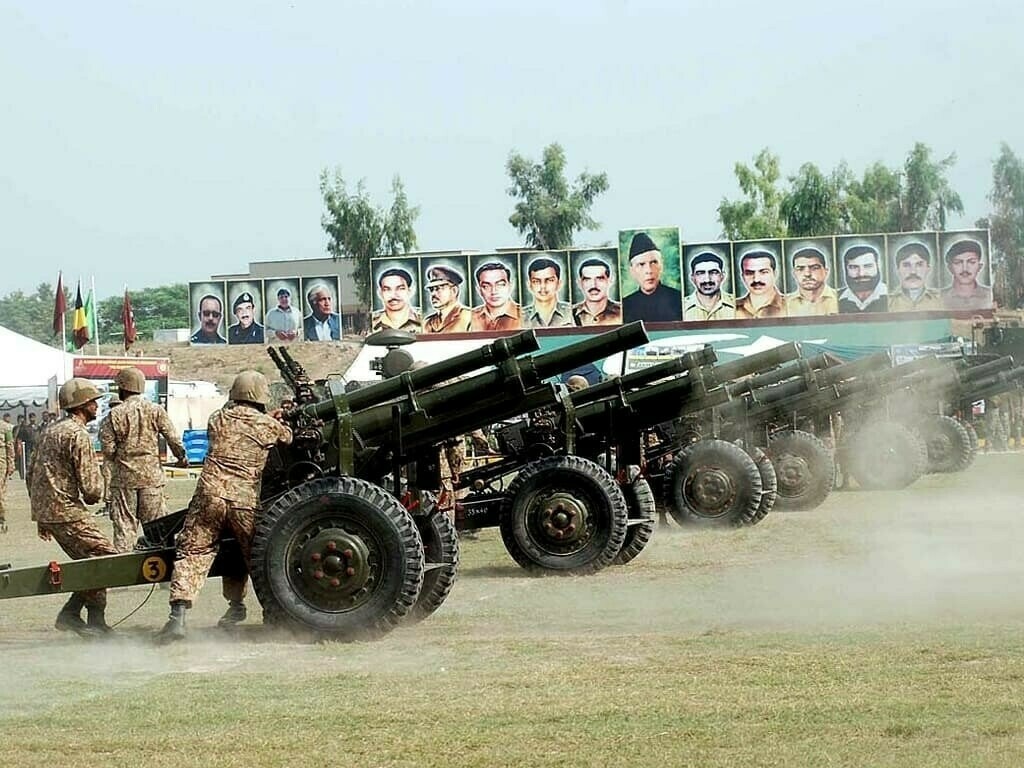
Nowhere is the military’s hold over the national budget more visible than in defence expenditure. The 2025–26 budget earmarks Rs 2.55 trillion solely for military operations and equipment—a 20% rise from the previous fiscal year. When defence pensions are factored in, this figure increases to Rs 3.29 trillion. By comparison, the Public Sector Development Programme (PSDP)—the central mechanism for promoting public welfare and infrastructure development—has been limited to just Rs 1 trillion, accounting for only 6% of total federal spending.
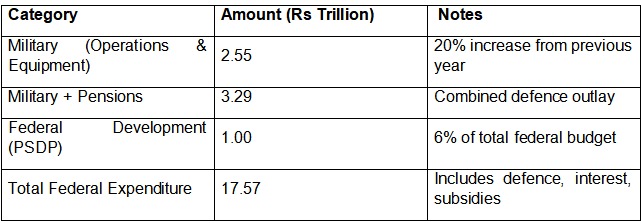
This fiscal imbalance reveals a troubling truth: Pakistan is not simply a state possessing a powerful military—it is a military possessing a state. Defence is allocated over three times the funding designated for all federal development initiatives combined. In a country burdened by IMF-driven austerity measures, escalating poverty, a failing education system, and a deteriorating healthcare sector, such budgetary priorities are not merely imprudent—they are fundamentally undemocratic.
The military’s economic dominion extends well beyond formal budgetary provisions. Through an extensive network of foundations, real estate enterprises, and corporate entities such as the Fauji Foundation and Army Welfare Trust, the Pakistan Army maintains a commanding presence across the national economy. Nevertheless, it persistently demands an increasing proportion of federal tax revenues under the pretext of “national security.” The most recent rise in defence spending has been rationalised by invoking perceived threats stemming from India’s Operation Sindoor—a cross-border strike purportedly revealing Pakistan’s defence vulnerabilities. Yet, leveraging such incidents to justify inflated military budgets further illustrates the Army’s adeptness at securitising each fiscal cycle to its advantage, frequently at the expense of economic prudence and democratic accountability.
Public reaction to the budget has been largely unfavourable, particularly across digital platforms where a limited degree of free expression persists. On Twitter/X, Facebook, and YouTube, trending hashtags such as #Budget2025, #PakistanDefenceBudget, and #CivilianNeglect reflect mounting discontent over the military’s dominance in determining national priorities. Sentiment analysis of user posts and comments reveals a citizenry increasingly aggrieved by rising inflation, unemployment, and deteriorating public services, all while observing the Army amass greater wealth, influence, and impunity.
From Baloch activists decrying the absence of schools and access to clean water, to Sindhi commentators criticising the inequities of the budget, and citizens in KP questioning the marginalisation of a region scarred by conflict and extremism, provincial discontent is no longer latent—it is erupting. Even prominent political leaders have begun to cautiously voice concerns over the budget’s military bias, although many continue to remain silent, constrained by the fear of institutional retaliation.
Exacerbating this growing public dissatisfaction is the stark contrast drawn between the current budget and those enacted during former Prime Minister Imran Khan’s tenure. Although his administration faced criticism for economic mismanagement, it was nonetheless seen as making some effort to invest in health, education, and social welfare. In the present context, citizens view even these limited advancements as having been reversed, supplanted by an inflated defence budget that delivers no tangible benefit to the ordinary Pakistani.
The debt burden is also intensifying. Pakistan’s obligations for debt servicing are steadily increasing, with a significant portion of non-defence expenditure now directed towards interest repayments. Yet, despite these fiscal pressures, the military remains untouched by austerity. On the contrary, it continues to benefit from consistent budgetary hikes, preferential land allocations, and expansive business entitlements—all safeguarded by a pervasive culture of impunity and the enduring absence of civilian oversight.
Even more troubling is the manner in which the military’s fiscal dominance is accompanied by political repression. Independent economists and journalists who challenge defence expenditures frequently encounter threats or censorship. Parliamentary scrutiny of military spending remains largely symbolic, with no transparency regarding detailed budgetary breakdowns. This lack of openness is deliberate—it constitutes an institutionalised mechanism of military governance by alternative means.
The 2025–26 federal budget thus reflects the distorted civil-military equilibrium in Pakistan. It is more than a fiscal plan; it constitutes a political declaration. It confirms that the Pakistan Army—unelected and formally subordinate under the Constitution—continues to operate as the country’s de facto authority, exercising control not only over foreign affairs and domestic security but also over financial governance. The implications of this dynamic are severe: inhibited human development, widening inter-regional disparities, and a nation locked into a persistent cycle of underdevelopment and authoritarian rule.
Nevertheless, the latest federal budget lays bare the deeply embedded militarism that characterises Pakistan’s state apparatus. While Punjab enjoys a disproportionately favourable share and the Army continues to consolidate its dominance, the provinces of Balochistan, Sindh, and KP remain mired in systemic marginalisation and underinvestment. The budget not only reinforces fiscal disparity but also perpetuates political inequity, upholding a status quo in which military power eclipses democratic will, and security takes precedence over justice, social welfare, and equity. Without a fundamental reconfiguration of civil-military relations—beginning with fiscal transparency and genuine civilian oversight—Pakistan’s prospects for democracy and development will remain subordinated to the ambitions of its military elite.